Ninjutsu — what this art is and what it taught
Ninjutsu (忍術) is the art of espionage, sabotage, stealth and survival: not a rank and not the name of people, but what shinobi, also known as ninja, trained in. Its heyday came in the Sengoku period of the 15th–16th centuries, when spies from Iga and Koga gathered intelligence for warring warlords rather than fighting in the open. The black suit and the shuriken as the main weapon are an image from a much later time.
Everyone knows the word from anime, but not everyone can explain what it means in the sources. We break down what ninjutsu consisted of in practice: what skills were taught in the Iga and Koga schools and where the division into three types of "jutsu" from "Naruto" came from. The black suit and the star in the hand are also a sign of another century, not of the warring provinces.
What ninjutsu is and who practiced it
Ninjutsu (忍術) is a set of techniques for espionage, sabotage, stealthy movement and survival used by spies of medieval Japan. Its heyday came in the Sengoku period (15th–16th centuries): warring warlords hired such people to find out about the enemy, set fire to his camp or secretly guide a messenger through foreign territory. The technique itself is not a rank or a class: those who mastered it were called shinobi or ninja, and "ninjutsu" is what they studied, not who they were.
How shinobi differ from ninja
Shinobi and ninja are the same word, 忍者, read in different ways: by kun reading it is "shinobi-no-mono" (shorter — shinobi), by on reading — "ninja". In documents of the Sengoku period, "shinobi" is found mostly, less often "rappa", "suppa" or "kusa", and "ninja" became widespread only in the second half of the 1950s, along with a wave of historical novels, manga and films. From that same wave came the widely circulated image of the elegant invisible assassin: in the sources, the people of Iga and Koga look more like peasant specialists who worked in the fields by day and trained in the evening.
The word and the kanji: 忍術
How it is read and what it means literally
忍術 is read にんじゅつ (ninjutsu) and consists of two characters. 忍 (nin) means "to endure", "to bear", "to hide" — the same character in 忍者 (ninja) and 忍耐 (nintai, "patience", "endurance"). 術 (jutsu) means "art", "technique", "method of action" — the same character in 技術 (gijutsu, "technology", "technique") and 武術 (bujutsu, "martial art"). Together, the semantic weight lies on the first character: it is more "technique of stealth" than "martial art" in the narrow sense.
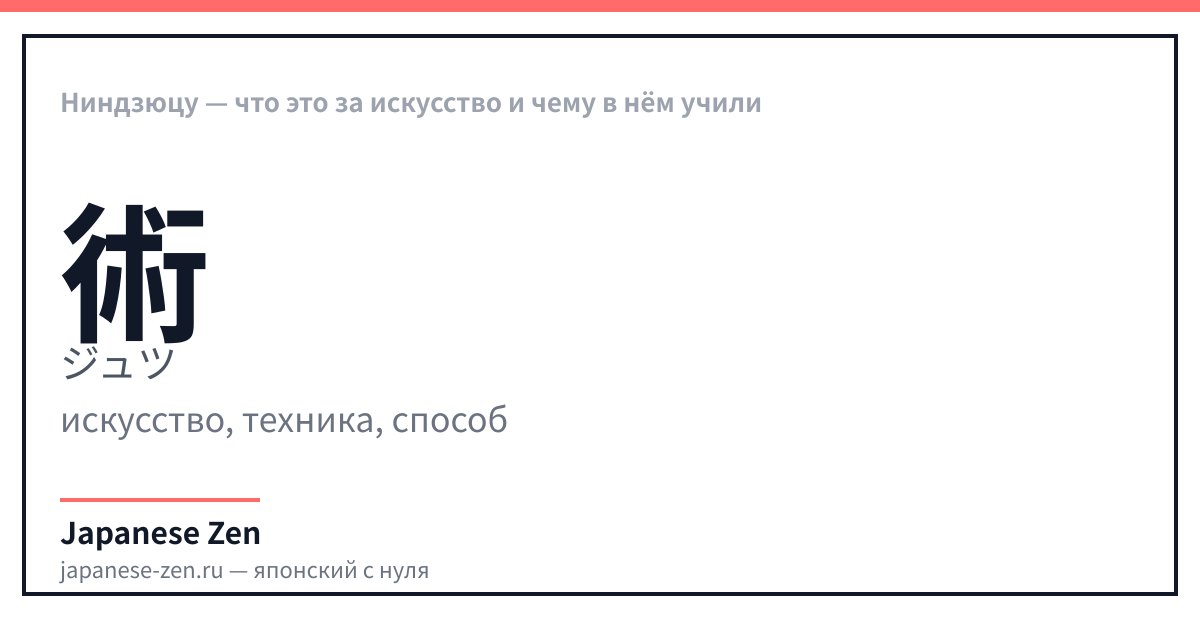
術 — значение: art, technique, method — онъёми: ジュツ — кунъёми: すべ — 11 штрих(ов). 術 — "art, technique": 11 strokes. The same character is in 技術 (gijutsu, "technology") and 武術 (bujutsu, "martial art").
| Japanese | Reading | Translation |
|---|---|---|
| 忍術 | ninjutsu · ninjutsu | "Art of stealth" — the word itself |
| 忍者 | ninja · ninja | A person who masters ninjutsu |
| 忍び | shinobi · shinobi | The same thing with a different reading — the historical name for the person |
| 忍耐 | nintai · nintai | "Patience" — the same first reading as in the word ninja |
| 武術 | bujutsu · bujutsu | "Martial art" — the second character is the same as in ninjutsu |
| 伊賀 | Iga · Iga | Province and school — one of the two main traditions of ninjutsu |
Write 術 along the guides and study the stroke order — it is the second character in the word ninjutsu.
What ninjutsu taught: disciplines and schools
Ninjutsu was not limited to combat. It was a broad set of practical skills for espionage, stealthy movement and survival behind enemy lines — these are the main disciplines taught in the Iga and Koga traditions.
| Discipline | What was taught |
|---|---|
| Disguise and changing clothes | To change appearance to that of a peasant, merchant, monk or warrior of another clan in order to pass unnoticed. |
| Climbing and movement | To climb walls and trees, walk silently, overcome moats and fences. |
| Signals and ciphers | To transmit information by conventional signs, fire, drumbeats and encrypted notes. |
| Explosives and incendiaries | To prepare gunpowder mixtures, arson and smoke screens to cover a retreat. |
| Medicines and poisons | To make potions, antidotes and poisons, to understand the properties of herbs. |
| Orienteering and weather | To read the terrain and the sky in order to plan a sortie route and calculate time. |
The Iga-ryu and Koga-ryu schools
The two main traditions of ninjutsu took shape in neighboring provinces: Iga-ryu (伊賀流) — in Iga, present-day Mie Prefecture, and Koga-ryu (甲賀流) — in neighboring Koga, in Omi Province. Literature and games like to portray these clans as mortal rivals, although the neighborhood worked differently: both alliances kept in touch and met for joint gatherings right on the border.
Ninjutsu began to be written down not at the height of the Sengoku period, but later, in the peaceful Edo era, when the former spies had nothing to do. "Bansenshukai" (万川集海, 1676) was compiled by Fujibayashi Yasutake, summarizing the knowledge of the Iga and Koga schools; "Shoninki" (正忍記, 1681) is a more practical guide to disguise and espionage. Both treatises describe an already fading craft, not an immediate practice.
Three myths created by film and anime
- The black suit is a theatrical device, not a combat uniform. In kabuki, stagehands (kuroko, 黒衣) appeared in black, showing the audience "this is as if invisible" — the same costume was put on the actors playing ninja. For a night sortie, real spies chose rather dark blue, gray or brown: a black silhouette against the night sky is more visible than it seems.
- The shuriken is a distraction weapon, not the main one. Bo-shuriken (rods, spikes) and shaken (flat stars) were thrown to gain a second and escape, not to kill with one hit — in films and games this priority is reversed.
- The division into ninjutsu, genjutsu and taijutsu came from the manga and anime "Naruto", not from the Sengoku period. What stands behind each of the three words — we break down below.
Genjutsu, taijutsu and ninjutsu — "Naruto" terms, not history
In the manga and anime "Naruto", three terms describe categories of techniques of fictional ninja. Taijutsu — techniques without the use of chakra, essentially hand-to-hand combat. Ninjutsu there is the broadest category, which includes everything that does not fit the other two definitions. Genjutsu — illusion techniques that affect the opponent's perception. This is the author's classification for the plot, not how ninjutsu was described in Japan of the Sengoku or Edo periods: in the sources of that time, this word is simply a general name for the whole craft of the spy.
FAQ
- What does the word "ninjutsu" mean?
- Ninjutsu (忍術) is the art of espionage, sabotage, stealthy movement and survival, which shinobi mastered in medieval Japan. It is not a rank or the name of people, but a complex of techniques: its heyday came in the Sengoku period of the 15th–16th centuries, when such skills were required by warring warlords.
- Which treatises on ninjutsu have survived to this day?
- There are two main ones, and they were written already in the peaceful Edo era. "Bansenshukai" (万川集海, 1676) was compiled by Fujibayashi Yasutake, bringing together the knowledge of the Iga and Koga schools into a multi-volume compendium. "Shoninki" (正忍記, 1681) is shorter and more practical: it is a guide to disguise, espionage and behavior in a foreign land. Both describe a craft that by that time was already fading.
- How do genjutsu, taijutsu and ninjutsu differ?
- This division was invented by the manga and anime "Naruto", not by Japanese history: there taijutsu is hand-to-hand combat without chakra, genjutsu is illusion techniques, ninjutsu is everything else. In the real sources of the Sengoku and Edo periods, "ninjutsu" is the general name for the whole craft of the spy, without such a division into categories.
- Do ninja exist today?
- As scout-saboteurs of the Sengoku period — no: that work disappeared along with the wars that needed it. The word "ninjutsu" itself lives on as the name of modern martial arts schools that rely on old treatises and teach historical technique, rather than working as spies.
- What were the ninja clans in Japan?
- The two main centers of the tradition are Iga (伊賀), present-day Mie Prefecture, and neighboring Koga (甲賀) in Omi Province. Cinema made them mortal rivals: in reality, both alliances kept in touch and convened joint gatherings on the border of the provinces.
- How is "ninjutsu" written in kanji?
- 忍術, read にんじゅつ (ninjutsu) and consists of two characters. 忍 (nin) means "to endure", "to hide" — the same character in the word 忍者 (ninja); 術 (jutsu) means "art", "technique" — the same character in 武術 (bujutsu, "martial art").
Sources
Updated: 2026-09-12