What a Shuriken Looks Like — Star, Spike, and What's Actually True
What a shuriken looks like in practice: not one object but two families of throwing weapons. The bo-shuriken is a straight, pointed spike: a nail, a thick spoke, a needle. The hira-shuriken, also called shaken (車剣), is a flat plate with star-like rays, from three to eight, the silhouette of the "ninja star" from movies. Both types are distraction weapons at a distance of a few meters, not killing tools.
The word "shuriken" has become so fused with the image of the ninja that many are sure: this is it, the main weapon of the shinobi. In reality, it is a modest auxiliary tool with two completely different forms — far less spectacular than in the movies. Let's break down how it is constructed, how many rays a star can have, how a shuriken differs from a kunai, and where the legend of poison on the blade came from.
What a Shuriken Looks Like: Bo-shuriken and Hira-shuriken
Shuriken (手裏剣) is not one object but a collective name for two different families of shinobi throwing weapons. The bo-shuriken (棒手裏剣) is a straight spike: a nail, a thick spoke, or a needle, usually sharpened only at one end. The hira-shuriken, or shaken (車剣), is a flat metal plate with star-like rays, from three to eight, often with a hole in the center for a cord or mounting. There was no single standard for the size and shape of a shuriken.
- Bo-shuriken — spikes, nails, heavy spokes, needles: usually only the tip is sharpened, not the whole shaft.
- Hira-shuriken, also called shaken — flat star-shaped plates, from three to eight rays, sometimes with a hole in the center.
- They were carried not one at a time but in a bundle in a cloth pouch — at the belt, in the sleeve, or in the breast of the kimono, so that several could be drawn at once.
- They were made from whatever metal was at hand — nails, blade fragments, coins — so one example rarely looks like another.
What Size and Weight a Shuriken Was
Exact figures vary among sources: the bo-shuriken is described as roughly 12 to 21 cm long and weighing from 35 to 150 grams. The hira-shuriken is about 10–12 cm wide and a few millimeters thick. The weapon was not produced to a single blueprint in a factory — the craftsman or the shinobi himself adjusted the blank to his hand and his task, so one cannot speak of a single "standard" shuriken.
A Weapon to Win a Second, Not to Kill
At short range, a few meters and no farther — that is where the shuriken worked. It was not aimed at the chest or head but at the face, hands, and legs. This forced the opponent to blink, pull back a hand, or stumble — and won a second or two for a retreat, one's own or someone else's. As a primary combat weapon, the shuriken was unsuitable: too light and with weak penetrating power against armor. The widespread myth about mass-poisoned shuriken blades has no documentary confirmation — it is a vivid detail from later ninja literature and cinema, not a documented shinobi practice.
手裏剣 — How It Is Written and Why "a Blade Hidden in the Hand"
手裏剣 is read しゅりけん (shuriken). Breaking down the characters: 手 (shu) — "hand", 裏 (ri) — "back, hidden side", 剣 (ken) — "sword, blade". Literally it comes out as "a blade hidden in the hand" or "a blade behind the hand" — a weapon that is hidden in the palm and drawn at the last moment, not worn openly like a katana.
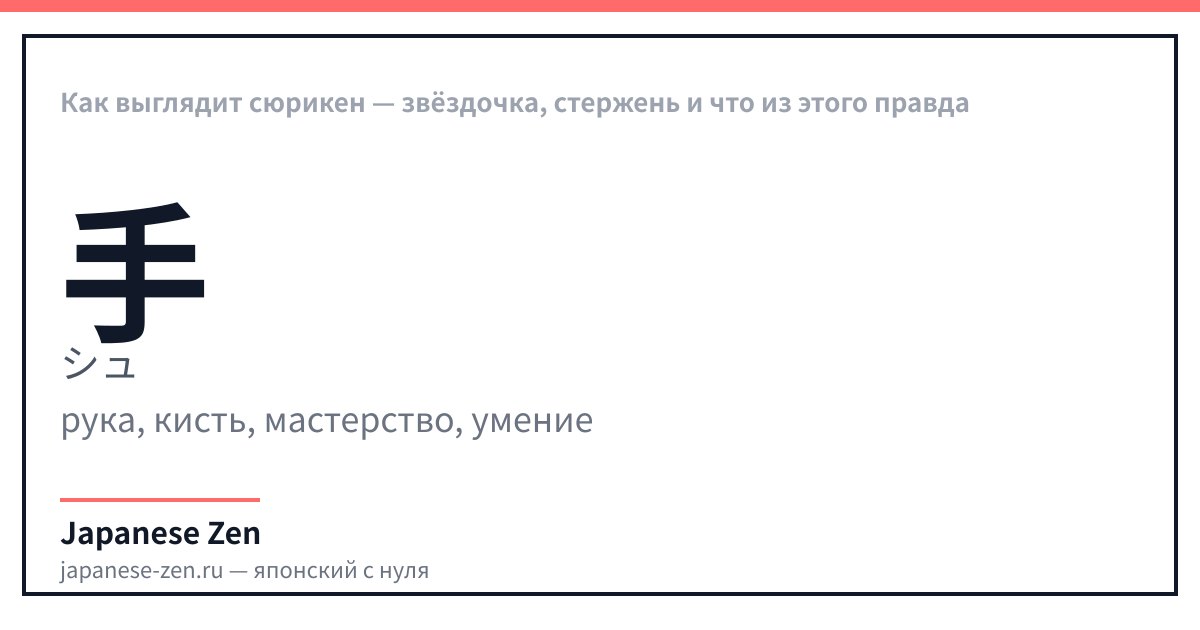
手 — значение: hand, palm, skill, ability — онъёми: シュ、ズ — кунъёми: て、て-、た- — 4 штрих(ов). 手 — "hand": the same character appears in 空手 (karate, literally "empty hand") and 手紙 (tegami, "letter"). In 手裏剣 it is read "shu", not "te".
How It Is Read and What Each Character Means
| Japanese | Reading | Translation |
|---|---|---|
| 手裏剣 | shuriken · shuriken | literally "a blade hidden in the hand" |
| 手 | te · te | "hand" — the basic reading of the character; in the word "shuriken" it is read "shu" |
| 裏 | ura · ura | "back, hidden side" — the second character in "shuriken" |
| 剣 | ken · ken | "sword, blade" — the third character in "shuriken" |
| 空手 | karate · karate | "empty hand" — the same character 手, here read "te" |
| 手紙 | tegami · tegami | "letter" — the same character 手 at the start of the word |
Write 手 along the guides — the character for "hand" that hides inside the word "shuriken".
Shuriken in Film, Games, and as a Ninja Symbol
- The classic anime and manga "Ninja Hattori-kun" (忍者ハットリくん) ran from 1964–1988 (manga, Fujiko Fujio A) and 1981–1987 (anime, TV Asahi). The young ninja Hattori in this story pulls out a shuriken in almost every episode for any reason — from battle to everyday mischief — one of the images that taught viewers that a ninja always has a shuriken.
- In "Naruto", the shuriken is a basic weapon for almost every ninja character, and among its varieties there is a large folding "shuriken windmill" (影風車, Kage Fūsha, literally "shadow windmill") — a more spectacular version than anything documented in shinobi sources.
- In the Ninja Gaiden video game series, the shuriken is part of the basic arsenal of the ninja Ryu Hayabusa in almost every installment. The character stuns an opponent at a distance with it before a more serious attack — as an auxiliary weapon should, only here it is brought to the forefront.
The Shuriken Star as a Symbol, Not Just a Weapon
By the 21st century, the silhouette of the shuriken — a flat plate with several rays — has become an independent recognizable sign of "ninja" and Japan in popular culture. It is printed on souvenirs and keychains, used in logos and emblems that have nothing to do with historical shinobi. The widespread claim that the shuriken served as the family crest (kamon, 家紋) of some specific clan is not confirmed by sources. Real kamon were indeed built on "star" patterns (hoshi-mon), but those are circles and dots in honor of the night sky, not the silhouette of a blade. Among documented kamon there are no crests in the shape of a shuriken — it is a beautiful legend, not a fact.
FAQ
- What does a shuriken look like?
- A shuriken is not one object but two different types of throwing weapons. The bo-shuriken is a straight pointed spike like a thick needle or nail. The hira-shuriken, or shaken, is a flat plate with star-like rays, from three to eight: it is this silhouette that has become fixed in popular culture as the "shuriken".
- How many rays can a shuriken have?
- The flat hira-shuriken (shaken) usually has from three to eight rays — there was no single standard, craftsmen made different shapes for their school and task. The spike-like bo-shuriken has no rays at all: it is a straight sharpened spoke or nail, not a star.
- Is it true that ninja mainly threw shuriken?
- No. The shuriken was an auxiliary distraction weapon at short range — it was aimed at the face, hands, and legs to win a second for retreat, not to defeat an opponent in open battle. The main tasks of the shinobi were reconnaissance, sabotage, and stealthy infiltration, not throwing stars.
- Is it true that shuriken were poisoned?
- There is no documentary confirmation of mass poisoning of shuriken blades. It is a persistent image from later ninja literature and cinema, not a documented practice: a real shuriken was dangerous simply because it struck places unprotected by armor — the face, hands, and legs.
- How does a shuriken differ from a kunai?
- The shuriken was originally designed as a throwing weapon — thin, symmetrical, sharpened along the edge or at the tip. The kunai is a household tool for digging and prying, thick and one-sided, which was rarely thrown and not for killing. They share only their common belonging to the shinobi arsenal.
- What does the word "shuriken" mean?
- The characters 手裏剣 read as: 手 (hand), 裏 (back, hidden side), 剣 (sword, blade) — literally "a blade hidden in the hand". The name describes the way the weapon is carried and suddenly used, not its shape: both the spike and the star are equally hidden in the palm.
Sources
Updated: 2026-09-12