Ninja House — Traps, Secret Passages, and What's Actually True
A "ninja house" is not a single museum address but a display of tricks that in Japan are called a spy's mansion, 忍者屋敷: revolving walls, hidden staircases, and crawl spaces under the floor. Some of these houses are authentic, like the Mochizuki family estate in Koga, while others, like Myoryu-ji temple in Kanazawa, are called a "ninja house" simply because of a nickname, with no connection to real shinobi.
Tour guides promise revolving walls and hidden staircases, but which of these wonders are real and which were invented for tourists is a separate question. Let's look at what is called a "ninja house," which three places in Japan display such mechanisms, how the real Mochizuki estate differs from a temple with a nickname, and how to write "ninja house" in Japanese.
What Is Called a "Ninja House"
In Japan, a "ninja house" is not one specific address but a type of museum exhibit: an old house where visitors are shown mechanisms that a spy could use to delay pursuit or hide valuables. The most common set is a revolving wall or door, a hidden staircase behind a false closet door, and a crawl space in the floor or ceiling for hiding a person and belongings.
How Real Spies Lived
According to historians, the shinobi of Iga and Koga themselves lived in ordinary peasant farmsteads that stood out in no way from neighboring ones — they worked the land and kept households, rather than designing traps for everyday life. A house with mechanisms is about protecting the secrets of a specific ninja family or about defending a fortress, not about the daily life of an ordinary spy.
Three Places That Show a Spy's House
- The Mochizuki estate, "Koga-ryu Ninjutsu Yashiki" (甲賀流忍術屋敷), in the city of Koga, Shiga Prefecture, is an authentic house from the Genroku era (1688–1704), built for Mochizuki Izumo-no-kami, first among the "53 houses of Koga." Inside are a revolving door, a pitfall trap in the floor, and a hidden staircase to a secret room; from the outside the house looks like one or two stories, but in fact it has three.
- The Iga-ryu Ninja Museum in the city of Iga (伊賀流忍者博物館) opened in 1964: an old house from the Takayama district near the city of Ueno was moved here and equipped with mechanisms for visitors. Whether this particular house was the home of a real shinobi is an open question: sources speak of an old building being relocated, not of its former owners.
- Myoryu-ji (妙立寺) in Kanazawa is not a house but a Buddhist temple of the Nichiren school. In 1643 it was built by Maeda Toshitsune, the third ruler of the Kaga domain, as a fortress-sanctuary with hidden staircases, a watchtower, and a pitfall trap in the floor at the entrance. The temple has no connection to shinobi — it was given the nickname "ninja temple" for its complex layout, and the nickname is even registered as a trademark.
Why a Spy's House Needs Traps at All
In the Mochizuki house the reason is practical: mechanisms for quick escape and hiding places were meant to protect family secrets and records from an unexpected guest or a search.
What Is Authentic in a "Ninja House" and What Is for Tourists
Of the three places, only the Mochizuki estate is truly connected to ninja: it is the authentic house of a real Koga family, and the mechanisms in it were built not for display but for practical use. The house in the Iga-ryu museum is also an old building, but it was arranged as a "ninja house" in the 20th century, specifically for visitors: part of the display is a reconstruction, and demonstrations are conducted by guides in shinobi costumes.
"Ninja-dera" Is a Nickname, Not History
Myoryu-ji in Kanazawa is the most obvious myth: the temple was built for a daimyo family, not for spies, and its complex passages served the defense of the castle and its lords, not ninjutsu. Even the treatises Bansenshukai and Shoninki describe disguise and climbing in detail, but do not draw revolving walls — such mechanisms belong to a broader Japanese tradition of houses with traps, which was used not only by spies.
忍者屋敷: An Estate, Not Just a House
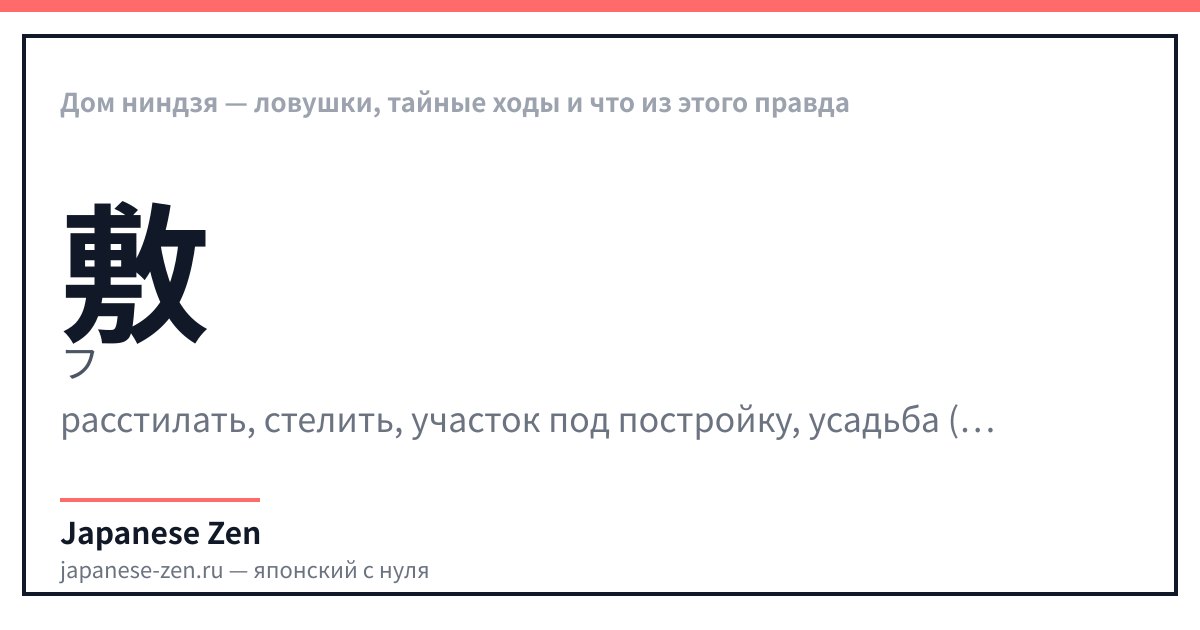
敷 — значение: to spread, to lay, a plot for a building, estate (as part of words) — онъёми: フ — кунъёми: し.く、-し.き — 15 штрих(ов). 敷 — "to spread": the second character in 屋敷 (yashiki), "estate." 屋 means "house," and 敷 originally means "to spread, to lay [ground for a building]": together it is not just a building but the entire developed plot.
忍者屋敷 is composed of 忍者 "ninja" and 屋敷 "estate" — 屋 "house" plus 敷 "to spread." The same character 敷 appears in 座敷 (zashiki), "a tatami room for receiving guests," and in 敷金 (shikikin), "money paid when renting housing." In all cases it refers to a space arranged for living, not just a building.
Zashiki — A Room, Not a House
座敷 (zashiki) is made up of 座 "to sit" and the same 敷 — literally "spread [tatami] for sitting": this is what a formal room in a Japanese house is called, where guests are received.
| Japanese | Reading | Translation |
|---|---|---|
| 忍者屋敷 | ninja yashiki · ninja yashiki | ninja house — the subject itself |
| 屋敷 | yashiki · yashiki | estate, mansion |
| 敷く | shiku · shiku | to spread, to lay |
| 座敷 | zashiki · zashiki | a tatami room for receiving guests |
| 敷金 | shikikin · shikikin | money paid when renting housing |
| どんでん返し | dondengaeshi · dondengaeshi | revolving wall trap |
Write 敷 along the guides — the character for "to spread" from the word 屋敷 (yashiki), "estate," the second half of the written form of "ninja house."
FAQ
- What is a ninja house?
- A "ninja house" is a collective name for museum buildings in Japan that display mechanisms believed to have been used by shinobi: revolving walls, hidden staircases, crawl spaces under the floor. Some of these houses are authentic estates of ninja families; others were arranged in this style in the 20th century for visitors.
- What traps were in a ninja house?
- The most common are a revolving wall or door (donden-gaeshi) that turns and opens a passage, a hidden staircase behind a false closet door, and a crawl space or secret room under the floor or in the ceiling. In the Mochizuki estate in Koga, such mechanisms helped one quickly hide and protect secret records from a search.
- Where in Japan can you see a ninja house?
- There are three such places. The Mochizuki estate, "Koga-ryu Ninjutsu Yashiki," in the city of Koga is an authentic house from the Genroku era. The Iga-ryu Ninja Museum in the city of Iga, where an old building was moved and equipped for display in 1964. And Myoryu-ji temple in Kanazawa, which is called a "ninja temple" only by nickname.
- Is it true that ninja lived in houses with secret passages?
- Partly: the Mochizuki family estate in Koga is the authentic house of a real ninja family with hidden mechanisms for quick escape and protecting secrets. But most shinobi, according to researchers, lived in ordinary peasant farmsteads — secret passages were not an everyday feature of their lives.
- Why is the temple in Kanazawa called a ninja temple?
- Myoryu-ji temple (妙立寺) was built in 1643 as a fortress-sanctuary with a complex interior layout: hidden staircases, a watchtower, and a pitfall trap in the floor at the entrance. Shinobi have no connection to it — the nickname "ninja temple" was given for the building's intricate design, not for real history.
- How do you say "ninja house" in Japanese?
- 忍者屋敷, read as にんじゃやしき (ninja yashiki). 忍者 means "ninja," 屋敷 means "estate": 屋 "house" plus 敷 "to spread, to lay [a plot for a building]." The same character 敷 appears in 座敷 "guest room" and 敷金 "money paid when renting housing."
Sources
Updated: 2026-09-15