Okita Sōji — the young swordsman of the Shinsengumi: what's true and what's legend
Okita Sōji (沖田総司, 1842 or 1844 – July 19, 1868) was the captain of the first unit of the Shinsengumi, the shogunate's force that guarded Kyoto, and one of the strongest swordsmen in the corps. He died of tuberculosis in Edo in the midst of the Boshin War, almost a year before its end. Much of his legend — coughing blood in battle, a rare sword, the face of a handsome man — goes back not to documents but to memoirs and novels of the 20th century.
Anime and games turn Okita Sōji into either a sword genius, or a female Saber from Fate, or a snarker from Gintama. Let's sort out what is known about him from documents of the bakumatsu era, what was added by later recollections and 20th-century novels, including the famous scene with blood at Ikedaya, and why even the year of his birth remains a subject of debate among historians.
A sword genius from the Shieikan dōjō
Okita Sōji was the captain of the first unit of the Shinsengumi, and according to the recollections of his comrades, one of the strongest swordsmen in the corps. From childhood he grew up in the Shieikan dōjō in Edo, where the Tennen Rishin-ryū school was taught, and as a young man he became a senior student who helped lead classes. In 1863, together with Kondō Isami and Hijikata, he left for Kyoto, where the Shinsengumi guarded the city for the shogunate. Tuberculosis brought him to the grave on July 19, 1868, in Edo, when the corps still had a year of struggle ahead.
| Year | Event |
|---|---|
| 1842 or 1844 | birth — the exact year is disputed |
| in childhood | sent to the Shieikan dōjō, studies fencing of the Tennen Rishin-ryū school |
| 1863 | leaves for Kyoto as part of a ronin corps, the future Shinsengumi |
| 1864 | takes part in the Ikedaya incident as captain of the first unit |
| 1867 | health sharply deteriorates, withdraws from active service |
| July 19, 1868 | dies of tuberculosis in Edo |
From assistant teacher to raid commander
Before Kyoto, Okita did the same as other Shieikan students — taught beginners the techniques of Tennen Rishin-ryū. In the Shinsengumi these same skills were applied differently: the first unit under his command was among the first to burst into houses where opponents of the shogunate gathered, and took part in the corps' toughest clashes, including Ikedaya in 1864.
What his name was: 沖田総司
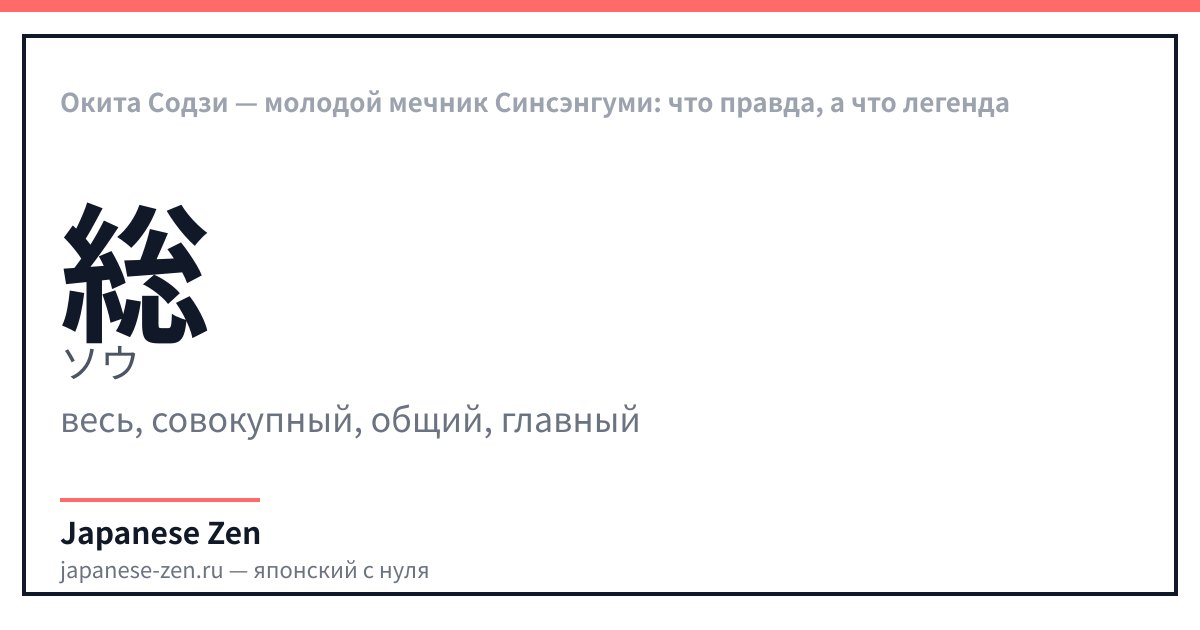
総 — значение: whole, aggregate, general, main — онъёми: ソウ — кунъёми: す.べて、すべ.て、ふさ — 14 штрих(ов). 総 — 'whole, general': the first character of the personal name 総司 (Sōji). The same character appears in 総理 (sōri, 'prime minister') and 総合 (sōgō, 'general, comprehensive').
Why his birth year is debated
No birth records for Okita have survived, so historians give either 1842 or 1844. Hence the discrepancy in his age at death: sources give from 24 to 27 years — depending on the accepted birth year and on whether years are counted the Japanese way, with birth as the first year.
| Japanese | Reading | Translation |
|---|---|---|
| 沖田総司 | Okita Sōji · Okita Sōji | Full name — in search you may also see the spelling 'Okita Soji' |
| 天然理心流 | Tennen Rishin-ryū · Tennen Rishin-ryū | The fencing school where Okita studied from childhood |
| 一番隊 | ichibantai · ichibantai | The first unit of the Shinsengumi under his command |
| 労咳 | rōgai · rōgai | An old word for tuberculosis — the disease he died of |
Listen to how 一番隊 and 労咳 sound — the app will rate your pronunciation.
From Gintama to Fate: Okita Sōji on screen
- Gintama (2006, Sunrise studio) — a parody double of Okita Sōgo (沖田総悟), the best swordsman of the Shinsengumi, with cold humor instead of documentary accuracy.
- Hakuoki (2010, Deen studio; based on the 2008 Otomate visual novel) — Okita is shown as a swordsman ill with tuberculosis in a fantasy plot about the Shinsengumi against a supernatural threat.
- Fate/Grand Order (since 2015) — Okita is portrayed as a female Servant of the Saber class; the image first appeared in the TYPE-MOON comedy spin-off manga Koha-Ace and from there moved into the main series.
- Rurouni Kenshin (manga 1994–1999) — the smiling and deadly Setta Sōjirō is modeled on Okita: even the name is taken from Sōji's childhood name.
How close these images are to the real Okita
None of these images claims to be documentary. Gintama and Fate take the name and the fame of a sword genius and build a comedy around them or change the character's gender, Hakuoki turns the biography into fantasy, and Rurouni Kenshin borrows only the personality.
Legends about Okita: truth and fiction
Death on the battlefield, an invincible technique, and the looks of a handsome man — of all the Shinsengumi fighters, Okita has accumulated more legends than the rest. Let's examine the main ones separately: what is confirmed by documents of the era, and what was added by memoirs of the 1910s and novels of the 20th century.
- Fiction: at Ikedaya in 1864, Okita coughed up blood in the middle of the fight. Truth: in Nagakura Shinpachi's recollections (1913), he merely loses consciousness — from illness or from heat, it is unclear. The blood was added by Shimozawa Kan in 1928, and a month later Okita was already marching with the corps to the Hamaguri Gate.
- Fiction: 'sandanzuki' — a secret invincible technique. Truth: the triple thrust of Okita, supposedly fitting into a single step, was told by Satō Toshinobu from Hino. This is the recollection of an acquaintance, and the technique was made 'invincible' by novels and anime.
- Fiction: the legendary sword 'Kiku-ichi-monji'. Truth: this blade was attributed to Okita by 20th-century literature. All that is documented is that at Ikedaya the tip of his sword broke — Kondō Isami wrote about this in a letter home.
- Fiction: a lifetime portrait of the handsome Okita has survived. Truth: no reliable image exists; the widely circulated 'portrait' was drawn in 1929 from Okita's grand-nephew, Kaname, and the fame of a handsome man is largely a cliché of novels.
FAQ
- Who was Okita Sōji in the Shinsengumi?
- Captain of the first unit of the Shinsengumi, the shogunate's force that guarded Kyoto in the 1860s, and one of the strongest swordsmen in the corps — a student of the Tennen Rishin-ryū school from childhood. He died of tuberculosis in the summer of 1868, almost a year before the end of the Boshin War.
- When was Okita Sōji born and when did he die?
- The birth year is disputed — 1842 or 1844, no exact records have survived. He died on July 19, 1868, in Edo of tuberculosis; sources give different ages at death — from 24 to 27 years, depending on which birth year is taken as the starting point.
- Is it true that Okita Sōji coughed up blood at Ikedaya?
- Documentarily — no. In Nagakura Shinpachi's recollections (1913), Okita at Ikedaya merely loses consciousness, and the cause is unclear: illness or heat. Coughing blood appeared in Shimozawa Kan's book Shinsengumi Shimatsuki (1928). And a month later Okita was already marching with the corps to the Hamaguri Gate.
- What sword did Okita Sōji carry?
- Little is reliably known: in a letter after Ikedaya, Kondō Isami reported that the tip of Okita's sword had broken. Most often Okita is credited with the blade 'Kashū Kiyomitsu' (加州清光), but there are no reliable documents about this, and the famous 'Kiku-ichi-monji' is an invention of 20th-century literature.
- Is Okita Sōji in Fate the same historical figure?
- Only the name and the reputation of the best swordsman of the Shinsengumi are shared. In Fate/Grand Order the character is portrayed as a woman of the Saber class; this image first appeared in the TYPE-MOON comedy spin-off manga Koha-Ace and from there moved into the main series of the game.
- In which anime does Okita Sōji appear?
- In Gintama — the parody swordsman Okita Sōgo, in Hakuoki — a tuberculosis-stricken fighter in a fantasy about demons, in Fate — a female Servant of the Saber class. And in Rurouni Kenshin, the young swordsman Setta Sōjirō is modeled on Okita.
Sources
Updated: 2026-09-13