Kondo Isami — Commander of the Shinsengumi from a Peasant Family
Kondo Isami (近藤勇, 1834–1868) was the commander (局長) of the Shinsengumi, a shogunate force that maintained order in Kyoto from 1863 to 1868. He was born into the peasant Miyagawa family and became the adopted heir of the Shieikan dojo and the Tennen Rishin-ryū school in Edo. After the shogun's defeat, he surrendered at Nagareyama and was beheaded as a criminal in Itabashi on May 17, 1868 — he was denied the right to seppuku.
In the parody series Gintama, the parody commander of the Shinsengumi is called Kondo Isao, and in search these names are constantly confused. Let's look at how a peasant's son became the commander of a shogunate force, why in 1868 he was beheaded rather than allowed to commit seppuku, and how the names Isami and Isao actually differ.
From Peasant's Son to Commander of the Force
Kondo Isami was born in 1834 into the peasant Miyagawa family in the village of Kami-Ishihara in the Tama region, west of Edo. As a boy he began fencing at the Shieikan dojo, run by the family of teachers of the Tennen Rishin-ryū school, and in 1849 he was adopted as heir to the dojo and school. Thus a peasant's son received the surname Kondo and the right to eventually head the school. In 1863 Kondo led the dojo's fighters who went to Kyoto as part of a ronin force, and then the Shinsengumi itself, the force that guarded the city for the shogunate.
| Year | Event |
|---|---|
| 1834 | born into the peasant Miyagawa family, Tama region |
| 1849 | adopted as heir to the Shieikan dojo and Tennen Rishin-ryū school |
| 1863 | leaves for Kyoto, becomes commander of the Shinsengumi |
| 1868 | after Toba-Fushimi forms the Kōyō Chinbutai, is defeated at Katsunuma |
| 1868 | surrenders at Nagareyama under the name Ōkubo Yamato, but is identified |
| May 17, 1868 | executed in Itabashi |
Why He Was Executed Rather Than Allowed to Commit Seppuku
The new government tried Kondo as a state criminal, not as a samurai who had suffered a military defeat, so he was denied the right to seppuku and beheaded. His head was sent to Kyoto and displayed at the Sanjō Bridge on the Kamo River — where the heads of executed criminals were traditionally displayed.
The Name 近藤勇: Why Isami, Not Isao
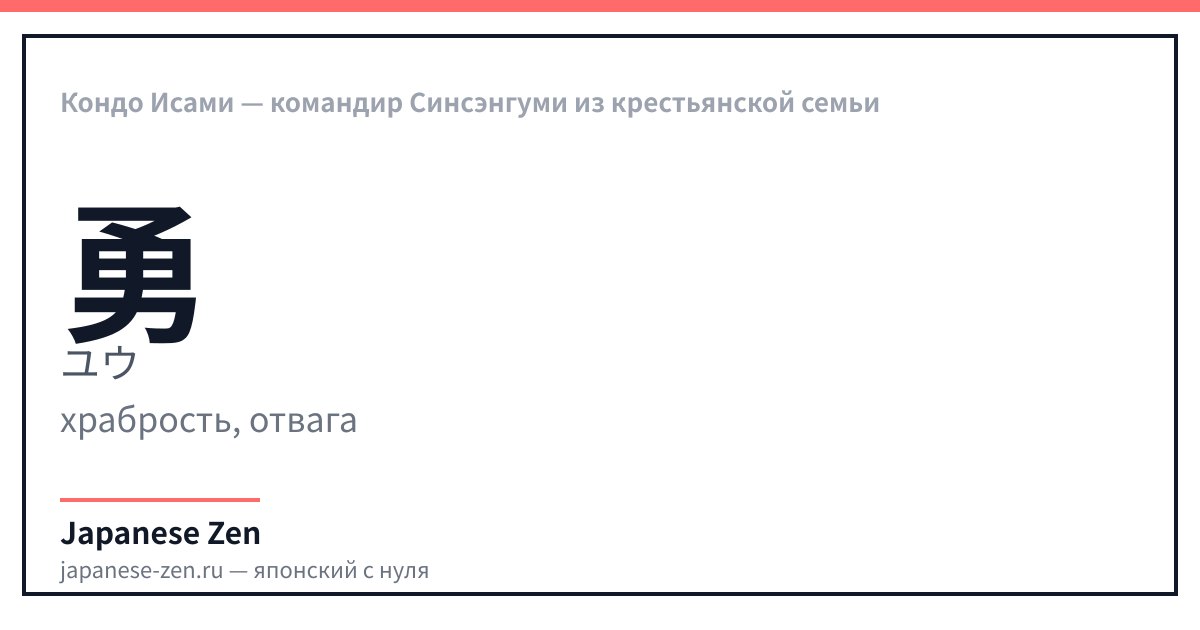
勇 — значение: bravery, courage — онъёми: ユウ — кунъёми: いさ.む — 9 штрих(ов). 勇 — 'bravery, courage' — Kondo's personal name; in male names this same character is sometimes read not as 'Isami' but as 'Isao' or 'Isamu' — all variants exist.
Isami or Isao — Confusion from Two Sources
The character 勇 in male names is read in different ways, and the real commander of the Shinsengumi was called Isami. In Gintama, the parody commander of the force is indeed called Kondo Isao, but his name is written with a different kanji — 近藤勲, not 近藤勇. The search query 'kondo isao' has two different reasons behind it: an alternative reading of the character 勇 and a parody character with a completely different kanji in his name.
| Japanese | Reading | Translation |
|---|---|---|
| 近藤勇 | Kondō Isami · Kondō Isami | Full name — commander of the Shinsengumi |
| 局長 | kyokuchō · kyokuchō | 'Force commander' — his position in the Shinsengumi |
| 天然理心流 | Tennen Rishin-ryū · Tennen Rishin-ryū | The fencing school he headed |
| 試衛館 | Shieikan · Shieikan | The dojo in Edo where Kondo became heir |
| 勇 | isamu · isamu | 'Bravery' — the same character as in his name |
Listen to how 局長 and the word 勇 — 'bravery' — sound; the app will evaluate your pronunciation.
Kondo Isami: Between Documents and Legend
Kondo's death is better documented than that of many of his comrades, but everyday details and posthumous reputation have become surrounded by legends. Let's go through the main points one by one.
- Disputed: Kondo owned a sword believed to be the work of the famous smith Kotetsu (虎徹). According to the prevailing view of historians, it is a forgery with a fake signature, and the blade itself was forged by another master, Minamoto Kiyomaro — but this view is not definitively proven.
- Fact, not legend: in 1876, Kondo's surviving comrade Nagakura Shinpachi secured the installation of a memorial stone at the execution site in Itabashi; today the monument has the status of a cultural heritage site of Kita Ward.
- Clarification: Kondo's exact age at the time of execution depends on the counting system — by the traditional Japanese count (kazoe) he was 35, by today's full years he was 33.
FAQ
- Was Kondo Isami a samurai?
- By birth, no: he was the son of a wealthy peasant, Miyagawa from Tama. He received the surname Kondo and the right to head the Tennen Rishin-ryū school through adoption in 1849. And in 1867, when the entire Shinsengumi force was enrolled as direct vassals of the shogun, he officially became one as well.
- What did Kondo Isami become famous for?
- For leading the Shinsengumi — a strictly disciplined police force that for years kept anti-shogunate forces in Kyoto under control, and after the shogunate's defeat was executed as a state criminal.
- How is the name Kondo Isami written in Japanese?
- 近藤勇, kana — こんどういさみ, romaji Kondō Isami. The second character of the name, 勇 ('bravery'), can also be read in male names as 'Isao' or 'Isamu' — hence the confusion in search between Kondo Isami and his namesakes with the same character.
- How was Kondo Isami executed?
- On May 17, 1868, in Itabashi he was beheaded as a state criminal, denied the right to seppuku. His head was taken to Kyoto and displayed on the bank of the Kamo River at the Sanjō Bridge.
- Is Kondo Isao from Gintama the same as Kondo Isami?
- No, he is a parody character from the comedy Gintama with a different kanji in his name — 近藤勲 instead of 近藤勇. The prototype is immediately recognizable, but in the spelling of the name and comedic character he is a separate comic hero, not a biography of the historical commander.
- When did Kondo Isami live?
- From 1834 to 1868. In 1849 he was adopted by the Kondo family of swordsmen, in 1863 he led the future Shinsengumi force, and on May 17, 1868, he was executed in Itabashi. The Boshin War continued without him for more than a year.
Sources
Updated: 2026-09-13