Hijikata Toshizō — the Shinsengumi's "Demon Vice-Commander"
Hijikata Toshizō (土方歳三) was the vice-commander (副長) of the Shinsengumi, nicknamed the "Demon Vice-Commander" for his harsh discipline. He was born in 1835 into a farming family in Hino that sold the medicine Ishida Sanyaku, and he trained in swordsmanship at the Shieikan dōjō. Unlike Kondō Isami, he fought through the entire Boshin War and died in battle on June 20, 1869, in Hakodate.
Anime portrays him sometimes as a stern handsome man in a European uniform, sometimes as a fantasy hero like in Drifters or Golden Kamuy. Let's look at where the nickname "Demon Vice-Commander" came from, what the Hijikata family did before the corps, why his collection of haiku survives, and what in pop-culture images relates to the real person.
A Farmer's Son Who Became the "Demon Vice-Commander"
Hijikata Toshizō was born in 1835 into a farming family in the village of Ishida near Hino, in the Musashi region. From a young age, he sold the family's bruise medicine Ishida Sanyaku alongside his older relatives while training in swordsmanship at the Shieikan dōjō of the Tennen Rishin-ryū school, where he grew close to Kondō Isami. In 1863, he left for Kyoto with Kondō as part of a rōnin corps that became the core of the Shinsengumi, and he took the post of vice-commander — responsible for discipline and enforcing the corps' strict internal rules.
| Year | Event |
|---|---|
| 1835 | born into a farming family in Hino |
| 1850s | sells the medicine Ishida Sanyaku, trains at the Shieikan dōjō |
| 1863 | leaves for Kyoto, joins the core of the future Shinsengumi, becomes vice-commander |
| 1868 | after the defeat at Toba-Fushimi, retreats north with the remnants of the corps |
| 1869 | fights in Hakodate on the side of the Republic of Ezo |
| June 20, 1869 | dies in battle during the defense of Hakodate |
Where the Nickname "Demon Vice-Commander" Came From
Hijikata earned the nickname 鬼の副長 ("Demon Vice-Commander") for the severity with which he maintained discipline: for serious offenses, members were ordered to commit seppuku. The text of the code itself (局中法度) is known only from later retellings — four articles in Nagakura Shinpachi's 1913 memoirs and five in Shimozawa Kan's 1928 book.
The Name 土方歳三 and His Poetic Pen Name
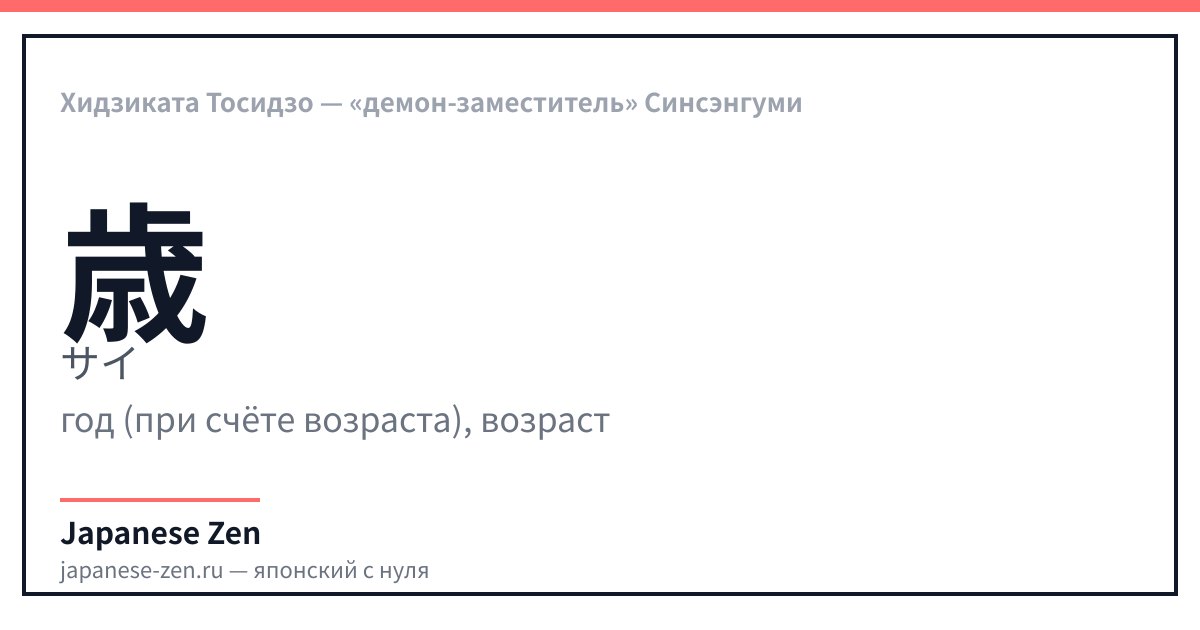
歳 — значение: year (in counting age), age — онъёми: サイ、セイ — кунъёми: とし、とせ、よわい — 13 штрих(ов). 歳 — "year, age": the first character of the personal name 歳三 (Toshizō), here read "toshi." In ordinary speech, it is the counter suffix for age, "sai": 三十歳 — "thirty years old."
The Pen Name Hōgyoku and His Haiku Collection
Hijikata wrote haiku under the pen name Hōgyoku (豊玉) and collected them in a notebook, the Hōgyoku Hokku-shū (豊玉発句集) — 41 poems compiled in Edo in the spring of 1863, before his departure for Kyoto. The manuscript is kept in the Hijikata Toshizō Museum in Hino along with his belongings and weapons.
| Japanese | Reading | Translation |
|---|---|---|
| 土方歳三 | Hijikata Toshizō · Hijikata Toshizō | Full name — vice-commander of the Shinsengumi |
| 副長 | fukuchō · fukuchō | "Vice-commander" — his post in the corps |
| 鬼 | oni · oni | "Demon" — from the nickname "Demon Vice-Commander" |
| 豊玉 | Hōgyoku · Hōgyoku | The pen name under which he wrote haiku |
| 俳句 | haiku · haiku | Short poems that he collected in a notebook |
Listen to how 副長 and 俳句 sound — the app will assess your pronunciation.
What in Hijikata's Image Is True and What Is Legend
Most speculation about Hijikata concerns his appearance and posthumous fame as the "ideal samurai." Let's go point by point through what sources confirm and what later novels and anime added.
- True: the famous photograph of Hijikata in a European military uniform is authentic — it was taken in Hakodate by photographer Tamoto Kenzō in 1869, and it is one of the few reliable photographs of Shinsengumi members.
- Fiction as alternate history: in the manga and anime Golden Kamuy (Geno Studio, 2018–2020), Hijikata does not die in Hakodate but decades later escapes from Abashiri Prison as a very old man. This is the author Satoru Noda's fantasy, not a biographical fact.
- Pure fiction inspired by his death: in the manga and anime Drifters (2016), Hijikata is transported to a fantasy world right after his death in Hakodate.
- A clarification, not an invention: in Gintama, the parody vice-commander has a similar name — Hijikata Toshirō (土方十四郎) — but it uses a different kanji and is a comedic character, not the biography of the prototype.
FAQ
- What is Hijikata Toshizō famous for?
- For being the vice-commander of the Shinsengumi — the shogunate corps that guarded Kyoto in the 1860s — and for being in charge of discipline, which earned him the nickname "Demon Vice-Commander." A farmer's son from Hino, he fought through the entire Boshin War and died in battle in Hakodate in 1869.
- Why was Hijikata Toshizō called the "Demon Vice-Commander"?
- For the severity with which he required members to follow the corps' internal rules: for serious offenses, members were ordered to commit seppuku. Hence the nickname 鬼の副長 — literally "demon vice-commander"; the code of rules itself, in the form usually quoted, is known only from later retellings.
- How did Hijikata Toshizō die?
- He died in battle on June 20, 1869, during the defense of Hakodate, fighting on the side of the short-lived Republic of Ezo — a week before the surrender of Goryōkaku fortress, which ended the Boshin War. Kondō Isami had already been executed more than a year earlier.
- Does an authentic photograph of Hijikata Toshizō exist?
- Yes, it is authentic. It was taken in Hakodate in 1869 by photographer Tamoto Kenzō: the image shows Hijikata in a European military uniform — one of the few reliable portraits of Shinsengumi members.
- Is Hijikata Toshirō from Gintama the same character as Hijikata Toshizō?
- No, he is a parody double with a different kanji in his name (土方十四郎 instead of 土方歳三). The character is instantly recognizable, but in the story he is a separate comedic character from Gintama, not the biography of the historical Hijikata, who died in 1869 in Hakodate.
- Did Hijikata Toshizō write haiku?
- Yes, under the pen name Hōgyoku (豊玉). He compiled the collection Hōgyoku Hokku-shū with 41 poems in the spring of 1863, while still in Edo, before leaving for Kyoto, and today the manuscript is kept in the Hijikata Toshizō Museum in Hino along with his personal belongings.
Sources
Updated: 2026-09-13