Haiku — what it really means
Haiku literally means 'comic stanza,' and in practice it is a poem of 17 syllables in a 5-7-5 pattern about a specific moment in the present, usually with a seasonal reference. The term became established as the name of an independent genre only in the 19th century — before that, the form existed as the first stanza of a longer poetic chain.
Haiku is commonly thought of as nature poetry with a moral at the end. In reality, it is more like a precise snapshot of a moment — without explaining what to feel about it.
What 'haiku' means
Haiku is a poem of 17 syllables written as 5-7-5, about a specific moment in the present, usually with a seasonal reference. Literally, the word means 'comic stanza': this was the name for the first, liveliest part of a long renga chain, long before it became an independent genre in the 19th century through the efforts of poet Masaoka Shiki. A working definition is simpler than a dictionary one: a short snapshot of a moment without explaining what to feel about it.
Why 'comic stanza' sounds strange
A direct translation often kills a haiku: the Russian syllable does not equal the Japanese mora, the counting unit of rhythm, and it is almost impossible to count the exact 5-7-5 in translation without losing the image. Translators more often sacrifice the syllabic form for the image — a short, concise picture — rather than the other way around.
Breakdown of the characters: 俳句
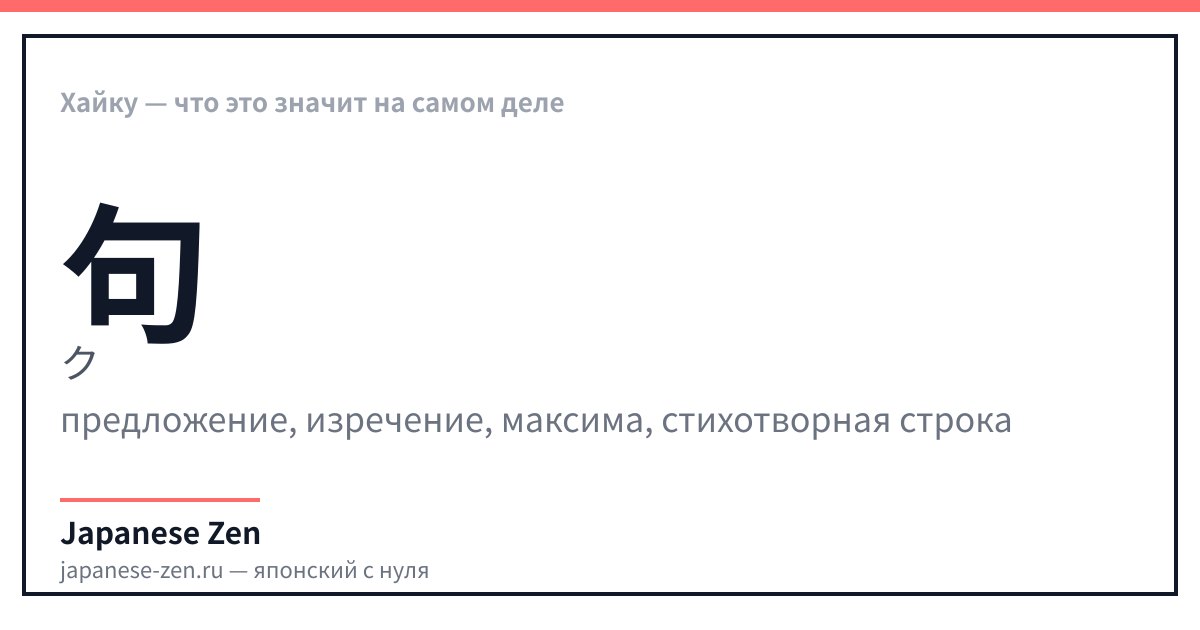
句 — значение: sentence, saying, maxim, poetic line — онъёми: ク — 5 штрих(ов). 句 — 'phrase, stanza': the second character in 俳句. The same character appears in 文句 'phrase, complaint' and 語句 'word combination,' everywhere referring to a complete segment of text.
| Japanese | Reading | Translation |
|---|---|---|
| 俳句 | haiku · haiku | Haiku |
| 季語 | kigo · kigo | Season word |
| 季節 | kisetsu · kisetsu | Season |
| 自然 | shizen · shizen | Nature |
| 短い | mijikai · mijikai | Short |
What the character 俳句 is made of
句 cannot be broken down into simple radicals with obvious meaning — it is a phonetic-semantic character where the element 'mouth, speech' 口 is combined with a phonetic part. It is easier to remember it through ready-made words: 俳句, 語句, 文句 — everywhere it means 'segment of speech,' not 'phrase' in the everyday sense.
Practice the stroke order of the character 句 in the trainer — the second character of the word 俳句.
How it works in practice
- Kigo — a season word: 'sakura' carries spring, 'cicadas' carry summer, without separately saying 'it is summer now.'
- Kireji — a 'cutting word,' a pause within the line, which in Russian is usually conveyed by a dash or a line break.
- Haiku are almost never titled — a title would contradict the idea of a snapshot.
- Modern Japanese haiku sometimes abandon the strict 5-7-5, keeping only the principle of brevity and seasonality.
What is Japanese about haiku and what is Western
In the Japanese tradition, haiku is primarily an observation, not a metaphor or a moral at the end. In the West, the genre is sometimes turned into a short aphoristic wisdom with a conclusion — that is already an adaptation, not the original principle: Japanese haiku rather shows than explains.
Common misconceptions
- 'Haiku must be about nature' — no, there are urban and everyday themes too, but a seasonal reference is almost always present.
- 'Haiku is just a short three-line poem' — without a season word and observation of a moment, it is no longer haiku but free verse in three lines.
- 'Haiku is easy to write because it is short' — the short form requires more precise word choice, not less effort.
- 'Haiku always has 17 syllables' — the rule works for the Japanese moraic system; for other languages it is a convention, not a strict law.
Where the myth about mandatory nature came from
The myth was cemented through translations and educational anthologies in the West, where landscape haiku were most often chosen as examples — they are more visual and easier to translate without losing the image. In Japanese practice, the share of everyday and urban themes is noticeably larger than it seems from anthologies for foreign readers.
FAQ
- What does 'haiku' mean?
- A poem of 17 syllables in a 5-7-5 pattern about a specific moment in the present, usually with a seasonal reference. Literally, the word means 'comic stanza' — this was the name for the opening part of a renga chain.
- How is 'haiku' written in characters?
- 俳句: 俳 'joke, comic' plus 句 'phrase, stanza.' It is read 'haiku' and became established as an independent term only in the 19th century.
- Where did this concept come from?
- From the hokku form — the opening stanza of a renga chain. It was singled out as a separate genre by the poet Masaoka Shiki at the end of the 19th century, when haiku ceased to be part of a longer poem.
- How does it work in practice?
- Through two tools: kigo — a season word, and kireji — a pause-'cut' within the line. Both work without directly explaining what to feel about what is seen.
- What is most often misunderstood?
- That haiku must be about nature and always contains a moral or conclusion at the end. In reality, it is more of a precise observation of a moment without explanation and without a lesson.
- Is 17 syllables mandatory in haiku?
- Not always: the 5-7-5 rule relies on the Japanese moraic system, and for other languages it is a convention, not a strict law. Modern Japanese haiku also sometimes deviate from the exact pattern.
Sources
Updated: 2026-08-24