Hokku and Haiku: What's the Difference
Hokku and haiku — what's the difference: hokku is a historical term for the opening stanza of a poetic chain called renga, always part of a longer work. Haiku is the same 5-7-5 form but set apart as an independent poem by poet Masaoka Shiki in the late 19th century. The difference is not in form but in status: a standalone text or the first stanza of a chain.
The form is the same — three lines, 5-7-5. The difference is in context: one lives inside a long chain, the other stands alone.
Hokku or Haiku: In Short
Hokku is the first stanza of renga or renku, a collective poetic chain: it has a seasonal word and sets the tone for the whole poem, which other authors continue. Haiku is the same form but standalone, without continuation. The difference appeared only when haiku was recognized as a separate genre.
| Feature | Hokku | Haiku |
|---|---|---|
| Context | First stanza of renga/renku | Standalone work |
| Author | Often opens the chain for a guest | Written by one author, no continuation |
| Function | Sets the theme and season for the whole chain | Works as a complete text |
| Term established | Since the early Middle Ages | As a separate word — since the late 19th century |
| Form | 5-7-5, seasonal word | 5-7-5, seasonal word |
The First Line of a Dialogue
A hokku without a chain is like the first line of a dialogue without the rest of the conversation: technically complete, but intended as a beginning. Haiku is self-sufficient from the start; it doesn't need a response from the next author.
Origin, Status, Era
- Origin: hokku is part of the practice of renga, collective poetry composition at a gathering of poets; haiku was extracted from it as a genre for a single author.
- Name: the term 'haiku' was popularized by poet Masaoka Shiki in the late 19th century; before that, only 'hokku' was used.
- Today: almost all short 5-7-5 poems are called haiku, even when they actually open a chain — 'hokku' remains a term for connoisseurs of the renga tradition.
- The form and techniques are completely identical: kigo (seasonal word) and kireji (cutting pause) work the same way in both cases.
17 Syllables and a Seasonal Word
Both hokku and haiku are 17 syllables in a 5-7-5 pattern with a seasonal word and an observation of a specific moment. Formally, they are the same text; the only difference is whether it stands alone or opens a chain.
What They're Called in Japanese: 発句
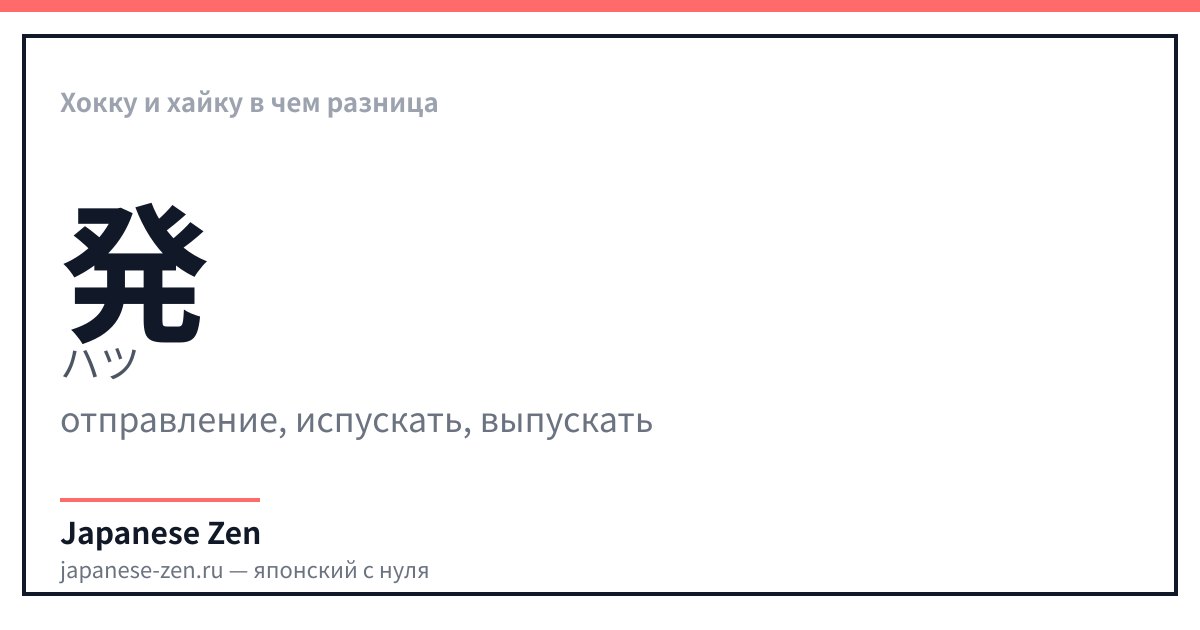
発 — значение: departure, to emit, to release — онъёми: ハツ、ホツ — кунъёми: た.つ、あば.く、おこ.る、つか.わす、はな.つ — 9 штрих(ов). 発 — 'to begin, to send': the first character in 発句. The same root appears in 出発 'departure' and 発見 'discovery' — everywhere the meaning is the start of something new.
| Japanese | Reading | Translation |
|---|---|---|
| 発句 | hokku · hokku | Hokku, opening stanza |
| 俳句 | haiku · haiku | Haiku |
| 挨拶 | aisatsu · aisatsu | Greeting |
| 順番 | junban · junban | Order, sequence |
| 連句 | renku · renku | Chain of stanzas by different authors |
Where the Second Name of Hokku Came From
発句 literally means 'opening stanza': 発 'to begin' plus 句 'stanza'. In renga poetics, hokku was also called 挨拶 'greeting' — because of its role: the author of the opening stanza was like bowing to the host of the gathering where the chain was composed.
Repeat the stroke order of the character 発 in the trainer — the first character of the word 発句.
How to Tell Them Apart in a Text
- If several authors add stanzas in turn — it's renku, and the first stanza there is technically hokku.
- If it's a single three-line poem without continuation — in practice it will almost always be called haiku, even by experts in informal speech.
- In anime and manga about poetry circles, a group renku session with multiple participants is rare; more often they show a single haiku composition.
- Historical dramas about Edo-era poets sometimes use the term 'hokku' more accurately, if the scene is specifically a group renga gathering.
Which One Is More Common
In colloquial speech, haiku has almost completely replaced 'hokku' — even when formally referring to the first stanza of a chain. The specialized term remains mainly in academic and club settings where renku is also written.
FAQ
- Hokku and haiku: what's the difference?
- Hokku is the first stanza of a collective poetic chain called renga; haiku is the same in form but a standalone poem. The term 'haiku' became established only in the late 19th century.
- Hokku and haiku — is the difference in form or status?
- The difference is not in form but in the status of the text: hokku is intended as the beginning of a longer work, while haiku is a complete thing in itself.
- What do they have in common?
- Both are 17 syllables in a 5-7-5 pattern with a seasonal word (kigo) and a cutting pause (kireji). Formally, they are the same type of text; the only difference is in context.
- What do 発句 and 俳句 mean?
- 発句 (hokku) means 'opening stanza', from 発 'to begin'. 俳句 (haiku) means 'comic stanza', a term that replaced 'hokku' in common usage.
- Which one is more common?
- Haiku — almost always: in colloquial speech, any short 5-7-5 poem is called that, even one that opens a chain. 'Hokku' remains a term for connoisseurs of the renga tradition.
- How to tell them apart at a glance?
- If there are several poems that continue each other — you have renku, and the first stanza is technically hokku. A single text without continuation will in practice always be called haiku.
Sources
Updated: 2026-08-24