Wakizashi and Katana: What's the Difference
The wakizashi and the katana are different swords: the difference lies in blade length and where they were allowed to be worn. The katana is a long sword from 60 cm, removed at the entrance to another's house; the wakizashi is a short sword of 30–60 cm, which a samurai kept with him even where the katana was out of place. Together they formed the paired daishō set.
On paper the distinction sounds simple — blade length. In practice it determined what you could take with you as a guest and what you had to leave at the door: the katana was removed, the wakizashi was not.
Short answer: how the wakizashi differs from the katana
The wakizashi and the katana are the paired swords of a single samurai, but with different tasks: the katana is the main weapon, from 60 cm long; the wakizashi is a short sword of 30–60 cm for tight spaces and as a backup weapon. When entering another's house, the katana was removed, while the samurai kept the wakizashi with him — this is the main practical difference.
How to remember the difference quickly
| Feature | Wakizashi | Katana |
|---|---|---|
| Blade length | 30–60 cm (1–2 shaku) | from 60 cm (usually 60–73 cm) |
| Grip | more often one-handed | two-handed |
| Where worn | almost always on the person, including indoors | removed at the entrance to another's house |
| Role in the daishō set | auxiliary, 'inner' sword | main, 'outer' sword |
Breakdown by features: what the wakizashi and katana have in common
- Length: the wakizashi is about half as long as the katana — this creates a different grip and a different striking radius.
- Place of wearing: the katana was left at the entrance, the wakizashi was not, so it was the samurai's only weapon indoors.
- Role in seppuku: the ritual cut was traditionally made with a short blade — a wakizashi or tantō, not a long katana, which is awkward to use on oneself.
- Symbolic status: the right to wear the daishō, the katana+wakizashi pair, was a privilege of the samurai class and distinguished it from others.
What they have in common
Both swords are products of the same weapon tradition: they are forged and sharpened in the same way, both are curved, single-edged, worn blade-up, thrust through the obi. The difference between them is not in quality or forging technique, but in length and purpose within a single set.
脇差 — 'that which is worn at the side'
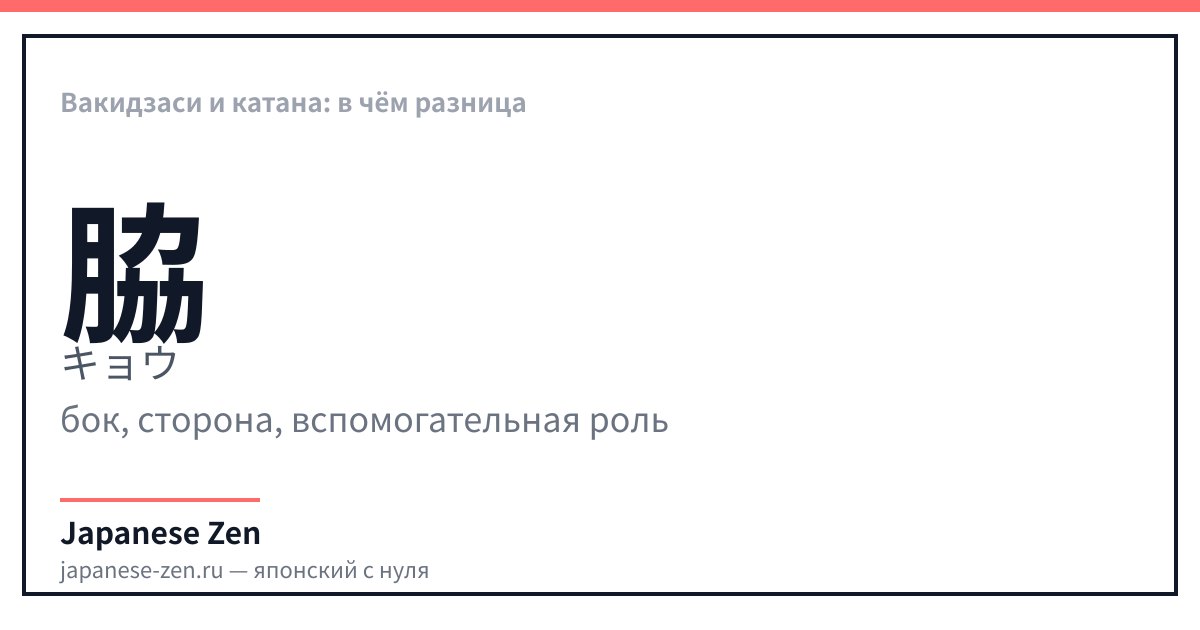
脇差 is read わきざし (wakizashi): 脇 — 'side, flank', 差 — 'to thrust through the belt'. Literally — 'that which is thrust at the side', unlike the katana, which is simply called 刀. The name directly indicates the manner of wearing — at the side, on the person, not as a main weapon on display.
脇 — значение: side, flank, auxiliary role — онъёми: キョウ — кунъёми: わき、わけ — 10 штрих(ов). 脇 — 'side, flank': the same character in 脇見 (wakimi, a sideways glance) and in the word 脇差 (wakizashi).
How it is read and what it literally means
| Japanese | Reading | Translation |
|---|---|---|
| 脇差 | wakizashi · wakizashi | short sword, paired with the katana |
| 脇 | waki · waki | side, flank |
| 大小 | daishō · daishō | the pair of katana and wakizashi |
| 守り刀 | mamorigatana · mamorigatana | 'guardian blade' — a short sword for protection |
Write 脇 along the guides — the character for 'side, flank' from the word 'wakizashi'.
How to tell a wakizashi from a katana on screen
- Look at the length relative to the character's height: if the blade is noticeably shorter than the forearm and ends at the thigh rather than below the knee, it is probably a wakizashi, not a katana.
- Pay attention to the setting: a character with a weapon indoors who has only one short blade is a typical situation for a wakizashi, because the katana was customarily left at the entrance.
- Look for the pair: if the sword is shown together with a second, noticeably shorter blade in the same belt, that is the daishō set, katana plus wakizashi.
FAQ
- Wakizashi and katana — what's the difference?
- The main difference is blade length and place of wearing: the katana is from 60 cm, removed at the entrance to another's house; the wakizashi is 30–60 cm, kept by the samurai even indoors. Together both swords formed the paired daishō set, which only a samurai could wear.
- What is the blade length of a wakizashi and of a katana?
- The wakizashi is 30–60 cm (1–2 shaku), the katana is usually 60–73 cm. The roughly twofold difference directly affects the grip: the katana is more often held with two hands, the wakizashi with one, which makes it convenient in a tight space.
- What do the wakizashi and the katana have in common?
- Both swords are single-edged, curved, forged and sharpened according to the same tradition, worn thrust through the obi blade-up. The difference is not in the quality of workmanship, but in length and purpose: the katana is the main weapon, the wakizashi is auxiliary and always on the person.
- What are the wakizashi and the katana called in Japanese?
- Wakizashi is written 脇差 (わきざし) — literally 'that which is thrust at the side'. Katana is simply 刀 (かたな). The pair of both swords together is called 大小 (daishō), literally 'large and small'.
- Which sword was used for harakiri — the wakizashi or the katana?
- For the ritual cut, a short blade was traditionally used — a wakizashi or tantō, not a long katana, which is awkward to use on oneself. This is one of the practical reasons why the wakizashi always remained with its owner, even when the katana had to be handed over.
- How can you tell a wakizashi from a katana at first glance?
- By length relative to the body: a short blade reaching the thigh is usually a wakizashi; a long one reaching the knee or below is a katana. The second sign is whether there is a second, shorter sword in the same belt: then you are looking at the paired daishō set.
Sources
Updated: 2026-09-10