Katana scabbard (saya) — what it is made of and how it is constructed
The katana scabbard (saya, 鞘) is a wooden case for the blade, traditionally made from soft honoki magnolia wood and coated with urushi lacquer. Inside, the blade should neither rattle nor get stuck: precise fitting protects the edge from scratches and from accidentally falling out. The saya has its own parts — the koiguchi mouth, the kurikata loop, and the sageo cord.
The saya is not a case "for beauty" but a working part of the sword: how precisely it is fitted to a specific blade determines both the preservation of the edge and the safety of the owner. Mistakes in scabbard care are a common reason why old blades rust faster than they should.
What katana scabbards are made of and how they are constructed
The saya (鞘) is a wooden katana scabbard made from two longitudinal halves glued around the blade, usually from honoki magnolia wood (朴): it is soft, does not scratch the steel, absorbs excess moisture, and hardly warps over time. Outside, the saya is coated with urushi lacquer (漆) — it protects the wood and sets the appearance, from plain black to the decorative maki-e technique. The mouth into which the blade enters — the koiguchi (鯉口) — is traditionally reinforced with buffalo horn so that the edge does not fray from constant friction against the tsuba.
- Koiguchi (鯉口) — the scabbard mouth, reinforced with horn; the place where the saya meets the guard.
- Kurikata (栗形) — a loop on the side of the saya for attaching the cord.
- Sageo (下緒) — a braided cord with which the saya was attached to the belt and tied in different ways in different situations.
- Kojiri — the tip at the lower end of the scabbard, protecting the wood from wear.
Why the blade should not rattle in the scabbard
Fitting the saya to a specific blade is not a formality: too loose a scabbard strikes the edge against the walls while walking and spoils the sharpening, while too tight a one risks getting stuck at a critical moment. A well-fitted saya, when the blade is fully returned, gives a characteristic dry click at the koiguchi — this sound is one of the ways the quality of the fit is checked.
Caring for a katana scabbard and typical owner mistakes
A storage saya and a carrying saya are not the same thing
The lacquered saya in which the sword was carried is not intended for long storage: remnants of oil and moisture inside it eventually provoke corrosion of the blade. For long-term storage, Japanese craftsmen traditionally use separate simple unpainted scabbards made of the same wood — shirasaya (白鞘), while the decorative battle saya (koshirae) is put on only for carrying or display. Changing one scabbard for another is a common practice, not a sign of a damaged sword.
- Storing the blade for months in a lacquered battle saya instead of a shirasaya.
- Putting the sword into the scabbard without oil on the blade — moisture inside the saya accelerates rust.
- Forcing the blade into a poorly fitted scabbard, risking splitting the wood.
- Storing the saya near a radiator or in a dry heated room — the wood dries out and cracks.
鞘 — a character that means more than just scabbard
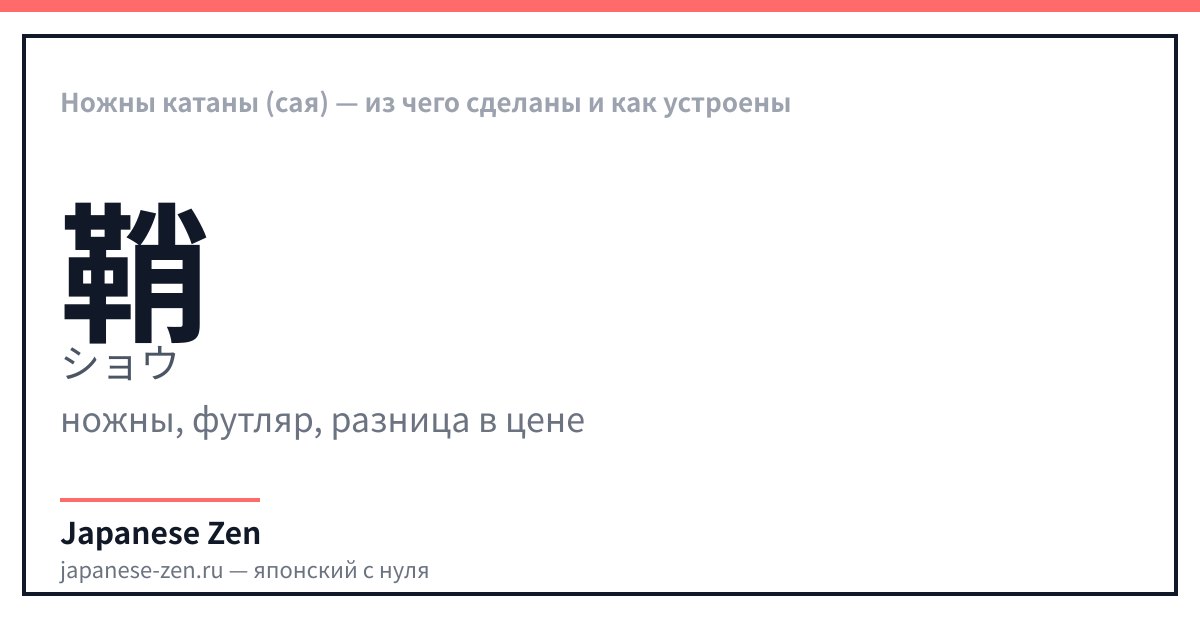
鞘 is read さや (saya) — the same word refers to the katana scabbard and to any case for bladed weapons, from tanto to naginata. The character is quite rare outside the topic of edged weapons: it almost never appears in everyday life, so knowing it is already a specialized skill.
鞘 — значение: scabbard, case, price difference — онъёми: ショウ、ソウ — кунъёми: さや — 16 штрих(ов). 鞘 — "scabbard, case": used for any bladed weapon — from tanto to katana.
How it is read and where the same character appears
| Japanese | Reading | Translation |
|---|---|---|
| 鞘 | saya · saya | scabbard of a katana and other bladed weapons |
| 鯉口 | koiguchi · koiguchi | scabbard mouth |
| 下緒 | sageo · sageo | cord for attaching the scabbard to the belt |
| 白鞘 | shirasaya · shirasaya | simple scabbard for long-term storage of the blade |
| 鞘に納める | saya ni osameru · saya ni osameru | to put the blade into the scabbard |
Write 鞘 along the guides — the character for "scabbard".
Katana scabbards in anime and games: the art of the quick draw
Where the saya is part of the technique itself
- In "Rurouni Kenshin", the hero's signature technique is battōjutsu of the Hiten Mitsurugi-ryū school: a lightning-fast lunge straight from the scabbard, where the speed of the draw decides the fight before the strike.
- In Ghost of Tsushima, duels are built on the same principle — victory is determined by one precise draw from the scabbard, not by a series of strikes.
- Such scenes are not an exaggeration: the technique of quickly drawing the blade (iaido) is a separate fencing discipline, where the scabbard and its fitting determine the speed and safety of the technique.
FAQ
- What is a katana scabbard made of?
- From soft honoki magnolia wood (朴): it does not scratch the steel, absorbs excess moisture, and hardly warps. Outside, the scabbard is coated with urushi lacquer to protect the wood and for decorative appearance, and the mouth is reinforced with buffalo horn so that the edge withstands constant friction against the blade.
- What is a katana scabbard called in Japanese?
- Saya (鞘) — a general word for the scabbard of any bladed weapon, not only a katana. The saya has its own named parts: koiguchi (mouth), kurikata (loop for the cord), sageo (the cord itself), and kojiri (tip at the lower end).
- Why should the blade not rattle in the scabbard?
- A loose gap strikes the edge against the walls while walking and spoils the sharpening, while too tight a fit risks getting stuck at the needed moment. A well-fitted saya, when the blade is fully returned, gives a characteristic dry click at the mouth — this is one of the ways the quality of the work is checked.
- How does a shirasaya differ from an ordinary battle scabbard?
- Shirasaya (白鞘) is a simple unpainted scabbard made of the same wood, intended only for long-term storage of the blade, without lacquer or decorative finish. The battle lacquered saya (koshirae) is put on for carrying or display, while for storing the blade for months it is better to keep it in a shirasaya.
- What mistakes most often spoil the scabbard and the blade?
- Long storage in a lacquered battle saya instead of a shirasaya, putting the sword away without oil on the blade, forcing the blade into a poorly fitted scabbard, and storing the saya near a radiator or in too dry a room, because of which the wood dries out and cracks.
- What are koiguchi and sageo?
- Koiguchi (鯉口) — the scabbard mouth, reinforced with buffalo horn, the place where the saya and the guard meet. Sageo (下緒) — a braided cord with which the scabbard was attached to the belt; the knot of the sageo could indicate status or the situation in which the sword was worn.
Sources
Updated: 2026-09-10