Tsuba — the guard of a Japanese sword: why it was decorated and why it is collected
Tsuba (鍔) is the guard of a Japanese sword: a metal disc between the hilt and the blade that keeps the hand from sliding onto the edge, protects the fingers, and balances the weapon. Battle tsuba were forged from plain iron, while ceremonial ones were decorated with openwork sukashi patterns and alloys such as shakudō and shibuichi. After the 1876 Haitōrei edict banned the wearing of swords, decorated tsuba became a separate collectible.
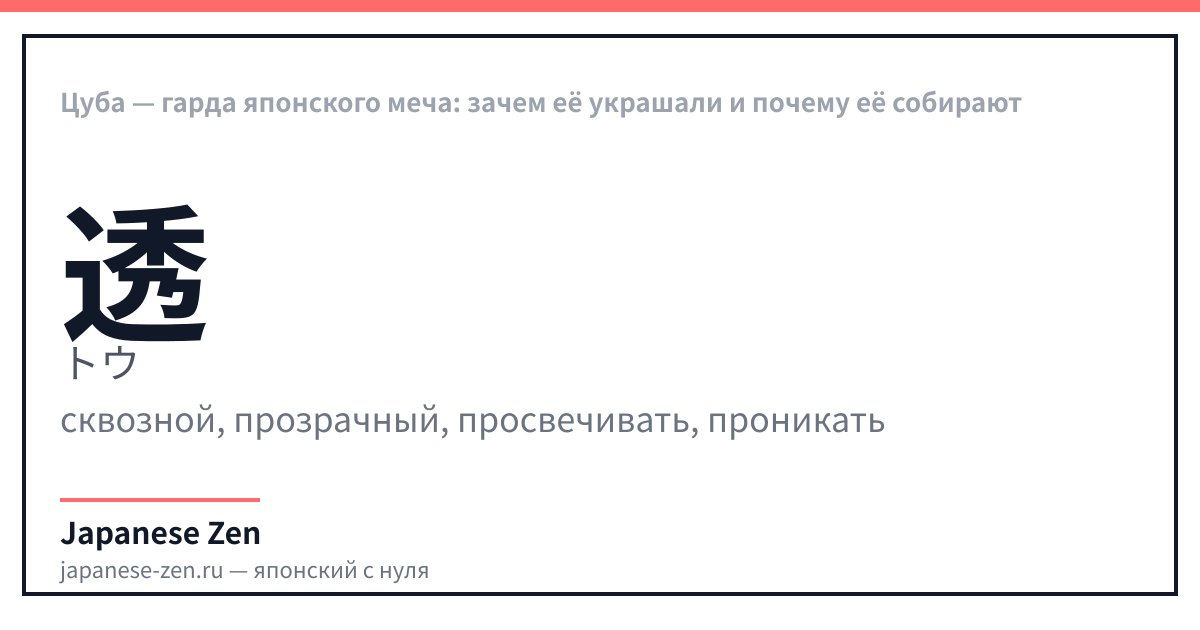
A sword guard is not just a dividing piece between hilt and blade: it has its own history of craftsmen, fashions in design, and a special fate after samurai were forbidden to carry weapons. Let's look at what tsuba were made from, what subjects the carvers cut, and what the character 透 — 'openwork' — means, the one that gave its name to the main technique of decorating them.
How a tsuba protects the hand and balances the sword
A tsuba (鍔) is a flat metal plate between the hilt and the blade of a Japanese sword. It keeps the palm from sliding forward onto the blade during a thrust, absorbs part of the impact from an opposing blade, and adds weight at the guard, which helps the weapon balance better in the hand. In the center is a hole for the blade tang, the nakago-ana. On the sides, many tsuba have two smaller cutouts: the kozuka-hitsu for the handle of a small utility knife called a kozuka, and the kogai-hitsu for a kogai hairpin, which was carried in the same sword mounting.
Battle tsuba were most often forged from plain iron — strong and inconspicuous in the hand during combat. Later, craftsmen also made ceremonial guards from soft copper-based alloys: shakudō, with a small amount of gold, and shibuichi, in which silver makes up about a quarter of the composition. After special treatment, both alloys take on a noble dark or gray-pearl color that ordinary copper does not produce.
Why a tsuba can be removed from the sword at all
A tsuba is not riveted permanently to the blade: it is held on the tang together with the wooden hilt and can be taken apart for cleaning or replacing the mounting. The owner of a sword could order a new guard to suit his mood or an occasion without touching the blade itself — much like changing a watch strap today while keeping the movement. That is precisely why tsuba have come down to us separately from swords: many surviving guards simply no longer have a matching blade.
How the tsuba became a signed work of a master rather than a piece of armor
The first tsuba were hardly different from other parts of armor: a simple iron disc was forged by the same craftsman who made the blade or helmet. At the end of the 16th century, in the Momoyama period, a separate craft of tsubakō emerged — guard carvers who signed their works. The two most famous makers of iron tsuba of this time are considered to be Nobuie and Kanaiye from Owari Province: their guards combine rough forging with precise openwork patterns. Later, under the Tokugawa shogunate, sword mountings for shogunal and samurai nobility were often commissioned from the Gotō workshop — a family of carvers who had worked with soft metals for centuries.
What happened to tsuba after the 1876 Haitōrei edict
In 1876, the Haitōrei edict (廃刀令) banned the everyday wearing of swords in Japan for everyone except military and police on duty. Sword makers suddenly lost their work, and many old swords along with their guards were sold for next to nothing. Some tsuba survived this wave thanks to collectors: artistically valuable guards were bought up by foreign travelers and museums. By the end of the 19th century, tsuba had scattered across collections in Europe and America separately from the blades they had once been fitted to.
Dragonfly, family crest, and wave: what was carved on the guard
The openwork pattern sukashi (透かし) is a technique in which the craftsman does not engrave the design on the surface of the guard but cuts it all the way through, so that the tsuba becomes partly openwork. The subjects were not chosen at random: almost every pattern carried a wish such as luck in battle, longevity, or belonging to a certain clan.
- Dragonfly (蜻蛉) — the 'insect of victory,' kachimushi: it flies only forward and never retreats, so warriors considered it a sign of steadfastness in attack.
- Family crest (家紋, mon) — a tsuba with a crest was commissioned as part of a ceremonial mounting so that the owner's house could be seen at once.
- Pine, bamboo, and plum (松竹梅, shōchikubai) — the three plants together mean resistance to frost and good fortune: pine and bamboo stay green in winter, and plum blossoms earlier than the rest.
- Seigaiha waves (青海波) — a pattern of even semicircular crests, a wish for endless calm and prosperity.
- Bat (蝙蝠, komori) — in Chinese the character 蝠 sounds the same as 福 'happiness,' and this pun passed into Japanese ornament as a wish for good luck.
Why empty space in a pattern is also part of the meaning
In sukashi, what is cut out — that is, removed — is no less important. An empty area could stand for a cloud, water, or simply the background against which the silhouette of the main motif reads: the craftsman was thinking of two designs at once, the cut metal and the emptiness left between it.
鍔 and 透: the guard and the 'openwork' pattern that made it famous
The tsuba itself has its own character — 鍔, read つば. But for this topic another kanji is more important — 透: it means 'openwork, transparent' and appears in the word 透かし鍔 (sukashi-tsuba) — 'a tsuba with an openwork pattern.' That is the name for the very type of guard that made tsuba come to be viewed as a separate work of art: a plain battle blank is not studied for hours, but an openwork silhouette is.
透 — значение: openwork, transparent, to show through, to penetrate — онъёми: トウ — кунъёми: す.く、す.かす、す.ける、とう.る、とう.す — 10 штрих(ов). 透 — 'openwork, transparent': the same character in 透かし (sukashi) — the openwork carving technique used to decorate the finest tsuba.
What else 透 means besides a pattern on a guard
The same character appears in the ordinary word 透明 (tōmei, 'transparent'): both glass and the openwork pattern of a tsuba are described by the same root — 'that through which one can see.' The readings of the character are トウ in compound words and す(く), す(かす), す(ける) in native Japanese verbs about showing through or straining.
| Japanese | Reading | Translation |
|---|---|---|
| 鍔 | tsuba · tsuba | sword guard |
| 透かし | sukashi · sukashi | openwork pattern cut through metal |
| 鍔迫り合い | tsubazeriai · tsubazeriai | a guard-to-guard clash — intense rivalry |
| 刀装具 | tōsōgu · tōsōgu | sword mounting — all metal parts except the blade |
| 鍔師 | tsubashi · tsubashi | a craftsman who makes tsuba |
| 透ける | sukeru · sukeru | to show through, to be transparent |
What the expression 'a guard-to-guard clash' means
鍔迫り合い (tsubazeriai) literally describes the moment in a sword fight when the combatants press their blades against each other guard to guard and neither can push the other back. From this image the expression passed into ordinary speech: it refers to intense rivalry where it is unclear who will come out on top — from a sports match to business negotiations.
Write 透 along the guides — the character for 'openwork pattern' that gave its name to collectible tsuba.
FAQ
- What is a tsuba?
- A tsuba (鍔) is the metal guard of a Japanese sword: a plate between the hilt and the blade that keeps the hand from sliding onto the edge and balances the weapon. Battle tsuba were forged from plain iron, while ceremonial ones were decorated with openwork patterns and alloys such as shakudō. Today tsuba are often viewed separately from swords — as independent works of metalwork.
- Why does a Japanese sword need a tsuba?
- Without a guard, the hand could slide right onto the blade during a thrust. In addition, the tsuba absorbed part of the impact from an opposing weapon, protecting the fingers, and served as a decorative part of the mounting by which the owner's status could be guessed.
- What were tsuba made from?
- Battle guards were forged from plain iron — strong, inexpensive, and inconspicuous in the hand. For the ceremonial swords of the nobility, craftsmen also used soft copper-based alloys: shakudō with a small amount of gold, and shibuichi, in which silver makes up about a quarter of the composition. After special treatment, both alloys take on a noble dark or gray-pearl hue.
- Why do collectors collect tsuba?
- After the 1876 Haitōrei edict banned the everyday wearing of swords in Japan, sword makers were left without work, and old blades were melted down en masse. Artistically valuable guards were bought up at this time by collectors and museums, and tsuba came to be valued in their own right — as miniature sculpture and carving, not merely as part of a battle sword.
- What does an openwork pattern on a tsuba mean?
- The openwork pattern sukashi (透かし) is cut all the way through the metal, so that the guard becomes partly openwork rather than merely decorated on the surface. The subjects were chosen with meaning: the 'kachimushi' dragonfly promised steadfastness in attack because it does not fly backward, a family crest indicated the owner's house, and waves or pine with bamboo wished prosperity and long life.
- How is 'tsuba' written in Japanese?
- Tsuba is written with a single character — 鍔, read つば. The kanji is fairly rare outside the topic of bladed weapons and hardly appears in ordinary vocabulary on its own. For this topic another character is more important, 透 ('openwork'): it explains the sukashi openwork technique that made tsuba collectible.
Sources
Updated: 2026-09-15