Iaido — Drawing the Sword in One Motion: How It Is Trained
Iaido (居合道) is the art of instantly drawing the sword from its scabbard and striking in one fluid motion. Unlike kendo and kenjutsu, where practitioners fence against each other, iaido is trained solo through predetermined forms (kata) against an imaginary opponent. The modern term was established in 1932, when master Nakayama Hakudo systematized it along the lines of kendo and judo.
In iaido there is no partner and no sparring — only you, the sword, and a sequence of movements that must be repeated hundreds of times before it becomes invisible.
What Iaido Is and How It Is Trained
Iaido (居合道) is the art of instantly drawing the sword from its scabbard while striking. Unlike kenjutsu and kendo, where one fences against a living opponent, iaido is trained solo through predetermined forms (kata): against one or several imaginary opponents. The modern term was established in 1932 — it was introduced by master Nakayama Hakudo, repeating the same transition from "jutsu" to "do" that had earlier occurred with judo and later with kendo.
Why the Sword Is Drawn Rather Than Held Ready
- The idea of the technique: a response to a sudden threat when the sword is still in its scabbard, not a duel with already drawn blades.
- The weapon: an iaito — an unsharpened imitation sword made of a zinc-aluminum alloy, close in weight and balance to a live blade.
- Practitioners: individual students in schools and federations, from beginners to long-time masters with high dan ranks.
- Founder of the tradition: Hayashizaki Jinsuke Shigenobu, a 16th-century swordsman credited with the first systematic technique of instant sword drawing.
The Four Phases of a Single Kata
- Nukitsuke (抜き付け) — drawing the sword from the scabbard with a simultaneous first strike.
- Kirioroshi (切り下ろし) — the finishing, stronger downward cut.
- Chiburi (血振り) — the ritual shaking off of the blade: a symbolic gesture, not a literal necessity.
- Noto (納刀) — returning the sword to the scabbard — the slowest and most controlled part of the kata.
- Changing stance and moving to the next kata without losing composure.
Why One Trains with an Iaito, Not a Live Blade
An iaito is an unsharpened imitation sword, usually made of a zinc-aluminum alloy, close in weight and balance to a live blade. Training is done solo, without a partner's control, and the movements are sharp and fast — that is why a live blade (shinken) is permitted only to experienced practitioners: injuries from one's own sword are not rare in iaido. Iaido is often confused with battodo (抜刀道), where the emphasis is on the cut itself — tameshigiri against a mat or bamboo — rather than on the precision of the form; kendo, meanwhile, is not a solo practice at all, but a contact duel with shinai and protective gear.
居合道 — "Being Where You Need to Be": Breaking Down the Name
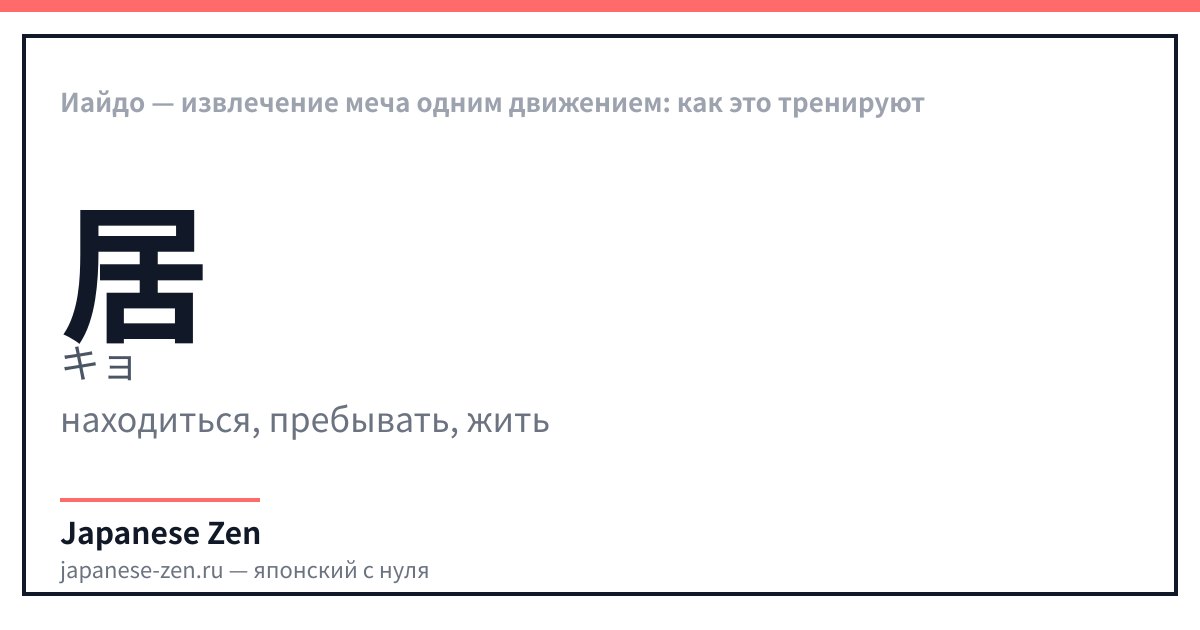
居 — значение: to be present, to reside, to live — онъёми: キョ、コ — кунъёми: い.る、お.る — 8 штрих(ов). 居 — "to be present, to reside": the first character in 居合 (iai) — literally "to meet [an opponent] while being [in place]". The same character appears in 住居 "dwelling" and 居間 "living room".
| Japanese | Reading | Translation |
|---|---|---|
| 居合道 | iaidō · iaidō | The way of instantly drawing the sword |
| 居合 | iai · iai | The technique of instantly drawing the sword |
| 抜き付け | nukitsuke · nukitsuke | The first strike simultaneous with drawing the blade |
| 納刀 | nōtō · nōtō | Returning the sword to the scabbard |
| 真剣 | shinken · shinken | A live, truly sharpened sword |
| 型 | kata · kata | A prescribed exercise form |
What the Name Literally Means
居合道 is read いあいどう: 居合 — "meeting in place" (居 "to be present" plus a form of 合う "to come together, to match"), 道 — "the way". The philosophy of iaido — resolving a confrontation with a single precise movement, without a prolonged fight — echoes the principle of the 16th-century swordsman Tsukahara Bokuden, founder of the Kashima Shinto-ryu school: the one who never had to draw his sword wins.
Listen to the words iaidō, nukitsuke, and shinken — the app will evaluate your pronunciation.
Iaido in Anime
Anime specifically about iaido as a sport are rare, but the very mechanic of instantly drawing the sword is a recognizable technique in stories about swordsmen.
- Rurouni Kenshin — Himura Kenshin's signature technique, battōjutsu, is built on the same mechanic of instant draw and strike as iaido, though in the story it is a combat technique of a school, not sport iaido.
- In games and films about samurai, the instant strike from the scabbard is usually shown as a spectacular climax of a duel — visually it is closer to iaido than to prolonged fencing.
FAQ
- What is iaido?
- Iaido (居合道) is the art of instantly drawing the sword from its scabbard while striking. Unlike kendo, it is trained solo through prescribed forms (kata) against an imaginary opponent, not in sparring with a live opponent and without direct physical contact with an opponent throughout the training.
- Who invented iaido and when?
- The technique of instantly drawing the sword is traced back to the 16th-century swordsman Hayashizaki Jinsuke Shigenobu. The modern term "iaido" was introduced in 1932 by master Nakayama Hakudo, repeating the transition from "jutsu" to "do" that had already occurred earlier with judo and later with kendo and kyudo.
- How is iaido training conducted?
- The practitioner performs kata one after another: drawing the sword with the nukitsuke strike, delivering the finishing kirioroshi cut, symbolically shaking off the blade (chiburi), and returning the sword to the scabbard (noto). There is no partner — only a prescribed sequence of movements, practiced to automaticity through long solo repetitions in the dojo.
- How is "iaido" written in Japanese?
- 居合道, read いあいどう. 居合 — "meeting in place": the technique of responding to a sudden threat when the sword is still in its scabbard. 道 — "the way". Training is done with an iaito — an unsharpened imitation sword, not a live blade (shinken), for safety reasons in solo practice without a partner.
- How does iaido differ from battodo and kendo?
- Battodo (抜刀道) emphasizes the cut itself — tameshigiri against a mat or bamboo — while iaido emphasizes the precision and beauty of the kata form. Kendo is not a solo practice at all: it is a contact duel with bamboo shinai in protective gear, not solo work with a blade.
- In which anime are there techniques similar to iaido?
- The closest is Himura Kenshin's battōjutsu in Rurouni Kenshin: the instant draw and strike is built on the same mechanic as iaido. Formally, however, it is a different technique: iaido has neither sparring nor a live opponent.
Sources
Updated: 2026-09-10