Budo — what the suffix "path" means in martial arts names
Budo (武道) literally means "martial way": an umbrella term for modern Japanese disciplines — judo, kendo, kyudo, iaido, aikido, karate-do — united not by fighting technique but by the idea of the way as long personal practice and character development. The suffix "-do" here is deliberately contrasted with "-jutsu" (bare technique): the first to rename it this way was Kano Jigoro, founder of judo, in 1882.
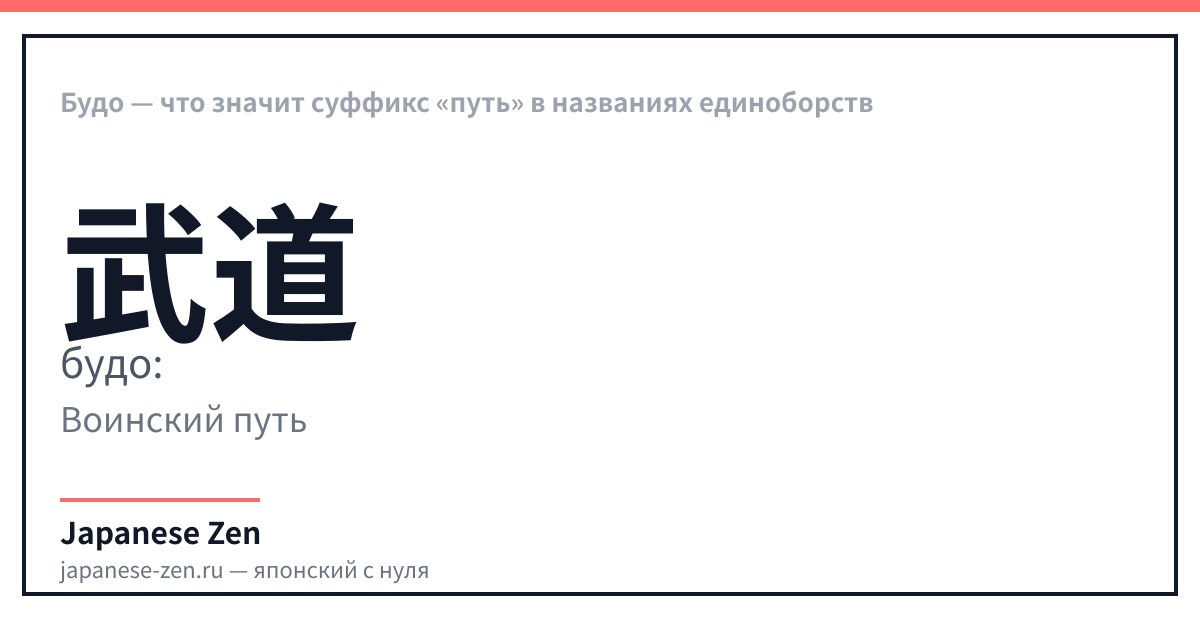
"Budo" in conversation is often confused with "bushido" — the ethics of the warrior class that disappeared in the 19th century. These are different words about different things: one about 20th-century disciplines, the other about a class that no longer exists.
What "budo" means
Budo (武道) literally means "martial way": 武 "military, martial" plus 道 "way". This is the name not for a specific art but for a whole category of modern Japanese disciplines — judo, kendo, kyudo, iaido, aikido, karate-do — united not so much by fighting technique as by the idea of the way as long personal practice and character development through the body. A working translation is "the martial way as a system of self-improvement", not "martial art" in the narrow sense.
How to translate this without losing the meaning
| Japanese | Reading | Translation |
|---|---|---|
| 武道 | budō · budō | Martial way |
| 武術 | bujutsu · bujutsu | Fighting technique, craft |
| 柔道 | jūdō · jūdō | The way of gentleness, judo |
| 空手道 | karatedō · karatedō | The way of the empty hand, karate-do |
| 合気道 | aikidō · aikidō | Aikido |
| 道 | michi · michi | Way, road |
武 and 道: the two characters that make up the concept
武 — значение: martial affairs, military, valor — онъёми: ブ、ム — кунъёми: たけ、たけ.し — 8 штрих(ов). 武 — "military, martial": the first character in 武道 (budo) and 武士 (bushi, warrior). The second character of the compound, 道 "way", is analyzed on the kyudo page.
What parts make up the character 武
The character 武 is often analyzed as a combination of 戈 "spear, halberd" and 止 "to stop": by this reading the character means not attack but "to stop weapons". Etymologists have doubts about the accuracy of this analysis — it is more folk etymology than strict reconstruction — but in budo circles it is retold eagerly: the idea itself fits well with the notion of a "way" rather than "war".
Write 武 along the guides — the character for "martial" that makes up the word "budo".
How "way" differs from "jutsu" in practice
The suffix 術 (jutsu) in names means technique, craft, applied skill — 剣術, 柔術, 弓術. The suffix 道 (dō) in kendo, judo, kyudo and aikido arose as a deliberate replacement: not just an effective technique, but a path of discipline followed throughout life. The first and most influential example was Kano Jigoro, founder of judo: in 1882 he renamed the inherited jujutsu as judo, explicitly contrasting the "path of education" with bare fighting technique. Other disciplines followed the model.
What the Japanese put into it, and what the West added
- Judo — from jujutsu, renamed by Kano Jigoro in 1882.
- Kendo — from kenjutsu, took shape by the 1920s as a school subject.
- Kyudo — from kyujutsu, the official term was fixed in 1919.
- Karate-do — from Okinawan tode, "do" was added in the 1930s when the art was brought to the mainland.
Common misconceptions about budo
- "Budo and bushido are the same thing." No: bushido (武士道) is the set of ideas about proper conduct of the warrior class that disappeared in the Meiji era. Budo (武道) is the disciplines that took shape in the 20th century as sport and a system of education. They share only the character 武; there is no direct continuity.
- "Budo is the same as bujutsu." The suffix distinguishes precisely the orientation: jutsu is an applied skill, do is a lifelong path, although in practice dojo students master both at the same time.
- "All modern budo are ancient." The disciplines themselves are a product of the late 19th and early 20th centuries; only the original fighting techniques from which the new system was assembled are ancient.
- "The Dai Nippon Butoku-kai still exists unchanged." The organization founded in Kyoto in 1895 to standardize budo was dissolved in 1946 by the occupation authorities; the modern federation with the same name is a postwar revival, not a direct continuation.
FAQ
- What does "budo" mean?
- Budo (武道) literally means "martial way". This is the name for modern Japanese disciplines — judo, kendo, kyudo, iaido, aikido, karate-do — united not by fighting technique but by the idea of long personal practice and character development through the body, not only through physical skill or victory.
- How does budo differ from bushido?
- Bushido (武士道) is the set of ideas about proper conduct of the warrior class that disappeared in the Meiji era. Budo (武道) is the disciplines of the 20th century: sport and a system of education through kendo, judo, kyudo and other ways. The words share only the character 武; there is no direct connection between them.
- How is "budo" written in kanji?
- 武道, read ぶどう. 武 — "military, martial", 道 — "way". The character 武 is sometimes analyzed as "to stop (止) weapons (戈)" — a disputed but popular interpretation precisely in budo circles, because it fits well with the idea of a way rather than conquest or war.
- How does "-do" differ from "-jutsu"?
- Jutsu (術) is technique, applied skill: kenjutsu, jujutsu, kyujutsu. Do (道) is the way as a system of education through long practice, not just a fighting technique. The first to make this replacement was Kano Jigoro, renaming jujutsu as judo in 1882; other disciplines followed the model.
- Which disciplines are included in budo?
- Most often named are judo, kendo, kyudo, iaido, aikido and karate-do — all of them went from "-jutsu" to "-do" in the late 19th and early 20th centuries. The list is not closed: it sometimes includes rarer modern disciplines with the same suffix.
- What is the Dai Nippon Butoku-kai?
- An organization founded in Kyoto in 1895 to standardize the scattered budo schools. It helped bring them to common rules and terminology, including the transition of names from "-jutsu" to "-do". It was dissolved in 1946 by the occupation authorities; the current federation with the same name is a postwar revival.
Sources
Updated: 2026-09-10