Kyudo — the way of the bow: what the ritual of a shot consists of
Kyudo (弓道) is Japanese archery as a martial way: judges and instructors evaluate the archer's form and inner state no less than the hit. A shot is divided into eight ritual phases — hassetsu, from the stance to holding the posture after the release. The bow itself is covered on a separate page; here it's about the technique and ceremony of shooting.
In kyudo there is the formula seisha seichū: — "a correct shot brings the hit by itself." It sounds like consolation for those who missed, but in fact it is a working principle of evaluation: form is judged more strictly than the result.
What kyudo is and what matters most in it
Kyudo (弓道) is Japanese archery as a martial way, not sport shooting for accuracy in its pure form. The archer's form and inner state are evaluated no less than the hit: in kyudo there is the formula seisha seichū (正射正中) — "a correct shot brings the hit by itself." Training takes place in dojo at federations; the bow itself, yumi, as an object is described separately — here it's about the technique and ceremony of shooting.
Why the hit is not the main criterion
- The archer's gear and clothing: the yugake glove on the right hand, kimono and hakama, obi belt.
- The target: mato, round, at a distance of about 28 meters for close-range shooting and up to 60 meters for long-range.
- Organization: the All Japan Kyudo Federation, the dan and kyū rank system — as in kendo and judo.
- Initial stage: shooting at a straw target makawara from close range before moving on to mato.
The eight phases of a single shot — hassetsu
- Ashibumi (足踏み) — the archer stands, placing the feet at the width of the arrow, marking the stance.
- Dōzukuri (胴造り) — aligning the torso and pelvis strictly above the feet.
- Yugamae (弓構え) — gripping the bow, nocking the arrow on the string, gaze on the target.
- Uchiokoshi (打起し) — raising the bow with the arrow above the head.
- Hikiwake (引分け) — spreading the arms: the left pushes the bow forward, the right draws the string to the ear.
- Kai (会) — the moment of full draw, a short pause before the release.
- Hanare (離れ) — releasing the string; the arrow leaves as if by itself, without a sharp jerk.
- Zanshin (残心) — the archer holds the posture and does not lower the bow, following the arrow with the gaze.
What happens after the release
After hanare the archer does not relax immediately: zanshin is a mandatory eighth phase, not just a dramatic pause. While the arrow flies and after it has reached the target, the archer holds the posture of spread arms for a few more seconds — this is how both the posture and the inner calm of the performance are checked.
弓道 — "the way of the bow": why it is no longer kyūjutsu
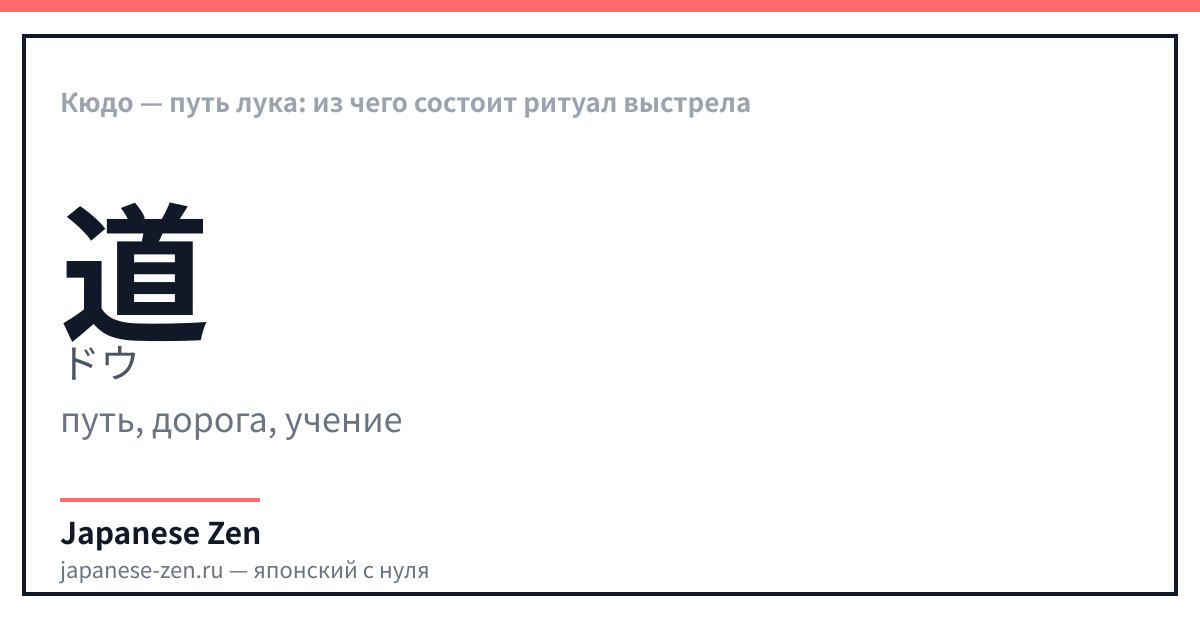
道 — значение: way, road, teaching — онъёми: ドウ、トウ — кунъёми: みち、いう — 12 штрих(ов). 道 — "way": the second character in 弓道 (kyudo), the same as in 剣道 "the way of the sword" and 茶道 "the way of tea." The first character of the combination, 弓 "bow," is covered on a separate page about the bow itself.
| Japanese | Reading | Translation |
|---|---|---|
| 弓道 | kyūdō · kyūdō | The way of the bow |
| 弓 | yumi · yumi | Bow |
| 矢 | ya · ya | Arrow |
| 的 | mato · mato | Target |
| 弦 | tsuru · tsuru | Bowstring |
| 袴 | hakama · hakama | Wide skirt-like trousers for training |
How 弓道 is read and what it literally means
弓道 is read きゅうどう: 弓 — "bow," 道 — "way." Before the term was officially established in 1919, the same practice was called kyūjutsu (弓術) — "the art of the bow"; the change of suffix reflects the same shift toward an educational discipline that occurred with kendo and judo.
Listen to the words kyudo, yumi, and hakama — the app will evaluate your pronunciation.
Kyudo in anime
Unlike kendo, kyudo has an anime built entirely around it, not just occasional appearances.
- "Tsurune" — an anime entirely about a school kyudo club: hassetsu, equipment, and ceremony are shown in detail and generally accurately.
- In other titles, kyudo is usually limited to a short shot of the dojo as a symbol of calm and focus — a separate plot about the ritual itself is almost never found.
FAQ
- What is kyudo?
- Kyudo (弓道) is Japanese archery as a martial way. The archer's form and inner state are evaluated no less than the hit: judges and instructors judge by the formula "a correct shot brings the hit by itself." The technique itself is divided into eight ritual phases — hassetsu.
- What is the point of the kyudo ritual if the hit is not the main thing?
- The ritual checks not only the result but also the path to it: posture, breathing, inner calm. The formula seisha seichū — "a correct shot brings the hit by itself" — means that precise technique over time yields a stable result by itself, not the other way around, which is why judges evaluate form.
- How does a shot in kyudo proceed step by step?
- A shot is divided into eight phases, hassetsu: from the ashibumi stance and aligning the body to raising the bow, drawing, the short pause kai, releasing the string hanare, and the final zanshin — holding the posture after the release. Each phase is evaluated separately by judges and experienced instructors of the school.
- How is "kyudo" written in Japanese?
- 弓道, read きゅうどう. 弓 — "bow," 道 — "way." Before 1919 the same practice was called kyūjutsu (弓術) — "the art of the bow"; the change of suffix to "dō" reflects the transition from a combat skill to a discipline of character training through a long daily ritual of precise shooting.
- Can a tourist try kyudo?
- Yes, in Japan and beyond there are clubs and one-off workshops for beginners with no experience. They start with shooting at a straw target makawara from close range — moving to the long-distance target mato takes months of regular training and mastering all eight phases of hassetsu.
- In which anime is kyudo shown?
- The closest to the real rules is "Tsurune," an anime entirely about a school kyudo club, where both hassetsu and the archer's equipment are shown in detail. In other titles, kyudo more often appears in the background, symbolizing a character's calm rather than a separate plot about the ritual itself.
Sources
Updated: 2026-09-10