Yumi — the Japanese Bow: Why the Samurai Had It Before the Katana
Yumi (弓) is the traditional Japanese bow: composite, made of bamboo and wood, about 221 cm long — one of the longest combat bows in the world. The grip is not at the center but about a third of the length from the bottom end — an asymmetry explained either by shooting from horseback or by the construction of the composite bow. Before the katana, it was the yumi that was the main weapon of the Japanese warrior.
In popular culture, the sword has long occupied the place of the main symbol of the samurai, although in the first centuries of the warrior class's existence, warriors were valued primarily for archery. The sword then was not the main weapon, but a backup.
What the yumi is and how it is made
Yumi (弓) is the traditional Japanese bow: composite, glued from bamboo and wood, about 221 cm long — one of the longest combat bows in the world relative to draw weight. Its main feature is asymmetry: the archer's grip is not at the center but about a third of the length from the bottom end. According to one version, this makes it easier to shoot from horseback without catching the horse's neck or saddle; according to another, it is easier to balance the uneven tension of a composite bow made from different types of wood and bamboo. Historians do not have a single opinion.
What it was carried for
- The string — tsuru (弦), traditionally of hemp or silk fiber, today more often synthetic.
- Arrows — ya (矢), fletched with feathers of birds of prey, with a yajiri tip.
- Bow material — glued layers of bamboo and wood; modern training bows are made of carbon and fiberglass.
- Grip — the hand holds the bow below the middle, hence the asymmetrical curve.
Why the samurai had a bow before the katana
In the military chronicles of the Heian and Kamakura periods, a warrior's skill was measured primarily by shooting from horseback — this was called the "way of the bow and horse" (弓馬の道). The archer Nasu no Yoichi, hero of The Tale of the Heike, became famous for shooting a fan on a pole from a rocking ship — the episode itself is legendary, but tied to the real naval battle of Yashima in the 12th century. Only later, when battles became foot and close-quarters, did the status of the warrior's main weapon pass to the sword.
What was carried together
| Feature | Yumi (弓) | Katana (刀) |
|---|---|---|
| When it was the main weapon | Heian–Kamakura, 9th–14th centuries: battle began with shooting | Muromachi–Edo, 15th century and later: battle came closer, the blade became more important |
| Hand work | Both hands occupied with drawing, asymmetrical grip | One- or two-handed grip, work of the wrist and body |
| Term for martial skill | 弓馬の道 kyūba no michi — "the way of the bow and horse" | 剣術/剣道 kenjutsu/kendo — took shape later |
| Status today | Ritual sport kyudo, Shinto rites | Symbol of the samurai in popular culture |
The Heian-era archer also carried a tachi sword — as a second, auxiliary weapon for close combat, not the other way around.
弓 — three strokes repeating the outline of a bow
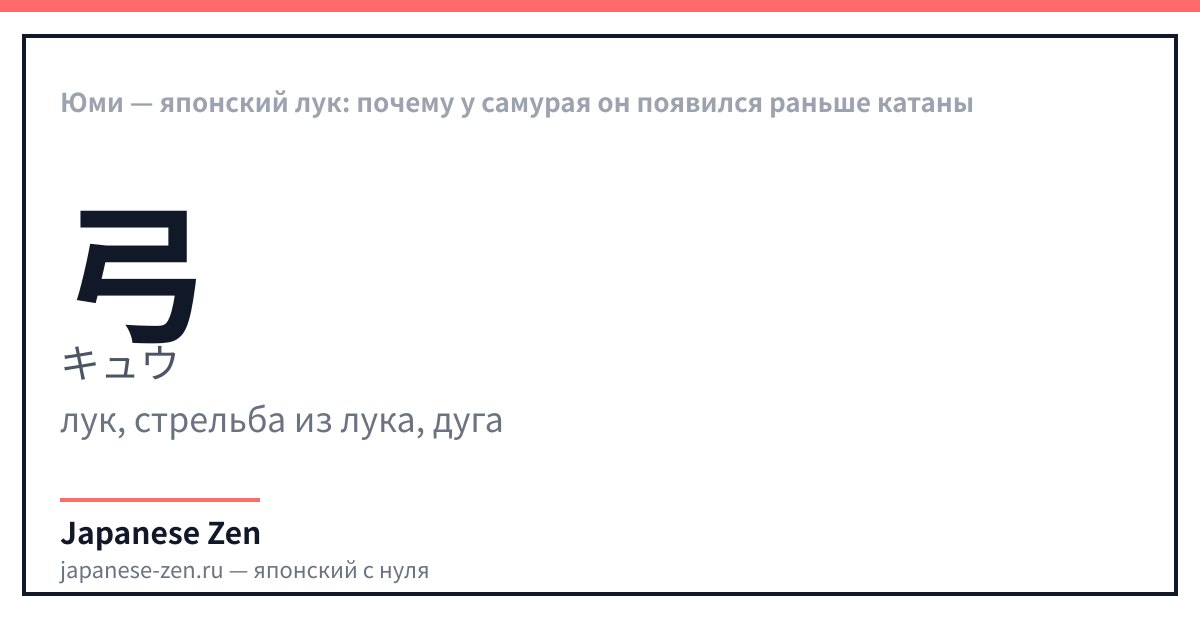
弓 — значение: bow, archery, arc — онъёми: キュウ — кунъёми: ゆみ — 3 штрих(ов). 弓 — "bow": three strokes, the sign itself resembles a curved bow with a string. The same sign is in 弓道 "the way of the bow" and 弓矢 "bow and arrows".
| Japanese | Reading | Translation |
|---|---|---|
| 弓 | yumi · yumi | Bow |
| 弓道 | kyūdō · kyūdō | The way of the bow, archery as a tradition |
| 矢 | ya · ya | Arrow |
| 弦 | tsuru · tsuru | Bowstring |
| 弓馬の道 | kyūba no michi · kyūba no michi | "The way of the bow and horse", the skill of the early warrior |
| 破魔矢 | hamaya · hamaya | New Year's arrow-amulet from Shinto shrines |
How it is read and what it means literally
弓 is read ゆみ and means simply "bow" — without additional meanings, unlike many other words about weapons. The bow also occupies an important place in Shinto rites: at New Year's fairs at shrines, hamaya (破魔矢) is sold — an amulet arrow "expelling evil", often accompanied by a decorative bow, hamayumi. The custom goes back to the same role of the bow as a weapon that drives away evil spirits, not only beasts or enemies.
Write 弓 along the guides — three strokes whose shape repeats a curved bow.
Yumi in anime and games
Where anime gets the physics wrong
- Inuyasha — the bow of Kagome, a miko archer whose spiritual arrows are tied to the Shinto tradition of shrine archery.
- Yona of the Dawn — the heroine masters shooting with a traditional bow as her main weapon over the course of the story.
- A common inaccuracy: anime usually draw the yumi as symmetrical, with the grip in the middle, like a European bow — whereas a real Japanese bow has the grip shifted toward the lower third.
FAQ
- What is the yumi bow?
- Yumi (弓) is the traditional Japanese bow: composite, glued from bamboo and wood, about 221 cm long. It is distinguished by asymmetry — the grip is shifted from the center toward the lower third. Before the katana became widespread, it was the yumi that was the main weapon of the Japanese warrior, and skill was measured by shooting from horseback.
- How does the yumi bow differ from the katana?
- The yumi is a long-range weapon of the Heian–Kamakura period, when a warrior's skill was measured by shooting from horseback ("the way of the bow and horse"). The katana became the main weapon later, when battles became close-quarters and on foot. The archer always carried a sword as an auxiliary weapon, not the other way around.
- How is "yumi" (bow) written in kanji?
- 弓, read ゆみ. The three strokes of the sign resemble a curved bow with a string. The same sign is in 弓道 "the way of the bow" (kyudo) and 弓矢 "bow and arrows", a stable designation of weapons in general in old military texts and chronicles of past wars.
- What was the yumi bow used for?
- As the main combat weapon of the early samurai, especially mounted archers of the Heian and Kamakura periods, when a warrior's skill was measured precisely by shooting from horseback. The bow was also used in Shinto rites — for example, the New Year's amulet arrow hamaya and the decorative bow hamayumi are still sold at shrines.
- How long is the yumi bow?
- The standard length of a traditional yumi is about 221 cm, which makes it one of the longest combat bows in the world relative to draw weight. This length is connected with the asymmetrical grip: the lower part of the bow is shorter than the upper, and the grip is shifted from the center toward the lower third.
- Which anime characters have a yumi bow?
- Kagome from Inuyasha is a miko archer with spiritual arrows tied to the shrine tradition. Yona from Yona of the Dawn masters the bow as her main weapon over the course of the story. Anime, however, often draw the bow as symmetrical, although a real yumi has the grip shifted from the center toward the lower third.
Sources
Updated: 2026-09-10