Odachi — the longest Japanese sword: what it looks like and how it differs from a katana
Odachi (大太刀) is a class of extra-long Japanese swords with a blade usually over 90 cm, and some surviving examples exceed two meters. Such a sword is almost impossible to wear at the waist, so it was carried on the shoulder or on the back. In the Edo period, authorities repeatedly restricted blade length by law, and some odachi were later shortened.
Odachi is not a combat standard but a rarity: such a blade was more often made for temple offerings or to demonstrate skill than for ordinary battle. The difference from the related term "nodachi" lies not in the weapon but in the word, and that is worth stating plainly.
What odachi is and what this sword looks like
Odachi (大太刀, "great tachi") is a general name for Japanese swords with a blade noticeably longer than a standard tachi or katana: usually from 90 cm, and the largest surviving examples exceed two meters. Exact figures for many legendary blades vary among sources. The handle is long and two-handed. Because of its size and weight, such a sword was not thrust through the belt: it was carried on the shoulder, on the back, or in the hands — sometimes an attendant carried the sword separately from the owner, who took it just before battle or a ceremony.
- The blade is noticeably longer than a standard tachi or katana, often with a more pronounced curve near the base.
- The handle (tsuka) is elongated for a two-handed grip.
- The scabbard is also long, sometimes with loops for carrying on a shoulder strap.
- The tang (nakago) is long, proportionate to the handle.
How much does an odachi weigh
The exact weight depends on length and period of manufacture and varies among sources based on surviving examples — it can run to several kilograms, which would be unmanageable for a one-handed weapon but is a working weight for a two-handed sword swung with full force. Figures like "ten or more kilograms" that sometimes appear online usually refer to legendary blades and are not confirmed by precise measurements — they should be treated as legend, not as a product specification.
What a tanto looks like — the shortest Japanese blade
At the other end of the scale is the tanto (短刀), a single-edged dagger with a blade usually up to 30 cm, without a long handle and with almost no curve. If an odachi needs reach and weight to cut from a distance, the tanto is designed for close-quarters action — as a personal or secondary weapon. The contrast is telling: the Japanese sword is not a single object but a range from "almost a halberd" to "a little more than a knife."
How odachi differs from katana and what makes it rare
| Feature | Odachi | Katana |
|---|---|---|
| Blade length | from 90 cm, large examples over two meters | about 60–73 cm |
| Grip | two-handed, handle elongated | usually two-handed, but handle shorter |
| How it was worn | on the shoulder, on the back, or in the hands; less often at the waist | thrust through the obi edge-up |
| When used | in the Middle Ages by mounted and foot soldiers; later as temple offerings and in ceremonies | as a samurai's everyday weapon |
What was carried alongside an odachi
An odachi was rarely the only weapon — a warrior using such a sword most often also carried a standard tachi or katana for close combat, in case the giant blade proved inconvenient at short range. Some surviving odachi were originally made not for battle but as temple offerings: their size was meant to impress, not to cut.
大太刀 — "great tachi": what the name says about length
大太刀 is read おおだち (odachi) — literally "great tachi": 大 means "great," 太刀 (tachi) means "sword," and it is an older word for a sword than 刀 (katana). The name directly indicates scale: it is not a separate type of blade but an enlarged version of one that already existed.
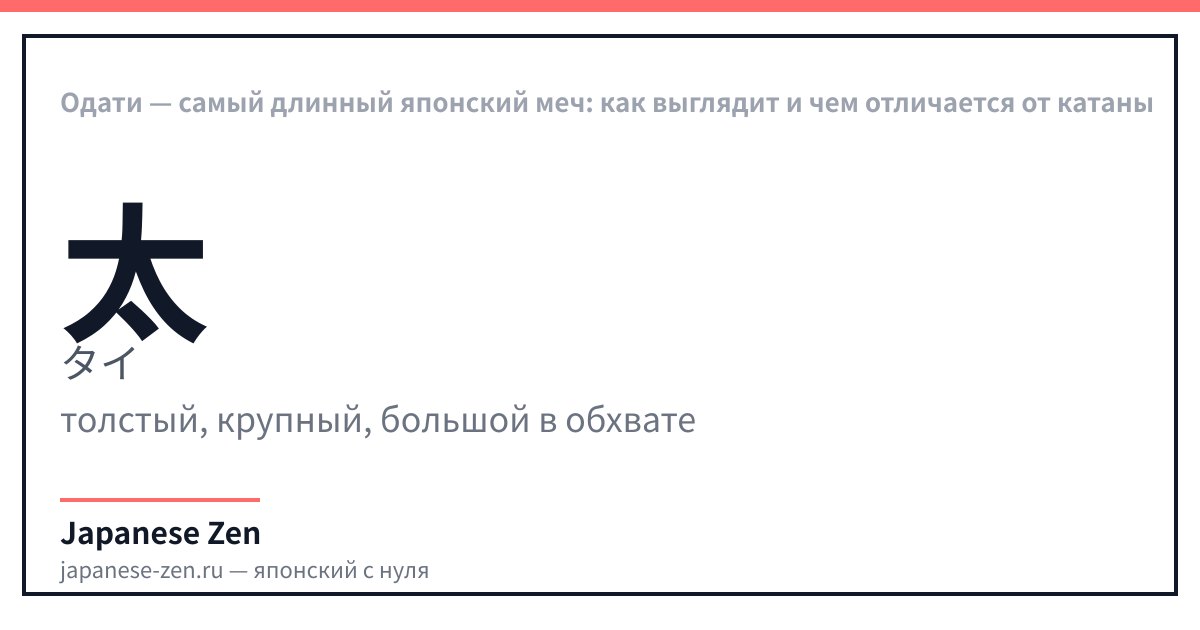
太 — значение: thick, large, big around — онъёми: タイ、タ — кунъёми: ふと.い、ふと.る — 4 штрих(ов). 太 — "great, thick": the same character appears in 太陽 (taiyō, sun) and in 太刀 (tachi, sword) — the basic word for a bladed weapon.
How it is read and what each character means
| Japanese | Reading | Translation |
|---|---|---|
| 大太刀 | ōdachi · ōdachi | great sword — a class of extra-long blades |
| 太刀 | tachi · tachi | sword (old word, predecessor of katana) |
| 太い | futoi · futoi | thick |
| 磨上げ | suriage · suriage | shortening of a blade |
| 刀鍛冶 | katanakaji · katanakaji | swordsmith |
Write 太 along the guides — the character for "great" from the name odachi.
Odachi in anime and games
Where fiction exaggerates the size
- In Nioh, the odachi is a separate weapon class with its own stance and sweeping strikes: a rare case where the term is used in a game appropriately.
- Oversized swords like Zabuza Momochi's "Kubikiribōchō" in Naruto visually evoke the image of an odachi, though it is an original invention, not a copy of a historical weapon.
- The genre of the giant fantasy sword in anime and games grew out of the real image of the odachi, but real blades rarely reached the sizes shown on screen.
FAQ
- What is an odachi?
- Odachi (大太刀) is a class of Japanese swords with a blade noticeably longer than a standard tachi or katana: usually from 90 cm, and large surviving examples exceed two meters. The handle is elongated for a two-handed grip, and because of its size the sword was carried on the shoulder or on the back rather than thrust through the belt.
- How much does an odachi weigh?
- The exact weight depends on the length of the specific blade and varies among sources based on surviving examples — usually it runs to several kilograms. The impressive figures of "ten or more kilograms" from the internet most often refer to legendary swords without precise measurements, so they should be treated as legend.
- How does an odachi differ from a katana?
- Primarily in length and method of carrying: an odachi blade is from 90 cm and up versus 60–73 cm for a katana, the handle is elongated for a two-handed grip, and it was carried on the shoulder or on the back because such a sword cannot be thrust through the belt. Odachi were used less often — as ceremonial or temple weapons, not everyday ones.
- What do the characters 大太刀 mean?
- The spelling is 大太刀, read おおだち. 大 means "great," 太刀 (tachi) is an older word for a sword that preceded katana. The name literally describes the essence of the object: an enlarged version of an already existing blade, not a separate type of weapon with its own construction.
- How does an odachi differ from a nodachi?
- Formally, almost not at all: many sources use both terms as synonyms for the same class of extra-long swords. "Odachi" more often emphasizes blade length, "nodachi" the method of carrying it on the back in the field. Japanese tradition never established a single rule for when to use one and when the other.
- What does a tanto look like compared to an odachi?
- A tanto (短刀) is a single-edged dagger with a blade up to 30 cm, almost without a curve and without a long handle: the opposite of an odachi in every parameter. If an odachi is designed for a sweeping strike from a distance, the tanto is for close-quarters action, as a personal or secondary weapon.
Sources
Updated: 2026-09-10