Kusarigama — the chain sickle: how it works and how it differs from the katana
Kusarigama (鎖鎌) is a Japanese weapon made of a sickle (kama) on a short handle and a chain with a weight at the end: the fighter used the chain to entangle the opponent's weapon at a distance, and the sickle to finish them up close. It was used in several samurai fencing schools as a rare auxiliary weapon, not a primary one. The image of the kusarigama as a "ninja weapon" took shape later, in 20th-century film and games.
The kusarigama's form is deceptive: the sickle is an ordinary farming tool, and the chain was long seen as a sideshow trick. Together they became a recognizable but rare weapon of several fencing schools, not standard equipment for secret agents.
What a kusarigama is and how it is built
A kusarigama consists of two parts: a short sickle (鎌, kama) with a curved blade on a wooden handle about 30–60 cm long, and a chain (鎖, kusari) attached at the base or the middle of the handle. At the free end of the chain is a metal weight, the fundō (分銅). Sources give different chain lengths — from two to four meters or more — and there was no single standard among schools. The chain was swung to entangle the opponent's weapon, while the sickle delivered a cutting strike at close range.
- Kama (鎌) — a sickle with a curved single-edged blade and a short handle.
- Kusari (鎖) — a chain attached at the base or the middle of the handle.
- Fundō (分銅) — a metal weight at the free end of the chain.
- Handle — wooden, short enough to control the sickle with one hand.
Who wielded this weapon and why
The kusarigama was studied in several Japanese fencing schools as an auxiliary rather than a primary weapon — usually alongside other disciplines such as sword or staff work. The fighter used the chain to entangle the opponent's weapon or arm from a distance, then finished with the sickle up close — a tactic requiring precise distance control and long training. The persistent association of the kusarigama with ninja took shape not in historical sources but in 20th-century adventure films and games.
What types of kusarigama exist
There is no strict typology of the kusarigama: schools differed in chain length, fundō weight, and which end of the handle the chain was attached to — at the blade base or the opposite end. Some used a longer, lighter chain for distance work, others a short, heavy one for close combat. These are variations within a single idea, not separate weapon types with their own names.
How the kusarigama differs from the katana and what was carried alongside
| Feature | Kusarigama | Katana |
|---|---|---|
| Length | sickle ~30–60 cm + chain 2–4 m (estimates vary) | blade ~60–73 cm, total length with handle about a meter |
| Grip | one hand on the sickle handle, the other controlling the chain | both hands on the sword handle |
| Where carried | at the belt or in a bundle, rarely visible | thrust through the obi edge-up |
| When used | as an auxiliary weapon paired with another | as the samurai's primary weapon |
What was carried alongside the kusarigama
The kusarigama was almost never the only weapon: a fighter who mastered it usually also carried a sword — a wakizashi or tantō — in case the chain and sickle failed at close range. Some schools combined the kusarigama with staff (jō) work within a single training program.
鎖鎌 — "chain and sickle": a name that simply lists the parts
鎖鎌 is read くさりがま (kusarigama) — literally "sickle (鎌) on a chain (鎖)," with no second meanings. The character 鎖 carries the meaning "chain, to lock," and 鎌 means "sickle"; both are used separately in everyday words, from 鎖国 "closed country" to the ordinary 鎌 "garden sickle."
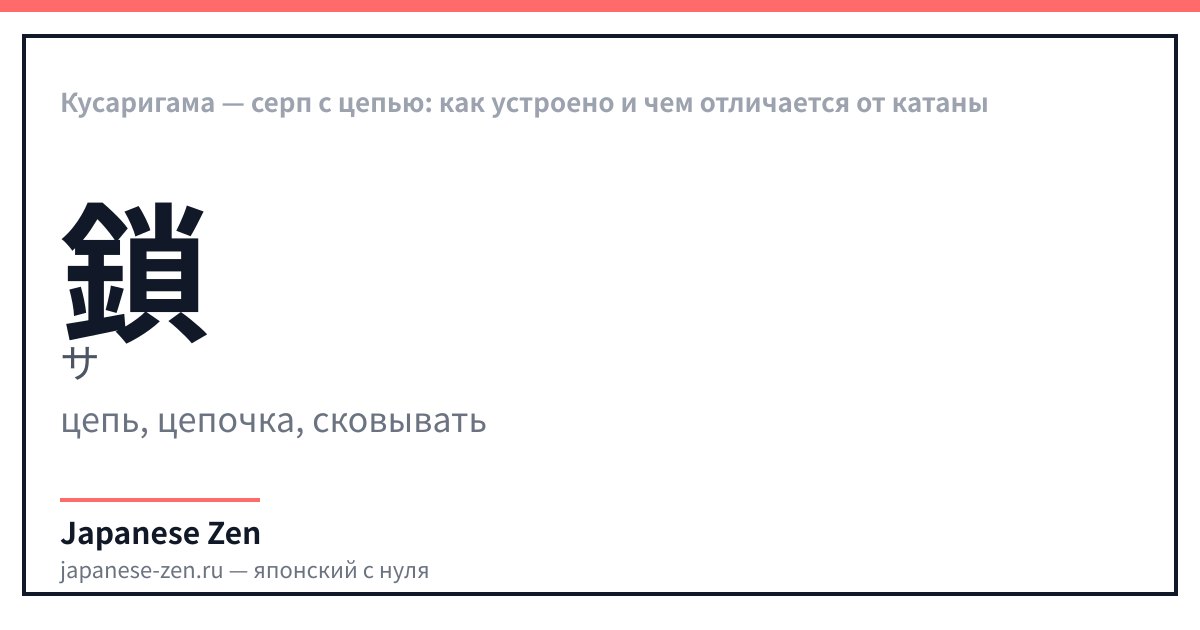
鎖 — значение: chain, link, to bind — онъёми: サ — кунъёми: くさり、とざ.す — 18 штрих(ов). 鎖 — "chain, to lock": the same character appears in 鎖国 (sakoku, the closed-border policy) and in 連鎖 (rensa, a chain connection).
How it is read and what each character means
| Japanese | Reading | Translation |
|---|---|---|
| 鎖鎌 | kusarigama · kusarigama | chain sickle |
| 鎖 | kusari · kusari | chain |
| 鎌 | kama · kama | sickle |
| 分銅 | fundō · fundō | weight at the end of the chain |
| 鎖鎌術 | kusarigama-jutsu · kusarigama-jutsu | the art of fighting with the kusarigama |
Trace 鎖 along the guides — the character for "chain" from the name kusarigama.
Kusarigama in pop culture: where the ninja-weapon image came from
What of this actually appears in games and anime
- Hidan from "Naruto: Shippuden" fights with a triple-bladed scythe on a rope — it looks visually similar to a kusarigama, but it is an original variation, not a copy of the historical weapon.
- In the game Nioh (Team Ninja, 2017), the kusarigama is a separate in-game weapon class with chain-grappling mechanics.
- The pairing "kusarigama = ninja weapon" took hold specifically through 20th-century film and games; historically, kusarigama-jutsu was taught in samurai fencing schools, not in secret clans.
FAQ
- What is a kusarigama?
- Kusarigama (鎖鎌) is a Japanese weapon made of a sickle (kama) on a short wooden handle and a chain with a metal weight at the end. Fighters swung the chain to immobilize an opponent's weapon or arm at a distance, then finished with the sickle up close. It was studied as an auxiliary weapon in several samurai fencing schools, not as a primary one.
- How does the kusarigama differ from the katana?
- The katana is a direct cutting weapon with a two-handed grip and a long blade, which a samurai carried as his primary weapon. The kusarigama is built differently: a short sickle plus a chain with a weight, requiring both hands to work differently — one controls the sickle, the other the chain. It is an auxiliary weapon that was almost always supplemented by a sword, not replaced by one.
- How is "kusarigama" written in kanji?
- The full form is 鎖鎌, read くさりがま. The character 鎖 means "chain, to lock," and 鎌 means "sickle"; both are also used separately in ordinary everyday words, such as 鎖国 (sakoku, "closing the country") and simply 鎌 as the name for a garden sickle.
- What types of kusarigama are there?
- There is no strict single typology: fencing schools differed in chain length (from about two to four meters or more by various estimates), the weight of the fundō at the end, and which edge of the handle the chain was attached to. These are variations of one idea within different traditions, not separate weapon types with their own names.
- Is it true that ninja used the kusarigama?
- There is little direct historical confirmation: kusarigama-jutsu is documented as being taught in samurai fencing schools as part of a broader curriculum, not as a separate art of secret agents. The persistent "ninja weapon" image took shape in 20th-century film and games and became far more firmly established in popular culture than in the sources.
- What was the kusarigama used for?
- As a rare auxiliary weapon paired with a primary one — usually a sword. The chain with a weight was used to entangle an opponent's weapon or arm from a safe distance, while the sickle delivered the decisive strike up close, when the opponent could no longer move freely. This tactic required precise distance control and long separate training.
Sources
Updated: 2026-09-10