Nodachi — the "field sword" and the confusion around its name
Nodachi (野太刀), literally "field sword," belongs to the same class of extra-long swords as the odachi, but the term emphasizes how it was worn: on the back or over the shoulder, not at the waist. Many sources use "nodachi" and "odachi" interchangeably, and this confusion is not a reader's mistake but a genuine divergence within Japanese tradition itself.
If for the odachi the main question is how long the sword can be, for the nodachi the main question is why one weapon has two names. The answer is straightforward: no single standard ever emerged for who called it what and when.
What "nodachi" means and how it was worn
Nodachi (野太刀) belongs to the same class of extra-long swords as the odachi: the blade is noticeably longer than a standard tachi, the hilt is two-handed, and the weight is designed for a sweeping cutting strike. The kanji 野 — "field, plain, wild" — points not to the shape of the blade but to the context of use: such a sword was associated with battle in open fields, not with ceremonial wear at court. It was worn differently from a katana or tachi: not thrust through the belt, but on a strap across the back or over the shoulder, from where it was drawn with both hands before combat.
- 野 (no) — "field, plain" — part of the name indicating the context of battle.
- 太刀 (tachi) — "sword," the same base as in 大太刀 (odachi).
- Method of wearing — on the back or over the shoulder, not at the waist.
- Grip — two-handed, with the hilt lengthened in proportion to the blade.
Why the terms "nodachi" and "odachi" get confused
Historically, 野太刀 and 大太刀 were not strictly separated: some sources link "nodachi" to an earlier context and to foot soldiers, while "odachi" is a word for the same class of weapon based on length alone, regardless of how it was worn. Modern dictionaries and museum catalogs often use both terms interchangeably for the same sword. If an article or a game calls a long Japanese blade sometimes "nodachi" and sometimes "odachi," that is not a translation error — the discrepancy is inherited from the language itself.
Who used the nodachi and when
Such swords are associated with the Muromachi and Sengoku periods, when foot soldiers, not only mounted warriors, took part in large battles: a long blade gave an advantage in reach against spears and other swords. The full picture of its combat use is hard to reconstruct — documentary descriptions are few, and some images come from later legends about specific warriors and their blades.
野太刀 — "field tachi": where the second name came from
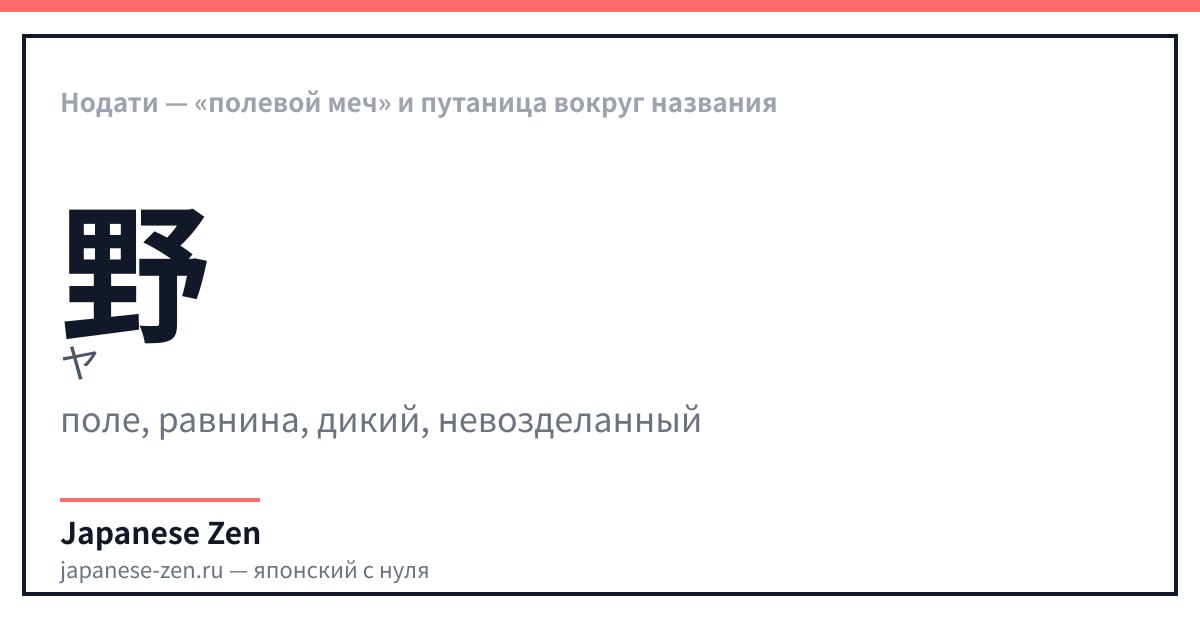
野太刀 is read のだち (nodachi): 野 — "field, wild, plain," 太刀 — "sword" (tachi). The same character 野 appears in everyday words like 野菜 (yasai, vegetables, literally "field vegetables") and 平野 (heiya, plain).
野 — значение: field, plain, wild, uncultivated — онъёми: ヤ、ショ — кунъёми: の、の- — 11 штрих(ов). 野 — "field, plain, wild": the same character in 野菜 (yasai, vegetables) and 平野 (heiya, plain).
How each character is read and what it means
| Japanese | Reading | Translation |
|---|---|---|
| 野太刀 | nodachi · nodachi | field sword — the same class as the odachi |
| 野 | no · no | field, plain |
| 太刀 | tachi · tachi | sword |
| 野菜 | yasai · yasai | vegetables |
| 平野 | heiya · heiya | plain, open field |
Write 野 along the guides — the "field" character from the name nodachi.
Nodachi in games: the same naming dispute
Where the term became established as a game weapon class
- In Elden Ring, extra-long blades were given their own class only in the Shadow of the Erdtree expansion — and it was called Great Katanas, not nodachi.
- In Nioh, essentially the same weapon class is called "odachi" — a direct illustration that for one phenomenon developers pick one term or the other.
- In "Naruto," certain characters fight with disproportionately long blades that visually evoke nodachi and odachi without being exact copies of historical weapons.
FAQ
- What is a nodachi?
- Nodachi (野太刀) — "field sword," a Japanese blade from the same class of extra-long swords as the odachi: long, two-handed, designed for a sweeping cutting strike. The name emphasizes the context of use — battle in open fields — and how it was worn: on the back or over the shoulder, not at the waist.
- How does a nodachi differ from an odachi?
- Formally, it is the same class of weapon under two names: some sources use the terms interchangeably, while others link "nodachi" to an earlier period and to wearing it on the back, and "odachi" to the sheer length of the blade. No single rule of separation became established in Japanese tradition.
- How does a nodachi differ from a katana?
- Primarily in length and grip: the nodachi blade noticeably exceeds 90 cm versus 60–73 cm for a katana, the hilt is lengthened for two hands, and it was worn over the shoulder or on the back, because thrusting such a sword through the belt like a katana is simply impossible.
- What characters are used to write nodachi?
- It is written 野太刀, read のだち. 野 means "field, plain, wild," and 太刀 (tachi) is an old word for sword. The literal meaning is "sword for the field," indicating the context of battle rather than a special blade shape.
- Why is the nodachi called a "field sword"?
- The character 野 in the name means "field, plain" and points to the context of use: such a sword was associated with open battlefields, not with ceremonial wear at court like the shorter tachi. This distinguishes the nodachi from the odachi, where the emphasis is on the length of the blade itself.
- How long is a nodachi?
- Its length matches the odachi — usually from 90 cm of blade, with some examples over two meters; there are no precise standard figures for the entire class of swords, as specimens varied greatly by era and maker.
Sources
Updated: 2026-09-10