Tachi — the sword worn edge-down: how it differs from the katana
The tachi (太刀) is a curved Japanese sword usually 70–80 centimeters long, used by mounted warriors of the Heian and Kamakura periods. Unlike the katana, the tachi was suspended from the belt on cords with the edge facing down, rather than thrust through the obi. This sword preceded the katana, and with the rise of foot combat in the Sengoku period it gave way to the katana as the samurai's primary weapon.
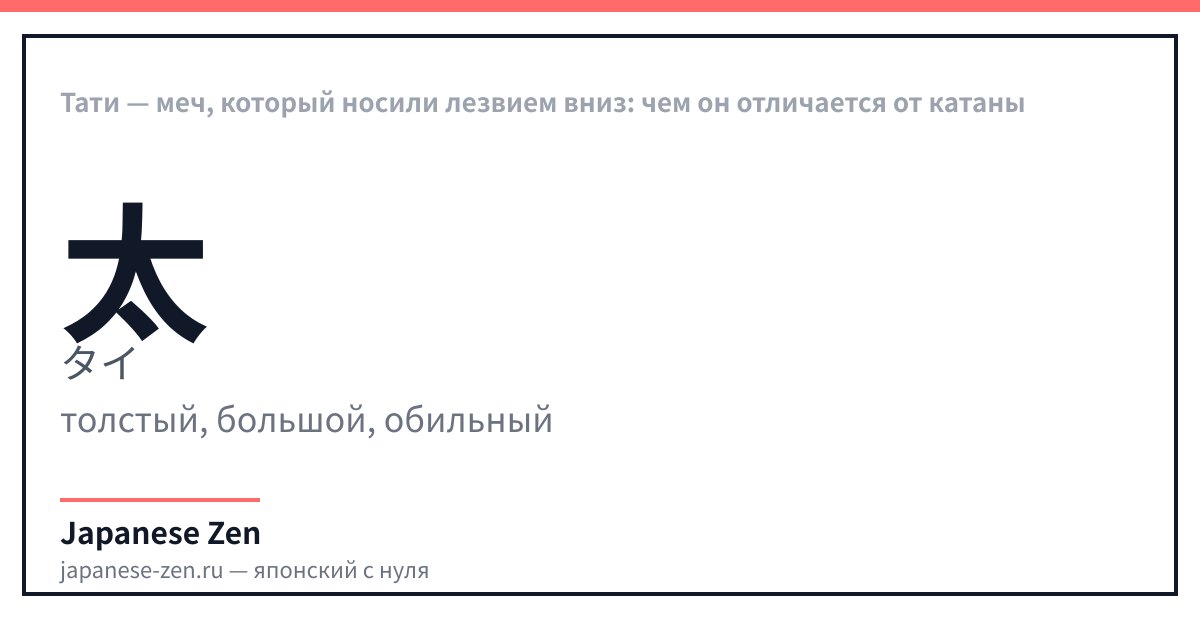
The tachi and the katana look alike, but they differ in how they were worn, where the deepest curve of the blade lies, and even which side of the tang the smith signed. Let's look at why an edge-down blade suited a mounted warrior, when the katana replaced the tachi, which surviving tachi is the most celebrated, and why its name uses the kanji 太 "big" instead of the earlier 大.
The tachi — a rider's sword suspended edge-down
The tachi (太刀) is a curved single-edged sword usually 70 to 80 centimeters long, formally from two shaku, that is, roughly from 60 centimeters. The curve of the blade is deepest near the hilt: this profile is called kosizori, "waist curve." It is a mounted warrior's weapon: the tachi appeared in the Heian period and remained the samurai's main sword through Kamakura and the Nanboku-chō period. It was worn on cords, suspended from the belt with the edge down — a way of wearing called 佩く (haku), as opposed to 差す (sasu) for the katana.
Why an edge-down position suited a rider better than edge-up
The explanation is usually practical: with this suspension, the tip of the scabbard did not strike the horse's rump at every step like a whip. Moreover, the rider held the reins in his left hand, and the tachi hung at his left hip — with the edge down, the blade was easier to draw in one motion of the right hand.
How the tachi differs from the katana and where to look for the smith's signature
| Feature | Tachi | Katana |
|---|---|---|
| How it was worn | edge down, on cords at the belt | edge up, thrust through the obi |
| When it was in use | Heian–Nanboku-chō, mounted combat | from the end of Muromachi and in Sengoku, foot combat |
| Deepest curve | closer to the hilt (kosizori) | shifted toward the middle of the blade |
| Where the smith's signature is | on the side facing outward when worn edge-down | on the opposite side of the tang |
How the smith's signature reveals what the blade originally was
The smith placed his signature (mei) on the side of the tang that faced outward, away from the body, when worn. On a tachi this is the side visible when suspended edge-down; on a katana it is the opposite side, because it is worn edge-up. Therefore the side of the signature on an unaltered blade immediately shows what kind of sword it was originally forged as.
The katana did not replace the tachi all at once. After the Ōnin War, toward the end of the Muromachi period and in the Sengoku period, combat became mass and on foot — with spears and arquebuses of the light ashigaru infantry — and the tachi, suspended at the belt, became inconvenient in such a crush. Many tachi of that time were shortened and remade into katana: such a conversion is called suriage.
Dōjigiri Yasutsuna — the most celebrated surviving tachi
Dōjigiri Yasutsuna (童子切安綱) is a tachi by the smith Yasutsuna of Hōki Province, Heian period. The blade is designated a National Treasure of Japan and is kept in the Tokyo National Museum.
The legend of the sword that cut down a demon
The name is connected with a legend: that the legendary commander Minamoto no Raikō used this blade to cut off the head of the demon Shuten-dōji on Mount Ōe. This is a legend, not a documented event — the name "Dōjigiri" itself became attached to the sword noticeably later than its creation, through layers of earlier names.
太刀 — why "big" rather than just "sword" on the tang
太 — значение: thick, big, abundant — онъёми: タイ、タ — кунъёми: ふと.い、ふと.る — 4 штрих(ов). 太 — "big, thick": the first character in the spelling 太刀 (tachi). The same kanji appears in 太陽 (taiyō, sun) and in 太鼓 (taiko, drum).
太刀 consists of 太 "big" and 刀 "sword," but the reading "tachi" itself is older than this spelling: the word is often traced to the verb 断つ (tatsu) — "to cut, to slice" — rather than to the meaning of the characters.
Why 太 and not 大: the unexpected history of the reading "tachi"
From the Nara period to the mid-Heian period, straight swords were written 大刀 or 横刀 — with the same reading "tachi," but with the character 大 "big." When blades became curved, according to a widely held view, to distinguish them from the earlier straight swords the character 大 was replaced by the similar-meaning 太, and the spelling 太刀 became fixed specifically for the new, curved swords.
| Japanese | Reading | Translation |
|---|---|---|
| 太刀 | tachi · tachi | tachi — a rider's sword, the predecessor of the katana |
| 太い | futoi · futoi | thick, big |
| 大刀 | tachi · tachi | an ancient spelling of the same word — for a straight sword |
| 佩く | haku · haku | to wear a sword suspended from the belt |
| 銘 | mei · mei | the smith's signature on the blade's tang |
| 磨上げ | suriage · suriage | shortening of a blade |
Write 太 along the guides — the character for "big" from the word "tachi."
FAQ
- What is a tachi?
- The tachi (太刀) is a curved Japanese sword usually 70–80 centimeters long, the weapon of a mounted warrior of the Heian and Kamakura periods. It was worn on cords, suspended from the belt with the edge down — this is the main difference from the katana.
- How does the tachi differ from the katana?
- Primarily in how it was worn: the tachi hung edge-down on cords, while the katana was thrust through the obi edge-up. On the tachi the deepest curve is closer to the hilt; on the katana it is shifted toward the middle of the blade, and the smith's signature on the tang is on different sides.
- Why was the tachi worn edge-down?
- According to one explanation, with this suspension the tip of the scabbard did not strike the horse's rump at every step. Moreover, the rider held the reins in his left hand, and the tachi hung at his left hip — with the edge down, the blade was easier to draw in one motion of the right hand.
- When did samurai switch from the tachi to the katana?
- The transition stretched over decades: after the Ōnin War, toward the end of the Muromachi period and in the Sengoku period, combat became mass and on foot, with spears and arquebuses of the light ashigaru infantry. The tachi, suspended at the belt, became inconvenient in such a crush, and the lighter katana replaced it.
- Which tachi is the most famous?
- Dōjigiri Yasutsuna — a Heian-period blade by the smith Yasutsuna, designated a National Treasure of Japan. It is kept in the Tokyo National Museum. The name is connected with the legend of the victory over the demon Shuten-dōji — this is a legend, not a fact of the sword's biography.
- How is "tachi" written in kanji?
- 太刀, read as たち. 太 means "big," 刀 means "sword," but the reading "tachi" itself is traced to the verb "to cut," not to the meaning of the characters. Before the appearance of curved blades, the same word was written 大刀, with the simpler character for "big."
Sources
Updated: 2026-09-15