Ninjato — the "ninja sword": did it really exist and how does it differ from a katana
The ninjato (忍者刀), or "ninja sword," is a straight, short blade with a large square tsuba that in movies is worn on the back rather than at the waist. No genuine old examples survive: historians consider this appearance an invention of 20th-century books and films. The Bansenshukai treatise describes the shinobi's armament differently — an ordinary but sturdy and wide wakizashi, without any special "ninja sword."
The screen image of a straight sword on the shinobi's back was invented not by medieval spies but by 20th-century directors and makers of museum replicas. We look at how the ninjato differs from the katana and wakizashi in length, curvature, and tsuba, what Edo-period treatises say about the shinobi's armament, and in which films the current look of the "ninja sword" took hold.
What a ninjato is and what it looks like
The ninjato (忍者刀), also called shinobigatana (忍刀), is what people call the "ninja sword": an almost straight blade (直刀) of a length between a katana and a wakizashi, a large angular tsuba, an elongated sageo cord, and matte scabbard with a sharp metal tip. A short straight blade cuts worse than a curved katana, so its advantage was at most in tight quarters — in a house or corridor. The main difficulty is elsewhere: not a single genuine old example has come down to us.
- The blade is straight or almost straight, without the pronounced curve of a katana; this shape is called chokuto (直刀).
- Length — between a katana and a wakizashi: the Japanese classify such swords as "long wakizashi."
- The tsuba is larger and more angular than on a katana.
- The scabbard is matte so it does not shine, with a sharp metal tip; the sageo cord is longer than usual.
What the shinobi actually armed themselves with
Neither the Bansenshukai (萬川集海, 1676) nor other treatises on ninjutsu describe any special "ninja sword." The Bansenshukai advises taking a thick and wide wakizashi, which is harder to break. The ninjato, however, is credited with a clever trick: prop the sword against a wall, stand on the large tsuba as on a step, then pull it up by the long cord. Skeptics note that the hilt and scabbard of such weight would not hold.
How the ninjato differs from the katana and wakizashi
| Feature | Ninjato (as it is shown) | Katana | Wakizashi |
|---|---|---|---|
| Blade | straight, without curvature (直刀) | curved | curved, shorter than a katana |
| Blade length | between a katana and a wakizashi | from 60 cm | from 30 to 60 cm |
| Tsuba | large, angular | round or oval, more compact | like a katana, more compact |
| How it was worn | in movies — on the back | thrust through the obi with the edge up | thrust through the obi next to the katana |
| Genuine examples | none survive | thousands in museums and collections | thousands in museums and collections |
Is it true that the ninjato is an invention
Swords called ninjato exist, but almost all of them were made after the Meiji era — for museums and tourist exhibitions. Treatises on ninjutsu do not mention such a sword, and for a spy posing as a peasant or merchant, a special sword would only get in the way. Some believe the image was inflated by Yamada Futaro's ninja novels, others that such swords were indeed forged as a secret sign of opponents of the shogunate. There is no definitive answer.
忍者刀 and 忍刀: two names for one sword
忍者刀 is read にんじゃとう (ninjatō) — "sword (刀) of the ninja (忍者)": a literal name with no second meaning. The second name is shinobigatana (忍刀), "sword of the shinobi"; the same spelling 忍刀 is also read as "ninto."
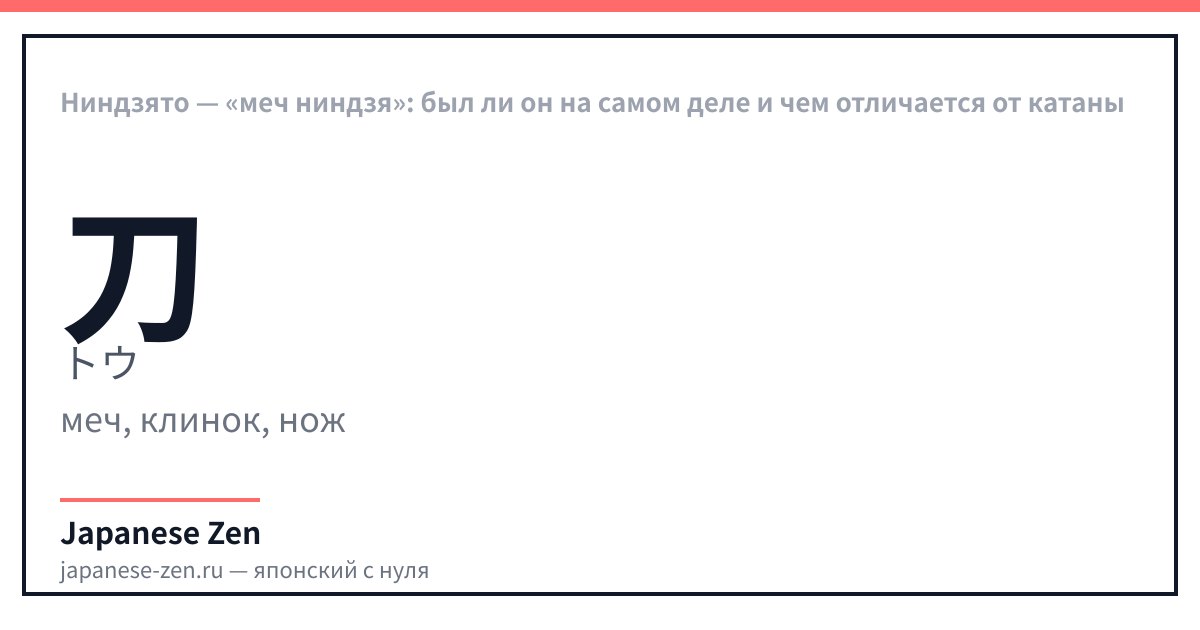
刀 — значение: sword, blade, knife — онъёми: トウ — кунъёми: かたな、そり — 2 штрих(ов). 刀 — "sword, blade": the last character in 忍者刀. On its own it is read かたな (katana), and in compound words — とう (tō), as in 日本刀 (nihontō) "Japanese sword" and 短刀 (tantō) "dagger."
忍者刀 syllable by syllable: にんじゃとう
| Japanese | Reading | Translation |
|---|---|---|
| 忍者刀 | ninjatō · ninjatō | "ninja sword" — the object itself |
| 忍刀 | shinobigatana · shinobigatana | second name, "sword of the shinobi" |
| 直刀 | chokutō · chokutō | "straight sword" — a blade shape without curvature |
| 鍔 | tsuba · tsuba | sword guard; on a ninjato it is large and angular |
| 脇差 | wakizashi · wakizashi | the short companion sword to the katana — according to treatises, the shinobi's weapon |
Write 刀 along the guides — the character for "sword," the last in the spelling of ninjato (忍者刀).
Ninjato in film: where this image came from
- 1956 — the first known photograph of a straight "ninja sword" appears in Okuse Heishichiro's booklet "Ninjutsu."
- "Shinobi no Mono: Kirigakure Saizo" (忍びの者 霧隠才蔵, 1964, director Tanaka Tokuzo, Daiei studio) — the fourth film in the "Shinobi no Mono" series, where such a sword is already on screen. In the same year the Iga-ryu Ninja Museum opened, displaying swords of this type made in the 20th century.
- "Enter the Ninja" (1981, director Menahem Golan, Cannon Films) — the first Hollywood film with a ninjato.
- "Revenge of the Ninja" (1983, director Sam Firstenberg, also Cannon Films) — the straight sword with a square tsuba becomes a cliché of ninja action films.
- "The Master" (1984, NBC) — the first American TV series with such swords.
What film invented about the ninja sword
In films the sword hangs on the back and flies out of its scabbard in one motion. A blade of that length cannot be drawn that way: from behind the back it is pulled with both hands, holding the scabbard, like a large odachi sword. Samurai wore the katana at the waist with the edge up — from there the sword is drawn faster. And the tube-scabbard through which a ninja breathes underwater does not work: for that they are too long.
FAQ
- What is the ninja sword called?
- The ninja sword is called ninjato (忍者刀) or shinobigatana (忍刀, "sword of the shinobi"): both words simply combine "sword" with "ninja" or "shinobi." The familiar image — a straight short blade with a large angular tsuba — took shape in 20th-century books and films, not in Sengoku-period sources.
- What is a ninjato?
- Ninjato is the name accepted today for the "ninja sword": a straight, almost uncurved blade, shorter than a katana, with a large angular tsuba. Not a single genuine old example of such a sword survives, and historians consider this appearance largely a 20th-century creation.
- How does the ninjato differ from the katana?
- The katana is a curved blade from 60 cm, which a samurai wore at the waist with the edge up. The ninjato, as it is shown, is an almost straight, shorter blade with a large angular tsuba; it cuts worse than a katana. Genuine katana number in the thousands; a genuine old ninjato — not one.
- How is "ninjato" written in kanji?
- 忍者刀 — three characters: 忍 "to endure, to hide," 者 "person," and 刀 "sword." The first two give the word 忍者 "ninja." The third is read here not as "katana" but as "tō": in compound words 刀 usually has the Sino-Japanese reading, as in 日本刀 (nihontō) "Japanese sword."
- What was the ninjato used for?
- According to the Bansenshukai treatise, the shinobi took not a special "ninja sword" but a thick and wide wakizashi, which is harder to break. The cinematic ninjato is credited with fighting in tight quarters and a tsuba-step for climbing a wall, but there are no genuine old swords on which to verify this.
- How long is a ninjato?
- There are no old examples, so there is no exact length either. Replicas are made with a length between a katana (blade from 60 cm) and a wakizashi (from 30 to 60 cm) — the Japanese classify such swords as "long wakizashi."
Sources
Updated: 2026-09-13