Bansenshūkai — the main ninja treatise: what is actually in it
The Bansenshūkai (万川集海) is the most famous treatise on ninjutsu: in 1676 Fujibayashi Yasutake compiled it, gathering the knowledge of the Iga and Koga schools into a 22-volume collection. The treatise deals not with combat techniques but with disguise, reconnaissance, equipment and weather signs, and it begins not with technique but with a section on the "correct heart" — the spy's ethics.
For three and a half centuries the Bansenshūkai has been considered the main compendium of ninjutsu, but most of its 22 volumes are not about fighting: they cover the spy's etiquette, weather, ciphers and equipment. Let's look at who wrote the treatise and when, what it consists of, and what its title means — the four kanji 万川集海, which the author himself explained in the preface.
Who compiled the Bansenshūkai and when
The Bansenshūkai was compiled in 1676 by Fujibayashi Yasutake, a country samurai from Iga, descendant of Fujibayashi Nagato, one of the "three upper houses" of Iga. The treatise brought together in one collection the knowledge of 49 ninjutsu schools of Iga and Koga — each of which had previously passed its secrets only within its own line — and divided the material into 22 volumes.
Why the Bansenshūkai is called the "bible of ninjutsu"
In Japan only three treatises of such detailed level survive: the Bansenshūkai (1676), the Shōninki (1681), and the Shinobi Hiden (忍秘伝) associated with the name Hattori Hanzō. They are called the "three great treatises of ninjutsu." Outside Japan, the Bansenshūkai has acquired the unofficial nickname "the bible of ninjutsu."
What the treatise consists of: not only weapons
The Bansenshūkai is divided into six substantive parts, not counting the introductory volume with the table of contents and preface:
- Seishin (正心, 2 volumes) — the moral qualities of a spy: loyalty, integrity, devotion to duty.
- Shōchiki (将知, 4 volumes) — what a commander must know to use spies correctly.
- Yōnin (陽忍, 3 volumes) — "open" infiltration: disguise and working under another's identity in broad daylight.
- Innin (陰忍, 5 volumes) — "secret" infiltration: night raids, climbing, evading guards.
- Tenji (天時, 2 volumes) — weather, time of day and celestial signs for planning a raid.
- Ninki (忍器, 5 volumes) — equipment: from hooks and torches to mizugumo for crossing water.
Why the treatise opens not with technique but with the "correct heart"
The first substantive section, Seishin (正心), is not about technique but about ethics: the treatise demands of a spy loyalty, integrity, devotion to duty and truthfulness before moving on to practice. The idea is that secret techniques in the hands of a person without a moral foundation are more dangerous than useful.
Who studies the Bansenshūkai today
What has come down to us are not so much Fujibayashi's own drafts as later copies of the treatise — they were made and kept in Iga and Koga, and one copy was presented to the shogunate in 1789 by descendants of the Koga warriors.
Japan's first academic degree in ninjutsu
Since 2018, at the graduate school of Mie University, where the International Ninja Research Center operates, it has become possible for the first time in Japan to defend a master's thesis in the field of "ninja and ninjutsu" — there they study, among other things, the texts of the Bansenshūkai. A complete modern Japanese translation of the treatise with commentary was published in 2015 by the researcher Nakashima Atsumi. The first complete English translation, "The Book of Ninja: The Bansenshukai" by Antony Cummins and Yoshie Minami, came out in 2013.
万川集海: how small rivers become a sea
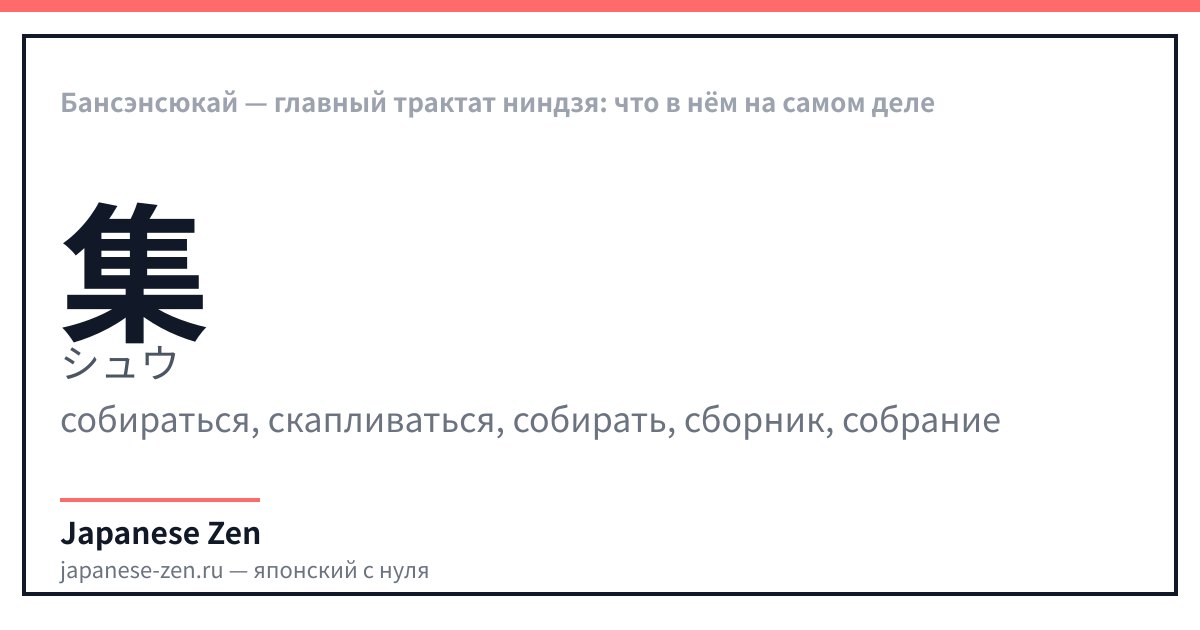
集 — значение: to gather, to accumulate, to collect, collection, gathering — онъёми: シュウ — кунъёми: あつ.まる、あつ.める、つど.う — 12 штрих(ов). 集 — "to gather": the last character before 海 "sea" in the title of the treatise. The same character appears in the ordinary words 集める (atsumeru) "to collect" and 全集 (zenshū) "complete works."
万川集海 is made up of 万川 "tens of thousands of rivers," that is, simply "many rivers," the character 集 "to gather," and 海 "sea." In the preface of 1676, Fujibayashi himself explained the meaning of the title: even small rivers, if gathered together, become a sea — just so the treatise brought together the scattered knowledge of different schools.
The same character 集 — in "complete works"
集 means "to gather, to accumulate" and appears in ordinary modern words: 集める (atsumeru) — "to collect" in everyday life, 全集 (zenshū) — "complete works" of some author. The meaning is the same — separate parts brought into one whole — whether for a bookshelf or for a treatise on ninjutsu.
| Japanese | Reading | Translation |
|---|---|---|
| 万川集海 | Bansenshūkai · Bansenshūkai | Bansenshūkai — the title of the treatise |
| 集める | atsumeru · atsumeru | to collect — the ordinary meaning of the character 集 in everyday life |
| 全集 | zenshū · zenshū | complete works |
| 正心 | seishin · seishin | "correct heart" — the first substantive section of the treatise |
| 忍器 | ninki · ninki | the spy's equipment — the last section of the treatise |
| 忍術 | ninjutsu · ninjutsu | the art to which the whole collection is devoted |
Write 集 along the guides — the character "to gather" from the title of the Bansenshūkai (万川集海).
FAQ
- What is the Bansenshūkai?
- The Bansenshūkai (万川集海) is the most detailed surviving treatise on ninjutsu: a 22-volume collection compiled in 1676 based on the knowledge of the Iga and Koga schools. It contains not so much combat techniques as the rules of disguise, reconnaissance, stealth movement and the spy's equipment.
- Who wrote the Bansenshūkai and when?
- The treatise was compiled in 1676 by Fujibayashi Yasutake, a country samurai from Iga province, descendant of Fujibayashi Nagato. He brought together in one collection the knowledge of 49 ninjutsu schools of Iga and Koga, each of which had previously passed its secrets only within its own line.
- What is written in the Bansenshūkai?
- The treatise consists of six sections: the spy's ethics, knowledge for a commander, "open" and "secret" infiltration, weather and time signs for planning a raid, and equipment — from hooks to mizugumo for crossing water. The collection begins not with technique but with a section on moral qualities.
- Is the Bansenshūkai available in English?
- The first complete English translation — "The Book of Ninja: The Bansenshukai" by Antony Cummins and Yoshie Minami — came out in 2013.
- What does the title Bansenshūkai mean?
- Literally — "tens of thousands of rivers gathering into the sea." This is how the compiler of the treatise himself explained the title in the preface of 1676: small rivers, gathered together, become a sea — just so the treatise brought together in one collection the scattered knowledge of the Iga and Koga schools.
- How is Bansenshūkai written in kanji?
- 万川集海, read ばんせんしゅうかい. The character 集 — "to gather" — is the same as in the ordinary word 集める "to collect" or in 全集 "complete works." This character conveys the very idea of the book, in which the knowledge of 49 schools is brought together.
Sources
Updated: 2026-09-15