Mizugumo — the ninja "water spider": did they really walk on water?
Mizugumo (水蜘蛛) is a piece of gear from the Bansenshukai: a round float about 62 cm in diameter that, according to legend, let ninja walk on water as if on dry land. In reality, you cannot stand on such a float: historians suggest that users sat on the mizugumo and paddled like a raft, or used it as a snowshoe for marshy ground.
The image of a ninja running across a pond's surface migrates from one anime to another, but it has a very real primary source — a drawing in the Bansenshukai with exact dimensions. Let's look at what is actually depicted there, why literally walking on water is physically impossible, and what a real spider with the same name — one that truly lives underwater — has to do with it.
What is depicted in the Bansenshukai
In the equipment section of the Bansenshukai (万川集海, 1676) there is a drawing of the mizugumo with a size indicated — about 62 cm in diameter — but not a single word on how to use it. For a long time this remained a mystery: only in another old document was a note found saying "sit on the central board," which became the basis for the modern interpretation.
How historians interpret the drawing in the treatise
According to one interpretation, users sat on the mizugumo like a small raft and paddled with their feet in special "water paddles" — this left their hands free for a bow or gun. According to another, the device was kept not for open water but for marshy shores or swamps, so that a foot would not sink into the mud and could quickly find a wide support, like a snowshoe. Both interpretations are reconstructions, not direct instructions from the treatise.
The myth of walking on water: where it came from
The popular image is simpler: wooden geta with four folding float rings around the sole, in which a ninja supposedly strode across a pond's surface as if on dry land. It looks beautiful, but by the laws of physics a piece of wood the size of a shoe does not create enough buoyancy to support an adult, and an enlarged version becomes so unstable that it is impossible to stand on without a supporting pole.
How a pond is crossed in competitions
Modern demonstrations confirm this. At the All-Japan Ninja Championship held by the Koka Ninjutsu Village (甲賀の里忍術村), contestants cross a pond on mizugumo so large that they have to spread their legs wide, and even then they use a staff for balance — without support, it is impossible to stay upright on the water.
Other water gear and the real underwater spider
Immediately after the mizugumo, the equipment section of the Bansenshukai describes 水掻き (mizukaki) — "water paddles": these were worn on the feet for paddling. The treatise also describes a variant of the mizugumo from "another school" — an inflatable float made of bamboo or baleen, covered with leather and lacquered: it was inflated through a tube and tied under the belt so one could swim rather than walk.
The real mizugumo lives underwater, not on it
The ninja gear has a full namesake in the natural world — the diving bell spider (ミズグモ, Argyroneta aquatica), the only spider species in the world with a fully underwater lifestyle. It builds a dome of silk underwater, fills it with air from the surface, and eats its prey there. In Japan it was first found in 1930 in Midorogaike Pond in Kyoto, and today the country's environment ministry lists the species as vulnerable.
水蜘蛛: the spider that keeps you on the water
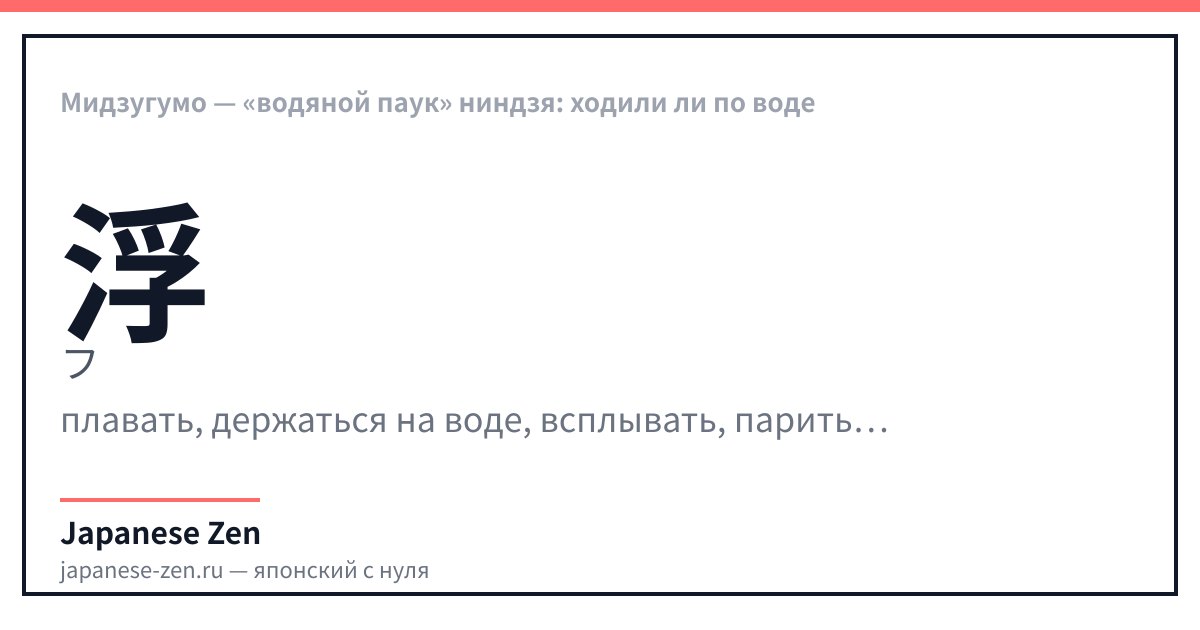
浮 — значение: to float, to stay on the water, to rise to the surface, to hover, frivolous, changeable (figurative) — онъёми: フ — кунъёми: う.く、う.かれる、う.かぶ、う.かべる — 10 штрих(ов). 浮 — "to stay on the water": it is not part of the word 水蜘蛛 itself, but it describes its function — the very reason mizugumo were made. The same character appears in 浮く (uku), "to float, not sink," and in 浮世 (ukiyo), "the fleeting, transient world."
水蜘蛛 is composed of 水 "water" and 蜘蛛 "spider" — both characters 蜘 and 蛛 almost never appear separately in modern Japanese, only together as "spider." For this topic, the character 浮 is more important, even though it is not part of the word itself: it conveys the very idea of the gear — staying on the surface of the water rather than sinking.
浮世 — the "floating world" and ukiyo-e prints
The word 浮世 (ukiyo) was once written as 憂き世 — "sorrowful, vale-of-tears world" in the Buddhist sense. Later, under the influence of a Chinese expression about the "impermanent world," the spelling shifted to 浮き世, "floating world," and in the Edo period the meaning shifted toward earthly pleasures of the moment. Hence 浮世絵 (ukiyo-e), "pictures of the floating world," Japanese woodblock prints about the fleeting joys of city life.
| Japanese | Reading | Translation |
|---|---|---|
| 水蜘蛛 | mizugumo · mizugumo | mizugumo — the gear and the real spider with the same name |
| 水 | mizu · mizu | water |
| 蜘蛛 | kumo · kumo | spider |
| 浮く | uku · uku | to float, to stay on the surface |
| 浮世 | ukiyo · ukiyo | fleeting, transient world |
| 水掻き | mizukaki · mizukaki | "water paddles" for the feet — another item from the Bansenshukai |
Trace 浮 along the guides — the character for "to stay on the water," which explains the very idea of the mizugumo (水蜘蛛).
FAQ
- What is a mizugumo?
- Mizugumo (水蜘蛛) is a piece of gear from the Bansenshukai (1676): a round float with a diameter of about 62 cm as stated in the text, intended for crossing water or marshy ground. How exactly it was used is not described in the treatise itself — historians reconstruct its use from indirect sources.
- Could ninja walk on water?
- No: floats the size of a shoe cannot support a person, and on a large ring you cannot keep your balance while standing without a supporting pole. It is more likely that users sat on the mizugumo and paddled like a small raft, or used it as a snowshoe for marshy ground.
- What did the mizugumo look like in the treatise?
- In the Bansenshukai it is drawn as a round float ring about 62 cm in diameter — probably made of light wood. The treatise also describes a second variant from "another school": an inflatable float made of bamboo or baleen, covered with leather, which was inflated through a tube and tied under the belt so one could swim.
- What was the mizugumo actually used for?
- The most likely interpretation is that the user sat and pushed off the water with their feet in special "water paddles" (水掻き), which are described in the treatise right after the mizugumo, leaving the hands free for a bow or gun. The second interpretation is that it was a device for stable walking on marshy, sticky ground rather than on open water.
- Why was it called a "water spider"?
- The name 水蜘蛛 literally means "water spider" — probably from its resemblance to a spider's legs spread out to the sides when the device is viewed from above. The same name 水蜘蛛 (ミズグモ) is borne by a real spider species, Argyroneta aquatica — the only spider in the world that lives entirely underwater.
- How is "mizugumo" written in kanji?
- 水蜘蛛, read as みずぐも. 水 means "water," and 蜘蛛 means "spider"; both characters 蜘 and 蛛 almost never appear on their own in modern Japanese, only together. The meaning of the device is conveyed by the character 浮, "to stay on the water," although it is not part of the word itself.
Sources
Updated: 2026-09-15