Hori — the moat of a Japanese castle: water, dry, and filled in at Osaka
Hori (堀) is the moat of a Japanese castle, which kept attackers from getting right up to the walls. A distinction is made between the water moat (水堀), common for flatland castles, and the dry moat (空堀) — for earlier mountain fortresses, where moats were often cut straight across the ridge. The most famous example of its role is Osaka Castle: the moats were filled in under the 1614 truce, and the fortress fell the very next summer.
A moat rarely makes it onto postcards, but it, rather than the thickness of the walls, most often decided the outcome of an assault on a Japanese castle. Let's look at how a water moat differs from a dry one, why in mountain fortresses a moat was cut across the ridge itself, and how one phrase about the filled-in moat of Osaka Castle became a saying about depriving a rival of protection.
Water and dry moat: the choice depended on place and era
A hori kept attackers from simply approaching the wall: a wide moat with a muddy bottom or steep slopes held up people and ladders under fire from the defenders. Earlier mountain castles more often made do with a dry moat (空堀) dug right into the slope — there was simply nowhere to bring water from.
Why flatland castles switched to water
With the spread of firearms and the relocation of castles to the plains, the water moat (水堀) became the main type: a wide band of water kept enemy cannons and muskets at a distance better than a dry ditch.
Outer, inner moat, and a moat across a mountain ridge
A flatland castle usually had several moats, one ring inside another: the outer moat (外堀) encircled the town and outer compounds, the inner one (内堀) — only the honmaru and ninomaru at the very center. The closer to the tenshu, the harder it was to get in, even if the outer defensive ring had already fallen.
Horikiri — a moat that cuts a mountain in half
In mountain castles, where water was unavailable and the terrain itself served as defense, the ridge was often cut across by a transverse moat (堀切). After that, it was impossible to climb along the narrow ridge path without first descending into the ditch itself under fire.
How "filling in the moat" became a saying about stripped protection
In the winter of 1614–1615, the troops of Tokugawa Ieyasu could not take Osaka Castle by storm and concluded a truce, one of the conditions of which was filling in the outer moat. In fact, not only it but also the inner moat was filled in — and the following summer the poorly defended fortress fell in a new assault.
What the phrase means today
Since then, the expression "to fill in the outer moat" (外堀を埋める) has been used far beyond military history. It refers to any indirect groundwork: securing the support of a person's or organization's circle before approaching them directly with the main question.
The "moat" character in castle names and Japanese surnames
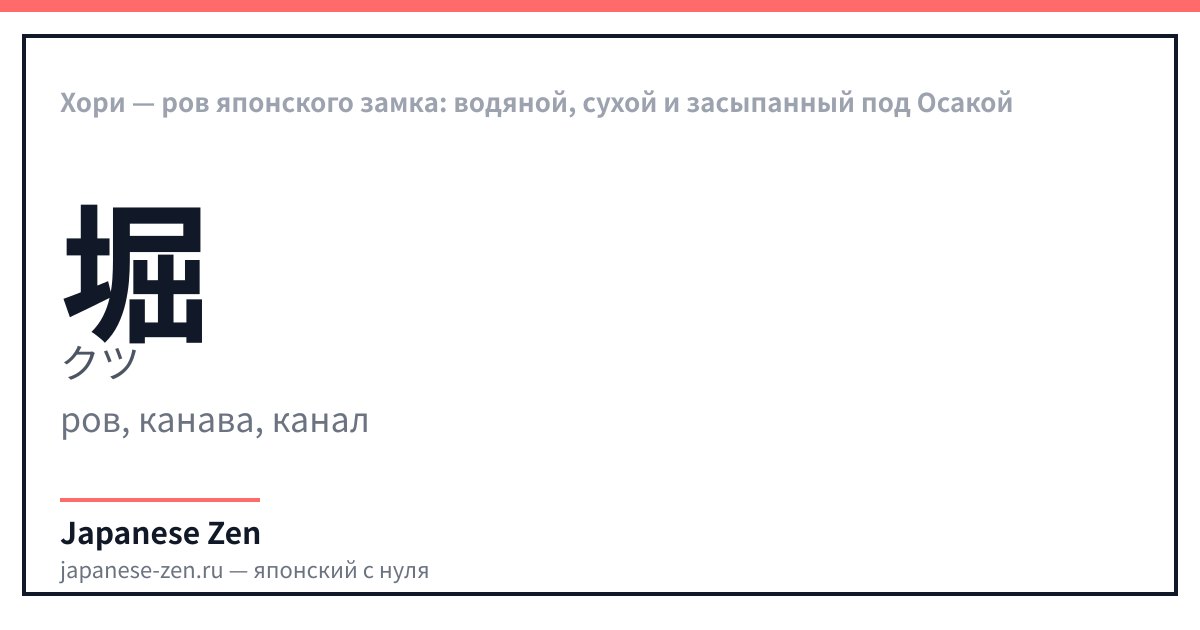
堀 — значение: moat, ditch, canal — онъёми: クツ — кунъёми: ほり — 11 штрих(ов). 堀 — the character for "moat" itself: 11 strokes, the topic of this page.
Kun reading and a familiar surname
堀 is read with the kun reading ほり (hori), both as a standalone word and as part of surnames — for example, in the surname Horio: that was the name of Horio Yoshiharu, who built Matsue Castle. In the names of castle structures, the same character almost always comes second — 外堀, 内堀, 空堀 — and becomes voiced as "-bori".
| Japanese | Reading | Translation |
|---|---|---|
| 堀 | hori · hori | Moat — as a standalone word |
| 水堀 | mizubori · mizubori | Water moat — the usual type for flatland castles |
| 空堀 | karabori · karabori | Dry moat without water |
| 外堀 | sotobori · sotobori | Outer moat of a castle |
| 堀切 | horikiri · horikiri | A moat cutting across a mountain ridge in a mountain castle |
Write 堀 along the guides — the character for moat, without which no Japanese castle could have stood.
FAQ
- Why did a Japanese castle need a moat?
- The moat, hori, kept the enemy from getting right up to the walls under fire from the defenders: a wide ditch with a muddy bottom or water held up people and siege ladders. Flatland castles usually filled their moats with water, while mountain castles more often left them dry — the terrain already made climbing difficult.
- How does a water moat differ from a dry one?
- A water moat (水堀) is filled with water and is typical of castles on the plain, where water can easily be brought from a river or lake. A dry moat (空堀) is simply a deep ditch without water, characteristic of earlier mountain fortresses, where there was nowhere to get water.
- What is a horikiri and where was it dug?
- A horikiri (堀切) is a moat that in a mountain castle cuts across the ridge itself, rather than surrounding buildings along the perimeter. It prevented passage along a narrow mountain path, forcing attackers to descend into the ditch under fire from the defenders.
- Why do people say "fill in the outer moat"?
- The expression goes back to the truce in the winter of 1614–1615: under its terms, the outer moat of Osaka Castle was filled in, and the inner one along with it — and without moats the fortress fell in the very next assault. Today it refers to any indirect groundwork before the main business.
- How many moats did a Japanese castle have?
- It varied: large flatland castles had moats in rings around each compound — the outer one around the town and outer structures, the inner one around the honmaru and ninomaru at the center. Small mountain fortresses often made do with one or two moats or transverse horikiri on the ridge.
- How is "hori" written in kanji?
- 堀, read ほり (hori): a single character meaning "moat, ditch." In combinations it often becomes voiced as "-bori" — 水堀 (mizubori), 空堀 (karabori), 外堀 (sotobori); the same character also appears in Japanese surnames, for example Horio.
Sources
Updated: 2026-09-15