Ishigaki — the stone walls of a Japanese castle: how they are used to date the walls
Ishigaki (石垣) is the stone base of a Japanese castle, not the island of Ishigaki in Okinawa, which uses the same kanji. Japanese castle masonry went through three stages of stone processing: first unworked boulders, then stones with chipped edges, and finally perfectly fitted blocks without a single gap. The tighter the stone is fitted, the later, as a rule, the wall was built — this is how historians roughly date the structures.
A Japanese castle wall is held together not by mortar but by the precision of the fit: dry masonry flexes during an earthquake instead of collapsing. Let's look at the three methods of laying stone, the Anō-shū craftsmen who were called to the country's most important construction sites, and the famous fan-shaped curve of the wall that makes it almost impossible to climb.
Why a castle needs a stone base, not just wooden walls
Ishigaki is not the island of Ishigaki in Okinawa, written with the same characters 石垣, but the stone base of a Japanese castle: on it stand the tenshu, yagura, and walls, and the stone itself is laid without mortar, in dry masonry. Such a wall not only supports the weight of the buildings but also drains rainwater through the gaps between the stones, and its steepness prevents attackers from climbing up.
Why the masonry was not held together with mortar
Dry masonry is more flexible than cement: during an earthquake the stones shift slightly relative to each other and absorb the shock, rather than cracking as a single piece. That is why the ishigaki of many castles have stood for centuries, although the strongest shocks can bring them down too — as at Kumamoto in 2016.
Three methods of stone processing — and how they reveal the age of a wall
| Method | How the stone is processed | When it was used |
|---|---|---|
| Nozura-zumi (野面積み) | Unworked boulders and broken stone of arbitrary shape | Sengoku period, until the early 17th century |
| Uchikomi-hagi (打込接ぎ) | Protruding edges are chipped off and fitted more tightly, gaps are smaller | After the Battle of Sekigahara in 1600 |
| Kirikomi-hagi (切込接ぎ) | Stone is cut into even rectangles, almost no gaps | From the early 17th century, especially in the 1620s |
Why the masonry can suggest the age of a wall
The three methods replaced one another as craftsmen learned to cut stone more precisely, so rough nozura-zumi is usually older than neat kirikomi-hagi. This is only a general rule, not precise dating: a castle was often expanded and repaired over decades, and a single wall may contain masonry from different eras.
The Anō-shū craftsmen and the fan-shaped wall
The Anō-shū (穴太衆) were hereditary stonemasons from the village of Anō on the western shore of Lake Biwa, who served Enryaku-ji temple on Mount Hiei. They gained nationwide fame for building the walls of Azuchi Castle for Oda Nobunaga in the late 1570s, after which the craftsmen were invited to construction sites in other provinces, all the way to Edo.
The fan-shaped curve that makes it impossible to climb up
Many walls were built not in a straight line but with an increasing slope: at the bottom a gentle rise, closer to the top an almost vertical wall. This curve is called the 'fan slope' (扇の勾配) for its resemblance to an open fan or the slope of a temple roof. The most famous example is the walls of Kumamoto Castle, which because of this technique were nicknamed 'walls that throw back warriors'.
The enclosure that holds up the entire castle
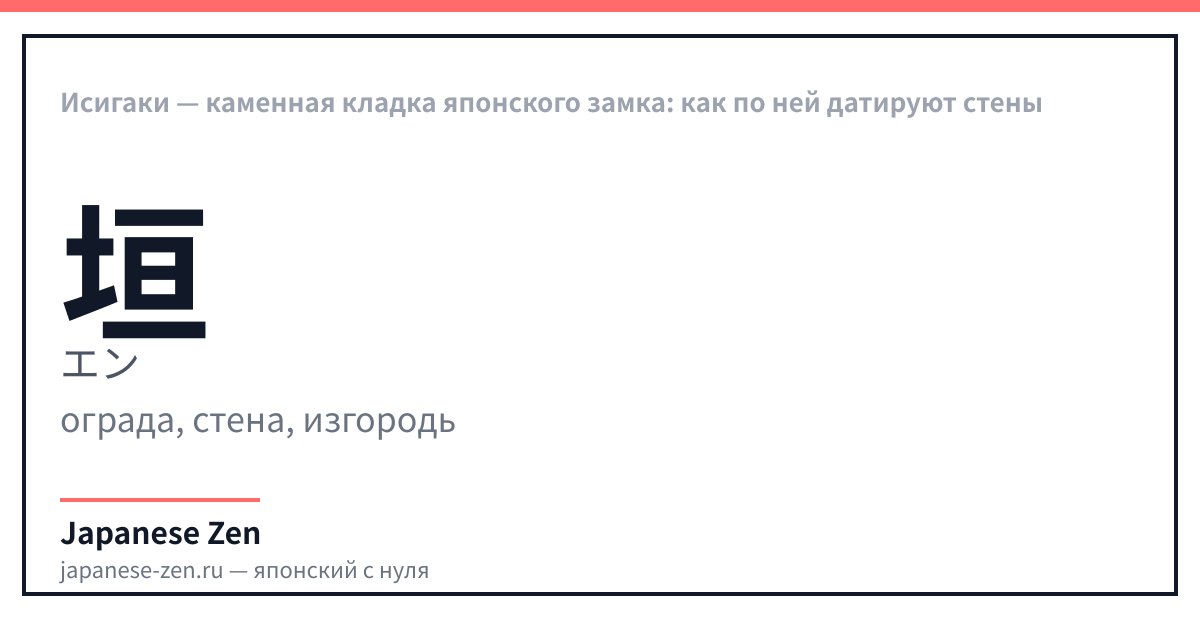
垣 — значение: enclosure, wall, fence — онъёми: エン — кунъёми: かき — 9 штрих(ов). 垣 — 'enclosure, wall': the second character in the word 石垣, the very one this topic is dedicated to.
What 石垣 means part by part
石垣 is read いしがき (ishigaki) and is made up of 石 'stone' and 垣 'enclosure, wall' — together it means 'stone enclosure'. The same second character appears in the everyday word 垣根 (kakine) — an ordinary fence or hedge around a house, with no connection to castles.
| Japanese | Reading | Translation |
|---|---|---|
| 石垣 | ishigaki · ishigaki | The stone base of a castle |
| 垣根 | kakine · kakine | An ordinary fence or hedge — an everyday word with the same character |
| 野面積み | nozura-zumi · nozura-zumi | Masonry of unworked boulders |
| 穴太衆 | Anō-shū · Anō-shū | Stonemasons from Lake Biwa |
| 扇の勾配 | ōgi no kōbai · ōgi no kōbai | 'Fan slope' — the increasing steepness of a wall |
Write 垣 along the guides — the second character in the word 'ishigaki', the stone enclosure of a Japanese castle.
FAQ
- What is called ishigaki in a Japanese castle?
- Ishigaki is the stone base of a castle: on it stand the tenshu, walls, and watchtowers. The stones are laid without mortar, dry, so the wall can shift slightly during an earthquake instead of breaking apart as a single piece.
- How does a castle's ishigaki differ from the island of Ishigaki in Okinawa?
- Only by sound and spelling: both words are written with the characters 石垣, but the island of Ishigaki in the Yaeyama archipelago has nothing to do with castle stone bases — they are two different meanings of the same combination of kanji.
- How is the age of a Japanese castle determined from its masonry?
- Stone processing became more precise over time: from unworked boulders of nozura-zumi to neatly fitted blocks of kirikomi-hagi without gaps. Rough masonry is usually older than neat masonry, but a castle was often repaired over decades, so this is only a guideline, not an exact date.
- Who are the Anō-shū craftsmen?
- Hereditary stonemasons from the village of Anō on Lake Biwa, who originally served Enryaku-ji temple. They gained nationwide fame for building Azuchi Castle in the late 1570s, after which they were invited to major construction sites in other provinces.
- What is the 'fan slope' on a Japanese castle wall?
- A wall with increasing steepness: at the bottom the rise is gentle, and closer to the top it is almost vertical, making it nearly impossible to climb without a ladder. The name 扇の勾配 comes from the resemblance of this profile to an open fan; the most famous example is the walls of Kumamoto Castle.
- How is 'ishigaki' written in kanji?
- 石垣, read いしがき (ishigaki): 石 means 'stone', 垣 means 'enclosure, wall'. The same second character also appears in the everyday word 垣根 — a fence or hedge around a house, with no connection to castles or fortifications.
Sources
Updated: 2026-09-15