Matsue Castle — dark walls above Lake Shinji and a status regained
Matsue Castle is one of the twelve Japanese castles with an original tenshu keep: it was completed in early 1611 on a hill above Lake Shinji by order of Horio Yoshiharu. The castle was not always a National Treasure: the status was granted in 1935, revoked in 1950, and only restored in 2015 — after wooden tablets with the construction date were found in a neighboring shrine. The lower tiers of the tenshu are clad in boards under a black coating — hence the tower's dark silhouette.
Matsue Castle has an unusual fate even among the twelve surviving tenshu of Japan: it was once a National Treasure, lost that title for 65 years, and regained it thanks to a discovery in a neighboring shrine. Let's look at how Horio Yoshiharu built the castle on a hill by Lake Shinji, which tablets proved the keep's authenticity, and what the writer Lafcadio Hearn, who lived in the city under the name Koizumi Yakumo, has to do with it.
How Horio Yoshiharu built the castle on Kameda Hill
After the victory at Sekigahara in 1600, the Horio clan was granted lands around Lake Shinji and first settled in the mountain fortress of Gassan-Toda — inconvenient for a trading town on the water. From 1607, construction of a new castle began on Kameda Hill. The work was overseen by Horio Yoshiharu: he had formally retired in 1599, but after his son Tadauji died suddenly in 1604, he managed the clan's affairs as guardian of his young grandson. By early 1611, the tenshu was ready.
The myth of the castle builder's death
For a long time it was believed that Yoshiharu died right on the eve of the construction's completion, never seeing the finished castle. This is a widespread but inaccurate version: he died in June 1611 — several months after the tenshu already stood on the hill.
The castle also survived the 1873 Meiji-era order to demolish fortifications: almost all buildings except the tenshu were dismantled and sold for a few yen. The tower itself was also slated for sale at 180 yen, but a local wealthy farmer and former clan retainer paid the same sum into the treasury and bought the tenshu back — that is how it survived.
How the castle regained its National Treasure status
In 1935, the Matsue tenshu was already recognized as a National Treasure under the old prewar law. After the war, when a new law on the protection of cultural properties was passed in 1950, the status was reviewed, and the castle was downgraded to an Important Cultural Property. For decades, city authorities and residents tried to restore the former title, but documents confirming the exact construction date were lacking.
The discovery that settled the matter
In 2012, two wooden votive tablets with a dedicatory inscription and the date "sixteenth year of Keichō" — that is, 1611 — were found in the neighboring Matsue Shrine. Their authenticity was confirmed simply: the nail marks with which the tablets had once been fastened exactly matched the marks on the beams of the tenshu's lower tier. In July 2015, the castle was officially returned to the list of National Treasures — for the first time in 63 years, a castle keep was added to that list.
The city on the water and the writer who fell in love with Matsue
The tenshu stands on Kameda Hill right on the shore of Lake Shinji, and the castle's second, less known name is Chidori-jō, "plover castle." The moats around the castle are connected to the lake, and Lake Shinji itself is brackish: seawater enters it.
Koizumi Yakumo and his year in Matsue
In 1890–1891, the writer Lafcadio Hearn taught English in Matsue: he liked the city so much that he married a local woman here and later took the Japanese name Koizumi Yakumo. Today, his museum and the house where he lived stand near the castle, and you can take a boat ride along the moats around the tenshu — the route passes through the same old town quarters that Hearn knew.
The sign of the lake in the name where the castle is hidden
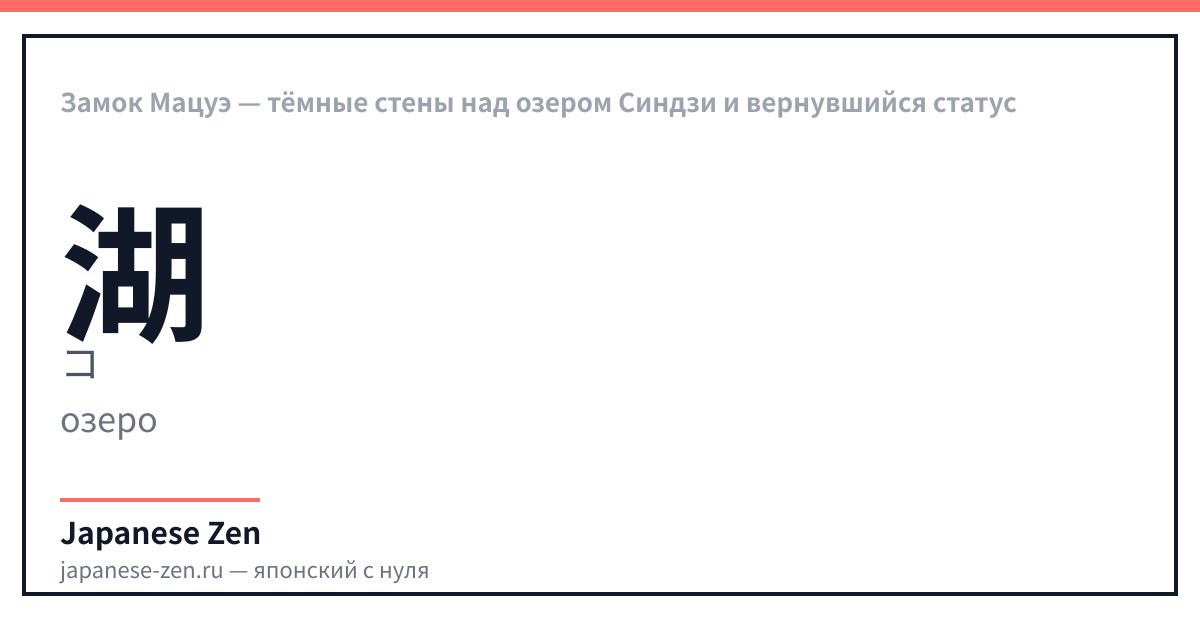
湖 — значение: lake — онъёми: コ — кунъёми: みずうみ — 12 штрих(ов). 湖 is not part of the name 松江城 itself, but without Lake Shinji you cannot understand either the city or its castle: the tenshu stands right by the water, and the moats are connected to the lake. For this topic, this sign is more important than any of the three that make up the castle's name.
What "Matsue" means part by part
松江城 is read まつえじょう (Matsue-jō) and is made up of three characters: 松 "pine," 江 "inlet, bay," and 城 "castle." Literally it comes out as "castle by the pine inlet" — but that is the meaning of the characters themselves, not a confirmed history of the specific name: sources do not separately explain why the city was named exactly that way.
| Japanese | Reading | Translation |
|---|---|---|
| 松江城 | Matsue-jō · Matsue-jō | Matsue Castle — the full Japanese name |
| 宍道湖 | Shinji-ko · Shinji-ko | Lake Shinji, on whose shore the castle stands |
| 千鳥城 | chidori-jō · chidori-jō | "Plover Castle" — a less known second name |
| 国宝 | kokuhō · kokuhō | National Treasure — the tenshu's current status |
| 堀川めぐり | horikawa meguri · horikawa meguri | A boat tour along the moats around the castle |
| 湖 | mizuumi · mizuumi | Lake — as a standalone word |
Write 湖 along the guides — the sign of the lake, without which you cannot understand the city and Matsue Castle.
FAQ
- What is Matsue Castle famous for among other surviving Japanese tenshu?
- Matsue Castle is one of the twelve Japanese castles with a tenshu keep that has survived to this day without being rebuilt: it was completed in 1611. The tenshu stands on a hill right by Lake Shinji, and since 2015 it has again been recognized as a National Treasure of Japan.
- When and by whom was Matsue Castle built?
- Construction on Kameda Hill began in 1607, and by early 1611 the tenshu was ready. The work was overseen by Horio Yoshiharu: he had formally retired in 1599, but after his son's death he managed the affairs for his young grandson.
- Why was Matsue Castle returned to the list of National Treasures only in 2015?
- The castle was granted National Treasure status back in 1935, but in 1950, after a new law on the protection of cultural properties, it was downgraded to an Important Cultural Property. The title could only be restored after wooden tablets with the construction date "1611" were found in 2012 in a neighboring shrine, and the marks of their fastenings matched the marks on the beams of the tenshu itself.
- Is it true that Matsue Castle has black walls?
- Yes, the lower two tiers of the tenshu are finished with dark wooden panels, and the upper tiers combine white plaster with the same dark wood. This finish is not found on all surviving castles and gives the tower a noticeably darker silhouette than neighboring tenshu.
- What does Lafcadio Hearn have to do with Matsue Castle?
- The writer Lafcadio Hearn taught English in Matsue in 1890–1891, married a local woman here, and took the Japanese name Koizumi Yakumo. He did not live in the castle itself, but his house and museum are nearby, in the old quarter by the castle moats.
- What do the kanji in the name Matsue mean?
- The castle's name is 松江城, read まつえじょう (Matsue-jō): 松 means "pine," 江 means "inlet, bay," and 城 means "castle." The castle also has a second, less known name — 千鳥城, "plover castle."
Sources
Updated: 2026-09-15