Japanese Castles: How Many Survived, How They Are Built, and What 城 Means
Japanese castles are built differently from European ones: the lord lived not in the tower but in a palace in the courtyard, and the defenses were the stone bases (ishigaki) and moats. Of the thousands of fortifications from the feudal era, the tenshu keep built before 1868 survives at only twelve castles, and only five of those are National Treasures. The kanji 城 means "castle, fortress, fortified settlement."
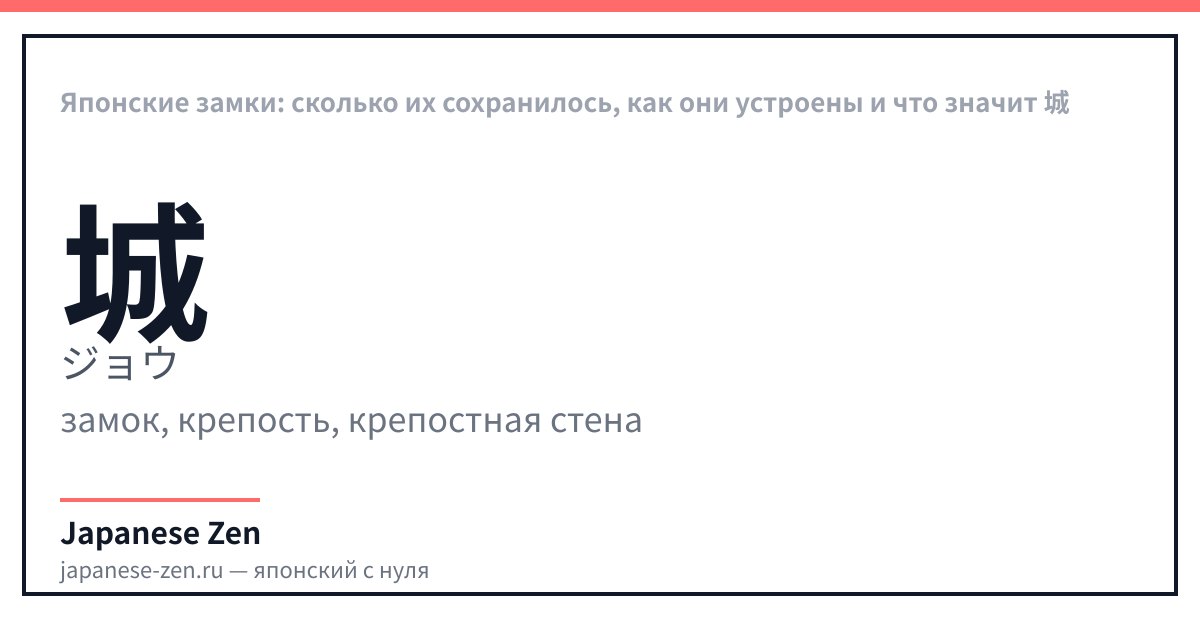
The word "castle" brings to mind an image from European history — a keep where the lord of the land lived. But a Japanese castle is built quite differently, and most of the famous towers that tourists see were rebuilt in the 20th century. We look at how many authentic tenshu survive today, what destroyed the rest, how a castle is laid out inside, and what the kanji 城 means — read shiro in some words and jō in others.
What Is a Japanese Castle and Why So Few Survive
A Japanese castle (城, shiro) is a fortified complex of stone bases, moats, and wooden buildings, not a single structure. The main keep, the tenshu, was more a lookout point and a symbol of power than a residence: the ruler and his retinue usually lived in a separate palace, the goten, in one of the inner courtyards. There were thousands of castles in Japan, but the tenshu built before the end of the Edo period survives at only twelve — these are called the "surviving tenshu" (現存天守).
| Castle | Prefecture | Tenshu built | Status |
|---|---|---|---|
| Himeji | Hyogo | 1609 | National Treasure |
| Matsumoto | Nagano | c. 1594–1597 | National Treasure |
| Inuyama | Aichi | late 1580s | National Treasure |
| Hikone | Shiga | 1606 | National Treasure |
| Matsue | Shimane | 1611 | National Treasure (since 2015) |
| Hirosaki | Aomori | 1810–1811 | Important Cultural Property |
| Maruoka | Fukui | 1620s (per 2019 research) | Important Cultural Property |
| Matsuyama | Ehime | 1852 | Important Cultural Property |
| Uwajima | Ehime | 1666 | Important Cultural Property |
| Kochi | Kochi | 1749 | Important Cultural Property |
| Bitchu-Matsuyama | Okayama | 1683 | Important Cultural Property |
| Marugame | Kagawa | 1660 | Important Cultural Property |
Why So Few Original Castles Remain
The reduction came in three waves. In 1615 the shogunate issued the "one province, one castle" decree (一国一城令): all castles except the main residence of each domain were to be demolished to weaken the military power of the daimyo. In 1873, in the Meiji era, the Castle Abolition Decree (廃城令) sent most surviving structures to demolition or to army control as relics of the old order. Natural disasters finished the job: fires, earthquakes, and the bombing of cities in 1945, which destroyed, for example, the tenshu of Nagoya, Okayama, and Hiroshima.
Breaking Down the Kanji: 城
城 — значение: castle, fortress, castle wall — онъёми: ジョウ、セイ — кунъёми: しろ — 9 штрих(ов). 城 — "castle, fortress": on the left is the radical 土 "earth," on the right the phonetic component 成. One interpretation: "earth that became a wall protecting a settlement."
| Japanese | Reading | Translation |
|---|---|---|
| 城 | shiro · shiro | "Castle, fortress" — as a standalone word |
| 天守 | tenshu · tenshu | The main keep of a castle |
| 石垣 | ishigaki · ishigaki | Stone base of the walls |
| 本丸 | honmaru · honmaru | The main, most protected courtyard of a castle |
| 堀 | hori · hori | Moat around a castle |
| 櫓 | yagura · yagura | A watchtower or corner turret smaller than the tenshu |
Write 城 along the guides and study the stroke order.
Why 城 Is Read Sometimes shiro, Sometimes jō
城 has two readings: the kun reading しろ (shiro) and the on reading じょう (jō). Shiro is a standalone word for "castle": it refers to a castle in general, without a name. Jō is part of compound names: in 姫路城 (Himeji-jō) or 松本城 (Matsumoto-jō), the character 城 is always read with its on reading because it follows a proper name, acting like a suffix.
How a Japanese Castle Is Laid Out
- The castle courtyards were arranged in concentric rings: the honmaru (本丸) in the center — with the tenshu and the ruler's palace, then the ninomaru (二の丸), and beyond that the sannomaru (三の丸) — courtyards of lower status where the retinue and garrison lived.
- Before reaching the tenshu, attackers had to storm several belts of defense at once: the sloped stone walls (ishigaki) gave no foothold, and the moats (hori) — dry or water-filled — prevented any approach altogether.
- Yagura — watchtowers and corner turrets along the perimeter of the walls, covering each other with overlapping fields of fire; a large castle could have dozens of them, and the tenshu was only the most conspicuous.
- By location, castles are divided into flatland (平城, hirajiro), mountain (山城, yamajiro), and intermediate — on a hill by a plain (平山城, hirayamajiro).
How a Japanese Castle Differs from a European One
In a European castle, the keep is usually the lord's residential tower, and thick walls are the main defense. In a Japanese castle, the tenshu is not so much a residence as a watchtower and a status symbol: the ruler and his family lived in a separate palace, the goten, inside the honmaru. The main strength of a Japanese castle is not the thickness of the walls but the difference in height, the water in the moats, and the layout of the courtyards, which forced attackers to weave under fire from all sides.
Common Misconceptions About Japanese Castles
- "The ruler lived in the tenshu." In fact, the ruler and his family usually lived in a separate palace, the goten, in one of the castle courtyards, while the tower served as a lookout and a storehouse in case of siege.
- "All famous castles are original buildings from the past." The tenshu of Osaka, Nagoya, and Kumamoto, for example, are 20th-century reinforced-concrete reconstructions: a tenshu from the Edo period or earlier survives at only twelve castles in the country.
- "Japan had thousands of huge castles." There were indeed very many fortifications of various scales — from large fortresses to small wooden forts — but the exact number depends heavily on what counts as a castle, and no reliable total figure exists.
- "The '100 Japanese Castles' list is all that survives." The 日本100名城 list was compiled in 2006 by the Japanese Castle Research Society for tourists and history enthusiasts. It includes original tenshu, reconstructions, and even castle sites with no buildings — it is a selection, not a list of all surviving castles.
FAQ
- How many original castles survive in Japan?
- Twelve: only these have a main tenshu keep built before 1868 that survives to this day. Five of them — Himeji, Matsumoto, Inuyama, Hikone, and Matsue — are National Treasures, and seven are Important Cultural Properties. The keeps of many famous castles, including Osaka, Nagoya, and Kumamoto, are 20th-century reconstructions.
- Why are there so few real castles in Japan?
- The reduction came in three waves. The 1615 decree "one province, one castle" forced the demolition of most fortifications in each domain, and the 1873 decree of the Meiji era sent most of the remaining ones to demolition as relics of the old order. Fires, earthquakes, and the bombing of cities in 1945 finished the job.
- What does the kanji 城 mean?
- 城 means "castle, fortress, fortified settlement." Its kun reading is しろ (shiro), used when the word stands alone; its on reading is じょう (jō), used in proper names, for example 松本城 (Matsumoto-jō).
- How does a Japanese castle differ from a European one?
- In a European castle, the keep was usually the lord's residential tower. In a Japanese castle, the tenshu is more a lookout point and a status symbol: the ruler and his family lived in a separate palace, the goten, inside the honmaru courtyard, and the main defense was not thick walls but moats and differences in height.
- What is a Japanese castle made of?
- It consists of concentric courtyards — the honmaru, ninomaru, and sannomaru — surrounded by stone bases (ishigaki) and moats (hori). Inside the courtyards stand the tenshu — the main keep — and yagura — smaller watchtowers; by location, castles are divided into flatland, mountain, and hill-by-plain types.
- Is the '100 Japanese Castles' list all the surviving castles?
- No. The 日本100名城 list was compiled in 2006 by the Japanese Castle Research Society — it is a selection for tourists and history enthusiasts that includes original tenshu, reconstructions, and castle sites with no buildings. Many castles and ruins are not on the list.
Sources
Updated: 2026-09-13