Kumamoto Castle — Kato Kiyomasa's Walls, the 1877 Siege, and the 2016 Earthquake
Kumamoto Castle on Kyushu was built by Kato Kiyomasa, who completed construction by 1607: the concave musha-gaeshi walls left attackers almost no chance of climbing up. In 1877 the castle withstood a month and a half of siege, while the tenshu burned down two days before the assault for a reason that has never been established. After the 2016 earthquake, the tower reopened to visitors in 2021, and full restoration is scheduled to run until 2052.
Kumamoto Castle has survived more upheavals than almost any other castle in Japan: a siege, a fire under unexplained circumstances, Meiji-era demolition, and the devastating 2016 earthquake — and each time it was rebuilt anew. We look at what in its appearance is authentic, what was restored with twentieth-century concrete, and what is still being repaired right now — and also why the famous mascot Kumamon has no direct connection to the castle.
Kumamoto Castle: Kato Kiyomasa's Fortress After the Earthquake
Kumamoto Castle on Kyushu was built by Kato Kiyomasa — a commander known for his engineering skills: construction stretched over years and was completed by 1607. The castle's main feature is its concave stone walls, ishigaki, which grow steeper the higher they go, so that climbing them was almost impossible for attackers.
| Year | Event |
|---|---|
| 1607 | Kato Kiyomasa completes construction of the castle |
| 1877 | A month and a half of siege during the Satsuma Rebellion; the tenshu burns down two days before the assault |
| 1960 | A concrete tenshu is restored |
| 2016 | The April earthquake collapses part of the walls and buildings |
| 2021 | The tenshu reopens to visitors after repairs |
| 2052 | The year by which, under the current plan, restoration of the entire grounds should be completed |
What the Castle Has Become Ten Years After the Earthquake
Restoration was divided into stages: by 2032 they plan to finish the Uto turret and the Honmaru Palace, by 2042 all buildings with the status of Important Cultural Property and the main areas, and the last secondary zones by 2052. Part of the visitor route runs along elevated walkways directly above the construction site, so the repairs have become part of the tour itself.
The Characters in the Castle's Name: 熊本城
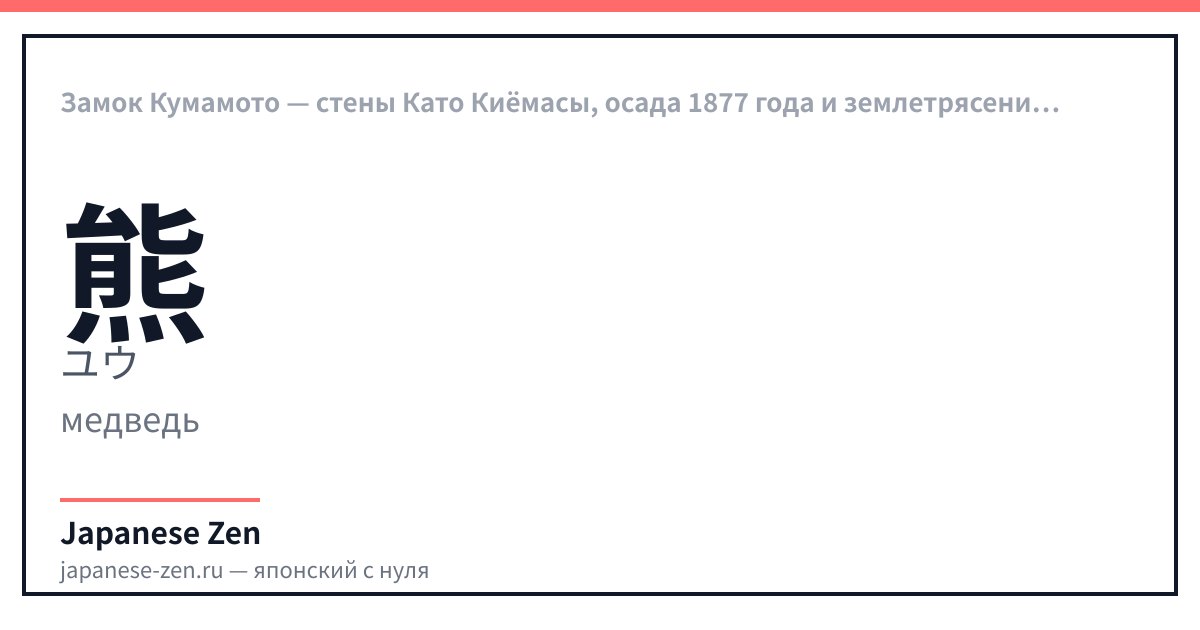
熊 — значение: bear — онъёми: ユウ — кунъёми: くま — 14 штрих(ов). 熊 — 'bear': the first character in the name 熊本城; on its own it is read くま (kuma).
| Japanese | Reading | Translation |
|---|---|---|
| 熊本城 | Kumamoto-jō · Kumamoto-jō | Kumamoto Castle — the full Japanese name |
| 武者返し | musha-gaeshi · musha-gaeshi | Concave stone walls that 'repel' attackers |
| 石垣 | ishigaki · ishigaki | Stone base of the walls |
| 天守 | tenshu · tenshu | Main tower of a castle |
| 復旧 | fukkyū · fukkyū | Restoration after destruction — the term used for the ongoing repairs |
Write 熊 along the guides — the first character in the castle's name.
Why 'Bear': 隈本 and 熊本
熊本城 is read くまもとじょう (Kumamoto-jō): 熊 means 'bear', and 本 in place names usually means 'main, at the base'. Before Kato Kiyomasa rebuilt it, this place was called 隈本 — with the same readings but different characters (隈 means 'bend, secluded nook'). The spelling was changed to the current 熊本 in the early seventeenth century, and the exact reason for the change is not established.
Kumamoto Castle: Repairs That Became a Tour
- A separate fragment of stone wall that stood in 2016 when neighboring sections collapsed is called the 'miracle wall' (奇跡の一本石垣) in the city — it has become an unofficial symbol of the city's resilience.
- Special elevated walkways for visitors run directly above the repair zone — you can watch the restorers at work up close today, not just in photographs.
- The collapsed walls are reassembled stone by stone: the blocks are numbered and, where possible, returned to their original places.
FAQ
- What is Kumamoto Castle?
- Kumamoto Castle is a fortress on Kyushu built by the commander Kato Kiyomasa, who completed construction by 1607. It is famous for its concave musha-gaeshi stone walls and for withstanding the 1877 siege, although its tower burned down shortly before the assault.
- What happened to Kumamoto Castle in the earthquake?
- The earthquake of April 2016 collapsed part of the castle's stone walls and buildings. The tenshu was repaired and reopened to visitors in 2021, and full restoration of the entire grounds under the current plan should be completed by 2052.
- Who was Kato Kiyomasa, the builder of Kumamoto Castle?
- The castle was built by Kato Kiyomasa — one of the notable commanders at the turn of the sixteenth and seventeenth centuries, a retainer of Toyotomi Hideyoshi, famed for his engineering skills. Construction stretched over several years and was completed by 1607; it was then that the place's name was changed from 隈本 to the current 熊本.
- Is Kumamon the mascot of Kumamoto Castle?
- No. Kumamon is a character of Kumamoto Prefecture, created in 2010 for a separate tourism campaign, not to promote the castle itself. The mascot has no direct connection to the castle, though because of the shared name they are often confused, both in souvenir shops and in guidebooks.
- Why is Kumamoto written with the character for 'bear'?
- 熊本城 is read くまもとじょう (Kumamoto-jō), in English usually Kumamoto Castle. 熊 means 'bear', and 本 in place names usually means 'base, main'. Until the early seventeenth century the place was called 隈本 — with the same readings but different characters: 隈 means 'bend, secluded nook'.
Sources
Updated: 2026-09-13