Meiji Era — When It Was and What It Is Known For
The Meiji Era lasted 44 years, from October 23, 1868, to July 30, 1912, when Mutsuhito was emperor and the country transformed from a closed shogunate into an industrial power with a constitution and railways. The 1868 Restoration returned power to the emperor, abolished social classes, and in 1876 banned samurai from wearing swords — a year later this led to the Satsuma Rebellion.
The Meiji Restoration dismantled the shogunate and within a single generation turned a closed feudal country into a parliamentary monarchy with a European-style army. We explore what changed in 1868, how Japanese people lived without social classes and swords, and why "Meiji" is not the emperor's name at all, even though it is often mistaken for one.
When the Meiji Era Was and How Long It Lasted
The Meiji Era (明治) lasted from October 23, 1868, the day the new era name was officially proclaimed, until July 30, 1912, when Emperor Mutsuhito died. Nearly forty-four years were devoted to the Meiji Restoration: power returned to the emperor from the Tokugawa shogunate, the country abolished the old social classes, disbanded the samurai warrior class, and carried out industrialization modeled on Western powers. The era name 明治, "enlightened rule," was chosen at court for the young Mutsuhito, who ascended the throne in 1867, and was proclaimed on October 23, 1868.
| Year | Event |
|---|---|
| 1868 | January 3 — Proclamation of the Meiji Restoration, power formally returned to the emperor |
| 1871 | The haihen chiken edict abolishes the old feudal domains (han) and replaces them with prefectures |
| 1876 | The haitorei edict bans the wearing of swords for everyone except military and police — the end of the visible samurai privilege |
| 1877 | Satsuma Rebellion — the last armed uprising of former samurai led by Saigo Takamori |
| 1889 | February 11 — the first Japanese constitution is promulgated; Japan becomes the first constitutional state in East Asia |
| 1912 | July 30 — Mutsuhito dies; the Taisho Era begins |
How the Era Differed from Its Neighbors
If the Edo period was a time of closed borders and an unchanging class hierarchy, and the Taisho Era that followed Meiji was a time of the first party cabinets and urban fashion, then Meiji is the turning point between them. In a single generation, the country went from a feudal shogunate to an industrial power with a parliament and universal conscription. The new Japan's fleet defeated first China and then Russia in successive wars.
How People Lived During the Meiji Years
- Power — the Tokugawa shogunate was abolished; the country was formally ruled by the emperor, but in reality by an oligarchy of former samurai from Satsuma and Choshu who had led the Restoration to victory.
- Social classes — the old classes were abolished by edicts of 1869–1871, and by 1876 samurai had lost their main privilege, the right to openly wear swords; many entered government service or were ruined.
- Army — instead of feudal retinues, a conscript army on the Prussian model and a navy on the British model appeared; already in 1894–1895 and 1904–1905 Japan won wars against China and Russia.
- Industry — the state built railways, textile factories, and shipyards, and the era's slogan 文明開化, "civilization and enlightenment," pushed everything from hairstyles to the calendar to conform to Western models.
- Law — the Meiji Constitution was adopted in 1889, and in 1890 the first elected parliament in Asia convened, though the franchise was still limited to a narrow circle of male taxpayers.
Name and Kanji: 明治
明治 is read めいじ (Meiji) and translates as "enlightened rule": 明 means "light, clarity," 治 means "rule, governance." An important nuance that is often confused: "Meiji" is not the emperor's name but the name of his reign. In life he was called Mutsuhito (睦仁); he received the name "Emperor Meiji" only posthumously, through the same gengō system that later gave the names Taisho, Showa, Heisei, and Reiwa.
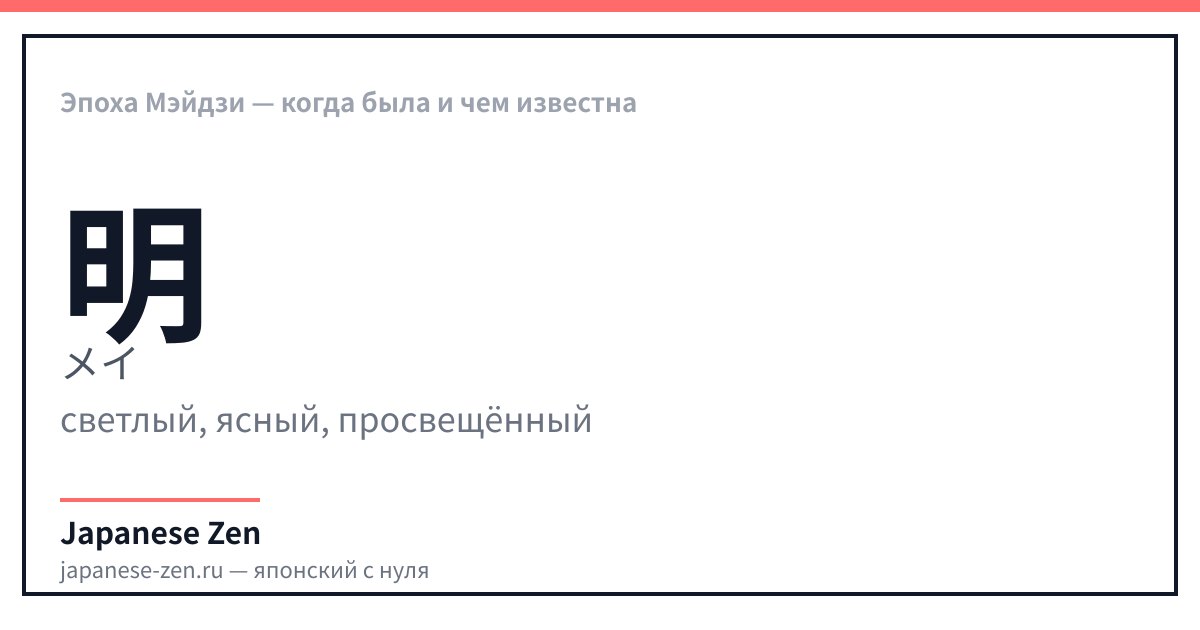
明 — значение: bright, clear, enlightened — онъёми: メイ、ミョウ、ミン — кунъёми: あ.かり、あか.るい、あか.るむ、あか.らむ、あき.らか、あ.ける、-あ.け、あ.く、あ.くる、あ.かす — 8 штрих(ов). 明 — "bright, clear": 8 strokes, JLPT N3. The character is composed of 日 ("sun") and 月 ("moon") — the combination of two sources of light gives the meaning "clarity." The same kanji appears in the first syllable of the era name 明治.
| Japanese | Reading | Translation |
|---|---|---|
| 明治 | Meiji · Meiji | The era name — "enlightened rule" |
| 明治時代 | Meiji jidai · Meiji jidai | The full name — "Meiji Era" |
| 文明開化 | bunmei kaika · bunmei kaika | "Civilization and enlightenment" — the slogan of modernization |
| 明るい | akarui · akarui | Bright — the same 明 as in the era name |
| 廃刀令 | haitōrei · haitōrei | The 1876 edict banning the wearing of swords |
| 鉄道 | tetsudō · tetsudō | Railway — a symbol of Meiji industrialization |
Write 明 along the guides — the first character in 明治, "enlightened rule."
Why Each Era Now Has Only One Name
After Meiji, era names continued to change with the accession of a new emperor: Taisho, Showa, Heisei, and from May 1, 2019, Reiwa. But it was Meiji that established the current rule: one emperor, one era name for the entire reign, without changing the name mid-reign as had happened for centuries before.
Which Anime Are Set in the Meiji Era
- "Rurouni Kenshin" (るろうに剣心) — a classic about former assassin Kenshin Himura, who vowed never to kill again: the main story begins in the 11th year of Meiji, that is, 1878.
- "Golden Kamuy" (ゴールデンカムイ) — the adventures of Russo-Japanese War veteran Saichi Sugimoto in Hokkaido: the story begins in the winter of 1907, in late Meiji, shortly after the war with Russia.
- "Meiji Tokyo Renka" (明治東亰恋伽) — a 2019 romantic fantasy about a schoolgirl transported to Meiji-era Tokyo: one season of 12 episodes aired, with no continuation.
How to Recognize the Era on Screen
Meiji on screen is recognized by the mix of old and new in a single frame: samurai swords alongside revolvers and telegraphs. Kimono coexist with European uniforms and top hats, and traditional wooden quarters with Western-style brick buildings. If the hero is a former samurai without class privileges, searching for his place in a new world, it is almost certainly the Meiji Era.
FAQ
- When was the Meiji Era?
- The Meiji Era lasted from October 23, 1868, when the new era name was proclaimed, until July 30, 1912 — the day Emperor Mutsuhito died. It began with the Meiji Restoration and ended with the start of the Taisho Era.
- How many years did the Meiji Era last?
- About forty-four years — from 1868 to 1912. During this time, the country went from a closed shogunate to a constitutional monarchy with a parliament, universal conscription, and its own industry.
- What happened during the Meiji Era?
- The restoration of power to the emperor in 1868, the abolition of social classes, the ban on wearing swords in 1876, the Satsuma Rebellion of 1877, the constitution of 1889, and rapid industrialization under the slogan "civilization and enlightenment" (文明開化).
- How is "Meiji Era" written in kanji?
- 明治, めいじ: 明 — "bright, clear," 治 — "rule." Together — "enlightened rule." It is the name of the reign, not the personal name of the emperor: in life he was called Mutsuhito.
- Which anime are set in the Meiji Era?
- "Rurouni Kenshin" begins in 1878, "Golden Kamuy" in 1907, and the romantic fantasy "Meiji Tokyo Renka" (2019) transports a schoolgirl to Tokyo of that time — only one season was released.
- How did the Meiji Era end?
- With the death of Emperor Mutsuhito on July 30, 1912. His son Yoshihito inherited the throne, and the country entered the Taisho Era — with a different, far more democratic political agenda.
Sources
Updated: 2026-09-11