The Taisho Era — When It Was and What It Is Known For
The Taisho era was the reign of Emperor Yoshihito from July 30, 1912 to December 25, 1926, between Meiji and Showa. In less than fifteen years the country introduced universal male suffrage in 1925, survived the 1923 Great Kanto Earthquake, and saw the "moga" and "mobo" fashions — European dress alongside kimono. It is precisely in this era that the story of "Demon Slayer" unfolds.
Fifteen years between two far longer eras are easy to lose in the general chronology. That is a mistake: it was then that Japan first tried mass politics, survived one of the strongest natural disasters of the 20th century, and acquired an urban fashion that is recognized today from anime frames. We look into what stood behind the word "Taisho" and why the creators of "Demon Slayer" chose precisely these years.
When the Taisho Era Was and How Long It Lasted
The Taisho era (大正) is a period of Japanese history from July 30, 1912, when after the death of Emperor Meiji his son Yoshihito ascended the throne, to December 25, 1926, the day of his own death. Just fourteen years and five months — one of the shortest eras in modern Japanese history, squeezed between the forty-four years of Meiji and the sixty-two years of Showa. The name 大正, "great righteousness," was given to the new emperor on the day of his accession, as is proper under the era-name system that still operates in Japan.
| Year | Event |
|---|---|
| 1912 | On July 30 Emperor Meiji dies, Yoshihito inherits the throne — the beginning of the Taisho era |
| 1912 | On September 13, the day of Meiji's funeral, General Nogi Maresuke commits ritual suicide — a farewell gesture of old, samurai Japan |
| 1918 | Hara Takashi becomes the first prime minister from a political party, rather than from the victorious clans of the Restoration |
| 1923 | September 1 — the Great Kanto Earthquake: over 100,000 dead and missing, a significant part of Tokyo burns down |
| 1925 | A law on universal suffrage for men over 25 is passed — simultaneously with the Peace Preservation Law, which restricted leftist movements |
| 1926 | On December 25 Yoshihito dies, his son Hirohito ascends the throne — the beginning of the Showa era |
The Place of Taisho on the Scale of Japanese Eras
Japanese history is divided into dozens of such periods, and they are counted in different ways: some by era names, like Taisho, others by archaeological features. The earliest and longest of them is the Jomon period, a hunter-gatherer culture that began, by various archaeological estimates, 13,000–16,000 years ago and lasted several millennia. It was named after the characteristic "cord" pattern on pottery (縄文 — "cord mark"). Against this background, the fifteen years of Taisho are almost a moment, but it is precisely they that lie roughly midway between deep antiquity and modern Japan with its subways and skyscrapers.
How People Lived in the Taisho Years
- Politics — for the first time in the country's history the cabinet was headed by a party politician, not a former samurai oligarch from the victorious clan of the Restoration; against this background historians speak of "Taisho democracy."
- Rights — suffrage for men expanded throughout the era and in 1925 became universal for men over 25, although women never received it — that happened only after World War II.
- Money — the stratum of "salarymen," hired employees of offices and department stores, grew rapidly; the economic boom after World War I was followed by the panic of 1920 and the Great Kanto Earthquake, which struck an already shaky economy.
- Fashion — alongside kimono, European dress appeared on city streets: dandies were called "mobo," short for "modern boy," and fashionable women with short haircuts were called "moga," from "modern girl."
- Daily life — trams ran through the streets of major cities, electricity and telephones appeared in the homes of wealthy townspeople, and after the 1923 earthquake Tokyo was rebuilt anew, already with an eye to earthquake resistance.
Name and Kanji: 大正
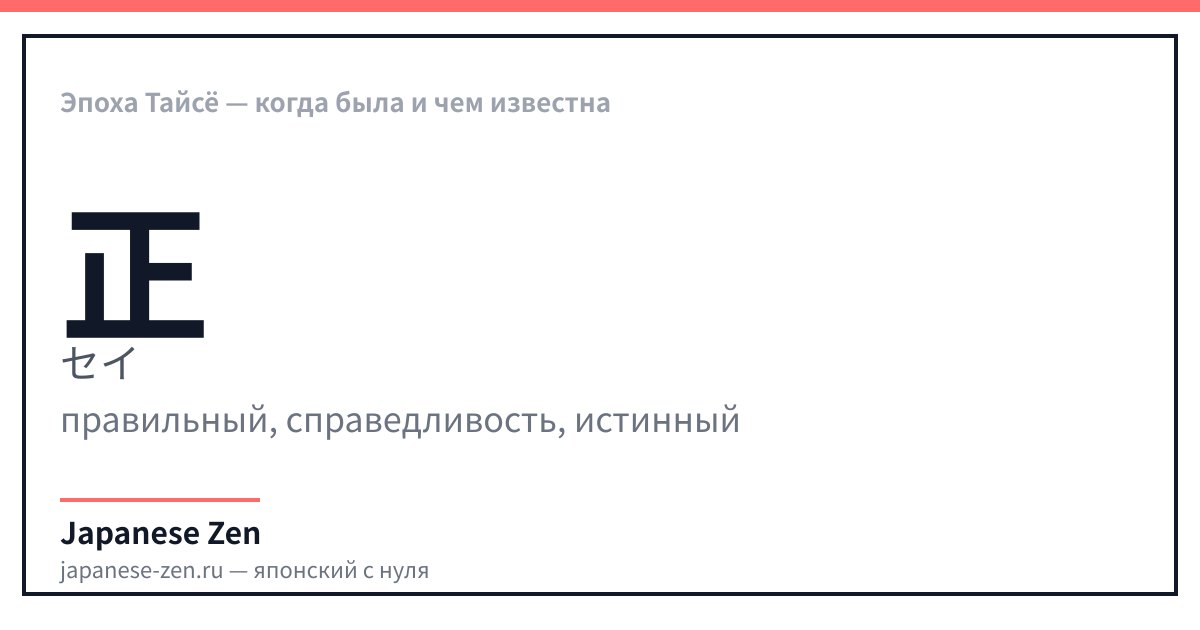
大正 is read たいしょう (Taishō) and translates as "great righteousness" or "great justice" — these two kanji for the era name were chosen by the imperial office according to old tradition, drawing on the ancient Chinese classic "I Ching" ("Book of Changes"). The second character, 正, is not alone in the era name: it also appears in 正義 (seigi, "justice") and in the ordinary word 正しい (tadashii, "correct").
正 — значение: correct, justice, true — онъёми: セイ、ショウ — кунъёми: ただ.しい、ただ.す、まさ、まさ.に — 5 штрих(ов). 正 — "correct, righteous": 5 strokes, one of the first characters taught in Japanese school. The same kanji is in the second syllable of the era name 大正 and in the ordinary word 正しい (tadashii, "correct").
| Japanese | Reading | Translation |
|---|---|---|
| 大正 | Taishō · Taishō | The name of the era — "great righteousness" |
| 大正時代 | Taishō jidai · Taishō jidai | The full name — "Taisho era" |
| 元号 | gengō · gengō | Era name — the system of counting years by the name of the era |
| 正しい | tadashii · tadashii | Correct — the same character 正 as in the era name |
| 震災 | shinsai · shinsai | Destructive earthquake — like Kanto in 1923 |
| 洋服 | yōfuku · yōfuku | Western clothing — the fashion of the Taisho era |
Write 正 along the guides — the second character in 大正, "correct, righteous."
How Japanese People Still Name the Years
The gengo system is alive today: since May 1, 2019, the Reiwa era has been ongoing; before it Heisei lasted thirty years, and before Heisei, Showa lasted sixty-two years, inheriting the throne immediately after Taisho. In official documents, calendars, and on coins in Japan, the year is still often written not by the Gregorian count but by the era name. "Reiwa 7" is 2025, and "Taisho 14" is that very 1925, when the law on universal suffrage was passed.
Which Anime Take Place in the Taisho Era
- "Demon Slayer" (鬼滅の刃) — the most famous title of the era. The manga does not name the year directly, but from the signs in the frame — military uniforms, rare automobiles and steam locomotives, early electric lights — readers and researchers agree. The action begins in the first years of Taisho, around 1912–1915.
- "Haikara-san: Here Comes Miss Modern" (はいからさんが通る) — a classic 1975 story about a headstrong "haikara" girl. The action unfolds in Tokyo in 1918, the seventh year of Taisho, against the backdrop of Taisho democracy, the Siberian Intervention, and the Kanto Earthquake; in 2017 a two-part feature anime adaptation was released.
- "Taisho Otome Fairy Tale" (大正オトメ御伽話) — a romantic manga and 2021 anime about an arranged marriage in the winter of 1921, the tenth year of Taisho.
- "Rurouni Kenshin" and "Golden Kamuy" take place a little earlier, at the end of Meiji — they are often confused with Taisho because of a similar mix of kimono and European hats on screen, although formally this is still the previous era.
By What Signs the Era Is Visible in the Frame
Taisho on screen has a recognizable set of signs: European suits and bowler hats alongside kimono, the first trams and still rare automobiles, electric lights on poles instead of gas, occasional telephone sets, and light semi-military uniforms. If the word "democracy" is heard in the frame or the action takes place against the backdrop of a city destroyed by the elements — it is almost certainly about 1923 and the Great Kanto Earthquake.
Who the Twelve Kizuki Are
The Twelve Kizuki (十二鬼月) are the twelve strongest demons serving the antagonist Muzan Kibutsuji, divided into two groups of six: the "Upper Moons" (上弦) are stronger than the "Lower Moons" (下弦), and within each group each demon has its own rank — from first to sixth. Among the Upper Moons are Kokushibo, Doma, and Akaza, the most recognizable opponents in the final arcs of the story; the composition of the group had hardly changed for decades before meeting the protagonist.
FAQ
- When was the Taisho era?
- The Taisho era lasted from July 30, 1912, when Yoshihito became emperor, to December 25, 1926 — the day of his death. It succeeded the Meiji era and gave way to the Showa era under Emperor Hirohito.
- How many years did the Taisho era last?
- Fourteen years and almost five months — from July 1912 to December 1926. It is one of the shortest eras in modern Japanese history: Meiji before it lasted nearly forty-four years, and Showa after it sixty-two.
- When was the Jomon period?
- The Jomon period is the earliest and longest era of Japanese history, long before Taisho: it began, by archaeological estimates, 13,000–16,000 years ago and lasted several millennia until it was replaced by the Yayoi period. It was named after the cord pattern on pottery of that time.
- In what year does the action of "Demon Slayer" unfold?
- The manga does not name the year directly. From the signs in the frame — uniforms, rare automobiles, electric lights — readers and researchers place the beginning of Tanjiro Kamado's story in the first years of Taisho, around 1912–1915.
- What are the Twelve Kizuki in "Demon Slayer"?
- The Twelve Kizuki (十二鬼月) are the twelve strongest demons in the service of Muzan Kibutsuji, divided into six "Upper" and six "Lower," each with its own personal rank. Among the Upper Moons are Kokushibo, Doma, and Akaza, key opponents in the finale of the story.
- How is "Taisho" written in kanji and what does the word itself mean?
- 大正, たいしょう: 大 — "great," 正 — "correct, righteous." Together — "great righteousness"; the phrase goes back to the ancient Chinese "Book of Changes" and was chosen as the era name of Emperor Yoshihito.
Sources
Updated: 2026-09-11