Harakiri — what it is and how it differs from seppuku
Harakiri (腹切り) and seppuku (切腹) are the same ritual: a samurai's suicide by cutting open the abdomen, written with the same two characters in different order. Harakiri is the colloquial Japanese reading that became the main name abroad; seppuku is the literary reading officially used in Japan itself. It was done by sentence, by order, or voluntarily, out of loyalty to a deceased lord. As a judicial execution, it was abolished in 1873.
In the West, the word 'harakiri' took root, but the Japanese themselves, when speaking of the same rite, will say 'seppuku' — it sounds more formal. The confusion is caused not by the meaning, but by the order of reading the same two characters.
Harakiri and seppuku: what's the difference
腹切り and 切腹 consist of the same two characters — 腹 'abdomen' and 切 'to cut', only swapped. 腹切り is read in Japanese: 'hara' — abdomen, 'kiri' — cut, hence 'harakiri'. 切腹 is read in Chinese and gives 'seppuku'. The meaning is the same, the difference is in register: harakiri sounds colloquial, almost rough, seppuku — bookish and official. In the 19th century, the West learned the word 'harakiri' through sailors and travelers who heard the colloquial form — and so it became established in European languages. In Japan itself, historical and official texts use 'seppuku'.
| What we compare | Harakiri 腹切り | Seppuku 切腹 |
|---|---|---|
| Reading | Japanese, colloquial | literary, official |
| Where used | spoken language, abroad | historical sources, documents |
| Tone | everyday, sometimes lowered | neutral and solemn |
Why the abdomen
The custom of cutting open one's own abdomen developed in the warrior class by the 12th century: it was believed that the seat of spirit and will is in the abdomen, so cutting it open means showing the purity of one's intentions at the moment of death. By the Edo period, from the 17th century, the rite acquired strict rules and turned from a spontaneous gesture into a formal procedure with a second, witnesses, and a protocol — this institution is covered on a separate page about seppuku.
Why harakiri was done and when it was stopped
The reasons fall into several scenarios. Sentence: harakiri replaced the shameful execution by decapitation for a samurai — thus the guilty one left life while preserving the dignity of the class. Defeat or capture: the warrior took his own life to avoid falling into enemy hands. Protest: harakiri as the last argument of disagreement with the lord's decision. Junshi (殉死) — following a deceased lord, a gesture of ultimate loyalty; such cases were periodically prohibited by special edicts from the 17th century, but the custom could not be completely eradicated until the end of the samurai era.
- As execution — by sentence for an offense, instead of beheading.
- On the battlefield — to avoid capture and shame.
- As protest — against an unjust decision of the lord.
- Junshi — following a deceased lord, out of loyalty.
When the rite was banned
As a judicial measure, harakiri was abolished in 1873, shortly after the Meiji Restoration, along with the samurai class itself. Individual voluntary cases occurred after that: General Nogi Maresuke followed Emperor Meiji in 1912, writer Yukio Mishima in 1970. But these were already personal gestures, not part of the judicial or military system. More about the ritual as an institution — on the page about seppuku, and about the role of the second — on the page about kaishaku.
Words and characters: 腹切り
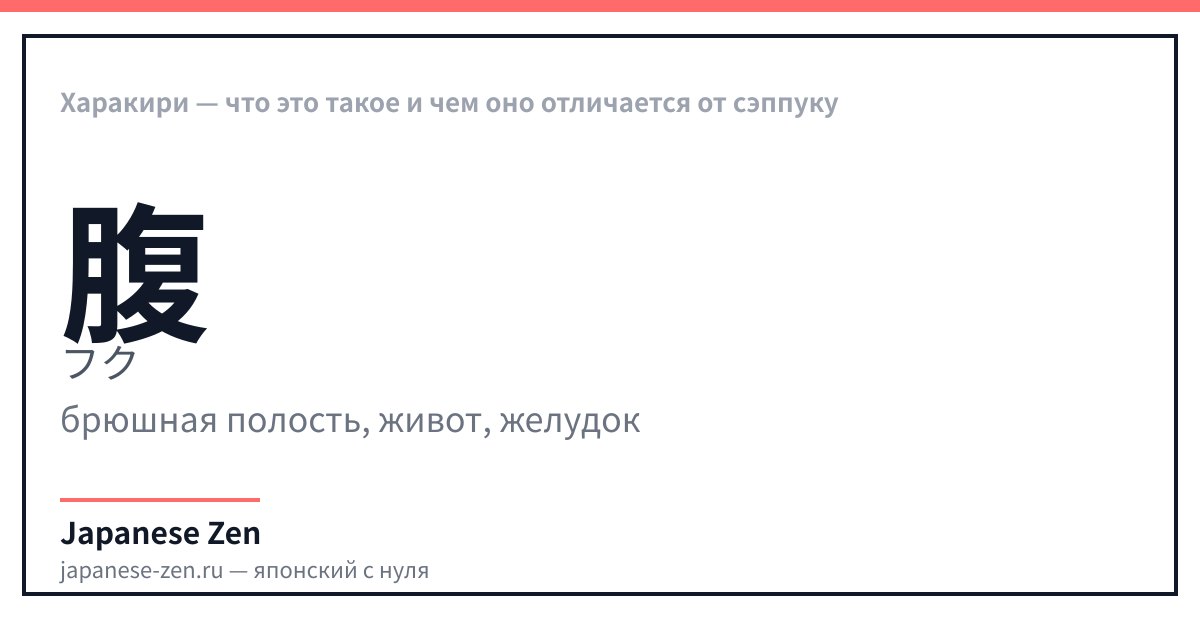
腹 — значение: abdominal cavity, abdomen, stomach — онъёми: フク — кунъёми: はら — 13 штрих(ов). 腹 — 'abdomen': on the left is the radical 'body' 月, on the right is the element 复, which also appears in 複 and 復. Paired with 切 'to cut' it gives 腹切り — harakiri; in reverse order 切腹 — seppuku, the same word in official reading.
| Japanese | Reading | Translation |
|---|---|---|
| 腹切り | harakiri · harakiri | Harakiri (colloquial reading of the same characters) |
| 切腹 | seppuku · seppuku | Seppuku (official literary reading) |
| 介錯 | kaishaku · kaishaku | Second, assistant at the rite |
| 殉死 | junshi · junshi | Following the lord in death |
| 名誉 | meiyo · meiyo | Honor, good name |
| 恥 | haji · haji | Shame, disgrace |
腹 and 切 — abdomen and cut
Both words are broken down into two simple characters: 腹 'abdomen' and 切 'to cut'. There is no separate character for the rite itself as a concept in the language — the name honestly describes the physical action, without euphemisms.
Listen to the words harakiri and seppuku and repeat — the app will evaluate your pronunciation.
Harakiri in anime
A direct naturalistic depiction of harakiri in anime is rare: more often the theme is presented through talk about honor, rather than as a separate scene.
- 'Rurouni Kenshin' — seppuku and harakiri are repeatedly discussed by characters as part of the samurai's moral choice, which the protagonist rejected.
- 'Gintama' — regularly plays harakiri for comedy, taking the ritual to the point of absurdity.
- 'Samurai Champloo' — a recurring theme is the code of honor to which harakiri appeals, although the rite itself is almost never shown on screen.
FAQ
- What does harakiri mean?
- Harakiri (腹切り) — 'cutting the abdomen': a ritual suicide by which a samurai ended his life by sentence, by order, or voluntarily. The same as seppuku — just a colloquial reading of the same two characters.
- Why was harakiri done?
- To avoid a shameful execution or capture, to carry out a sentence while preserving the dignity of the class, or to follow a deceased lord (junshi). Less often — as a protest against the lord's decision.
- How does harakiri differ from seppuku?
- Not at all in essence — it is the same word written with the same kanji 腹切り and 切腹 in different order. Harakiri is the colloquial Japanese reading, seppuku is the literary reading officially adopted in Japan itself.
- When was harakiri abolished?
- As a judicial measure — in 1873, along with the abolition of the samurai class after the Meiji Restoration. Individual voluntary cases (Nogi Maresuke in 1912, Mishima in 1970) occurred later, but outside the judicial system.
- How is 'harakiri' written in Japanese?
- 腹切り, in kana はらきり. 腹 — 'abdomen', 切り — 'to cut'. In the official reading, the same characters in reverse order give 'seppuku' (切腹).
- What types of harakiri are there?
- There are three main types: by sentence as execution, voluntary — to avoid capture or express protest, and junshi — following a deceased lord. The formal procedure is covered on the page about seppuku.
Sources
Updated: 2026-08-24