Seppuku — what this ritual was and how it was carried out
Seppuku (切腹) is a formal ceremony of ritual suicide by a samurai: cutting open the abdomen according to strict procedure, in the presence of witnesses and with a second (kaishaku) who ended the suffering with a fatal blow. Abroad, the same act is called harakiri — the colloquial reading of the same characters. As a judicial measure, it was abolished in 1873.
Seppuku was not a spontaneous gesture of despair — by the Edo period it had become a well-established procedure: with a location, protocol, witnesses, and a pre-appointed assistant.
What is seppuku and how did a sentence differ from a voluntary act
Seppuku was distinguished by initiative. By sentence, a samurai received it as a substitute for beheading — an honorable execution for an offense that preserved the dignity of the class. Voluntary seppuku was performed by a person on their own decision: out of loyalty, protest, or to avoid capture. Formally, both options followed the same scenario: in a garden or a specially designated room, on a white mat, in the presence of official witnesses who drew up a report of the death.
- Who was present: the condemned person himself, the second (介錯人, kaishakunin), and official witnesses.
- Where it was held: a house garden, a temple, a specially designated room — not a public square.
- What was worn: a white ceremonial kimono (死装束, shinishōzoku) — the color of purity and farewell to life.
- What happened: a short ceremony with ritual objects, then the second's blow ended the suffering.
- Who kept records: witnesses kept a protocol — historians reconstruct the order of the ritual from these documents.
By the late Edo period, the ceremony in some places became even more symbolic: instead of a real blade, a fan could be placed on the tray, and the second delivered the blow at the moment the condemned person merely reached for it. This variant was called 扇腹 (ōgibara, 'fan belly') — the gesture had completely lost its practical meaning, retaining only the form.
Junshi: following one's lord in death
Junshi (殉死) is a separate case: a vassal performed seppuku after the death of his lord to follow him. The custom was already being restricted in the 17th century: the Tokugawa shogunate in 1663 issued a special decree banning junshi as a waste of valuable retainers and an attempt to circumvent the new order of vassal service inheritance, but it was not completely eradicated.
Famous cases of seppuku
Two episodes are known outside Japan more than others. In the winter of 1702–1703, the forty-seven rōnin of Akō avenged their executed lord, after which the authorities sentenced them to honorable seppuku — this story became a national tale of loyalty. In 1970, writer Yukio Mishima committed seppuku after a failed attempt to incite a mutiny at the Self-Defense Forces headquarters — an event many call the last truly prominent case of the ritual.
| Year | Who | Circumstances |
|---|---|---|
| 1703 | Forty-seven rōnin | Revenge for their lord, collective seppuku by sentence |
| 1912 | Nogi Maresuke | Junshi following Emperor Meiji |
| 1970 | Yukio Mishima | Voluntary seppuku after the failed mutiny |
When the ritual was abolished
The sentence of seppuku was abolished in 1873 by decree of the Meiji government, along with the abolition of samurai class privileges. From that moment, the ritual ceased to be part of the legal system and remained a personal, extremely rare gesture.
Words and characters: 切腹
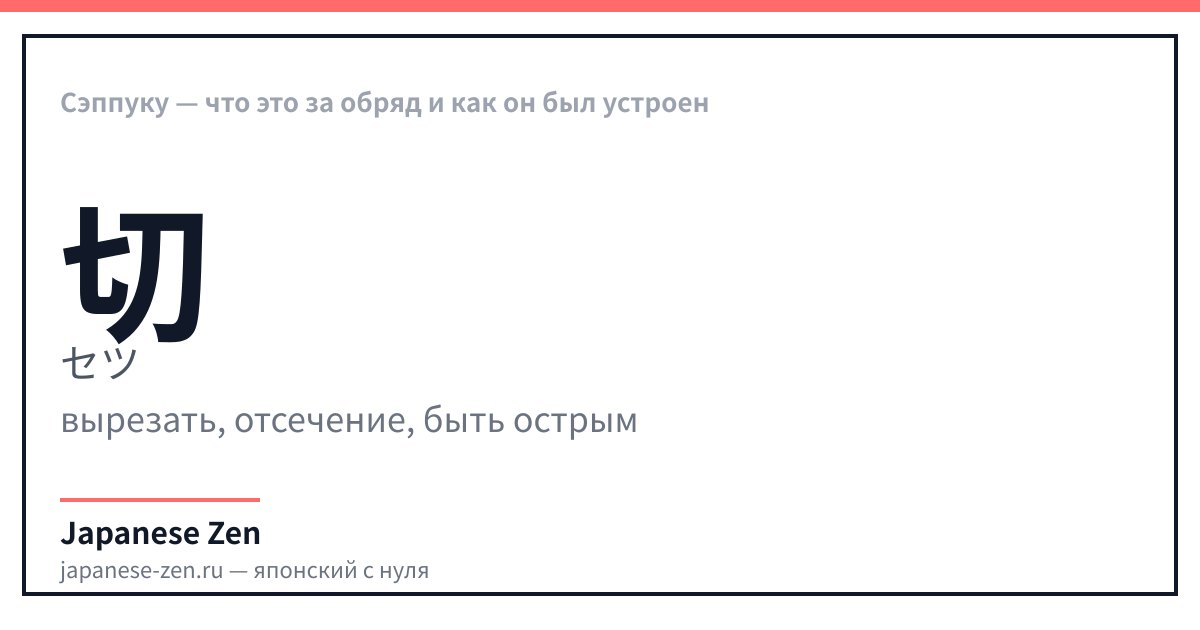
切 — значение: to cut, cutting off, to be sharp — онъёми: セツ、サイ — кунъёми: き.る、-き.る、き.り、-き.り、-ぎ.り、き.れる、-き.れる、き.れ、-き.れ、-ぎ.れ — 4 штрих(ов). 切 — 'to cut': 4 strokes, level N5 — one of the first kanji beginners learn. In combination with 腹 'belly' it gives 切腹 — seppuku in the official reading; in reverse order the same characters are read 'harakiri'.
| Japanese | Reading | Translation |
|---|---|---|
| 切腹 | seppuku · seppuku | Formal ritual, official reading |
| 介錯人 | kaishakunin · kaishakunin | Second who ends suffering with a sword blow |
| 殉死 | junshi · junshi | Following one's lord in death |
| 証人 | shounin · shōnin | Witness of the ritual |
切腹 — the same characters reversed
切腹 breaks down into two characters: 切 'to cut' and 腹 'belly' — the same combination as in harakiri, only in reverse order and with the literary reading. There is no separate word for 'ritual' as an abstract concept in the language — both terms literally describe a physical action.
Listen to the word seppuku and related terms — the app will evaluate your pronunciation.
Seppuku in anime and film
Unlike everyday harakiri, seppuku in film and anime is almost always shown as a ceremony — with protocol and extras, not as an act of despair.
- 'Rurouni Kenshin' — seppuku is repeatedly discussed by characters as part of a samurai's moral choice.
- Japanese film adaptations of the Akō story end with the mass seppuku of the forty-seven rōnin by sentence.
- 'Harakiri' (1962, directed by Masaki Kobayashi) — a classic drama that examines the ceremony as an institution, not as a feat.
FAQ
- What is seppuku?
- 切腹 — a formal ceremony of ritual suicide by a samurai: cutting open the abdomen in the presence of witnesses, ending with a blow from the second. It was assigned as a sentence or performed voluntarily.
- How did seppuku differ from harakiri?
- Not at all in essence — both words denote the same ritual with the same kanji, 切腹 and 腹切り. Seppuku is the official literary reading used in Japan itself; harakiri is the colloquial variant that became established abroad.
- How did sentenced seppuku differ from voluntary?
- Sentenced seppuku was imposed by the authorities as a substitute for beheading — an honorable execution. Voluntary seppuku was performed by a person themselves: out of loyalty, protest, or to avoid capture.
- What is junshi and why was it banned?
- 殉死 — following one's deceased lord in death. The Tokugawa shogunate banned it by special decree in 1663 as a waste of vassals, but the custom was not completely eradicated.
- When was seppuku abolished?
- As a judicial measure — in 1873, during the Meiji reforms, along with the abolition of the samurai class.
- Which cases of seppuku are the most famous?
- The mass seppuku of the forty-seven rōnin in 1703 and the voluntary death of writer Yukio Mishima in 1970 — the last truly prominent case.
Sources
Updated: 2026-08-24