The Book of Five Rings — what it is and what it's about
The Book of Five Rings (五輪書, Gorin no sho) is a treatise by swordsman Miyamoto Musashi on strategy and the art of the sword, dictated in 1643–1645 shortly before his death. It consists of five scrolls, each named after one of the five elements: Earth, Water, Fire, Wind, and Void. In the West, it is often published not as a military treatise but in the business section — as a book on strategy and decision-making.
The title sounds esoteric, but the content is far more practical: it's an analysis of sword-fighting technique written by a man who tested his ideas in real duels, not a philosophical treatise on the harmony of the elements.
What the Book of Five Rings is about
The author is Miyamoto Musashi (宮本武蔵), a swordsman who, according to legend, won more than sixty duels and founded his own school of two-sword combat, Niten Ichi-ryū. He dictated the treatise in the Reigandō cave on the island of Kyushu in 1643–1645, a few weeks before his death — as the culmination of a life in swordsmanship, not a textbook for beginners.
- Author: Miyamoto Musashi, swordsman and artist of the early Edo period.
- Written: 1643–1645, dictated shortly before his death.
- Genre: a practical treatise on combat technique and strategy, not philosophy.
- Form: five scrolls corresponding to the elements of Buddhist cosmology.
How the five scrolls are structured
The Earth scroll sets out the general principles of strategy and the structure of Musashi's school. The Water scroll analyzes sword technique: stances, strikes, body movement — named so because water takes the shape of its container, and a fighter must adapt just as flexibly to the opponent. The Fire scroll is devoted to the duel itself: how to read the opponent and choose the moment of attack. The Wind scroll criticizes other fencing schools, showing their weaknesses through comparison. The Void scroll is the shortest: about the state of mind beyond technique, when mastery becomes intuition.
Shortly before his death, Musashi, in addition to the Book of Five Rings, dictated another short text — Dokkōdō (独行道, 'The Way of Walking Alone'): twenty-one short principles on self-discipline and relying only on oneself. It is sometimes published together with Gorin no sho as an appendix.
Why it's published in the business section in the West
Since the mid-20th century, the Book of Five Rings has been read in the West not as a military treatise but as a guide to strategy applicable to competition, negotiation, and management. Especially after it began to be compared with Sun Tzu's The Art of War: both books offer principles that easily transfer from the battlefield to the boardroom — knowing the enemy, flexibility of tactics, the importance of preparation. Hence the shelf in bookstores — next to management literature, not Japanese history.
What's really there, and what was added
Musashi himself wrote exclusively about swordsmanship and did not intend economic metaphors — those were added by translators and interpreters of the 20th century. But the principle for which the book is torn from its historical context is indeed present in Musashi: the one who wins is not the one who knows more techniques, but the one who soberly understands the situation and the opponent.
Title and characters: 五輪書
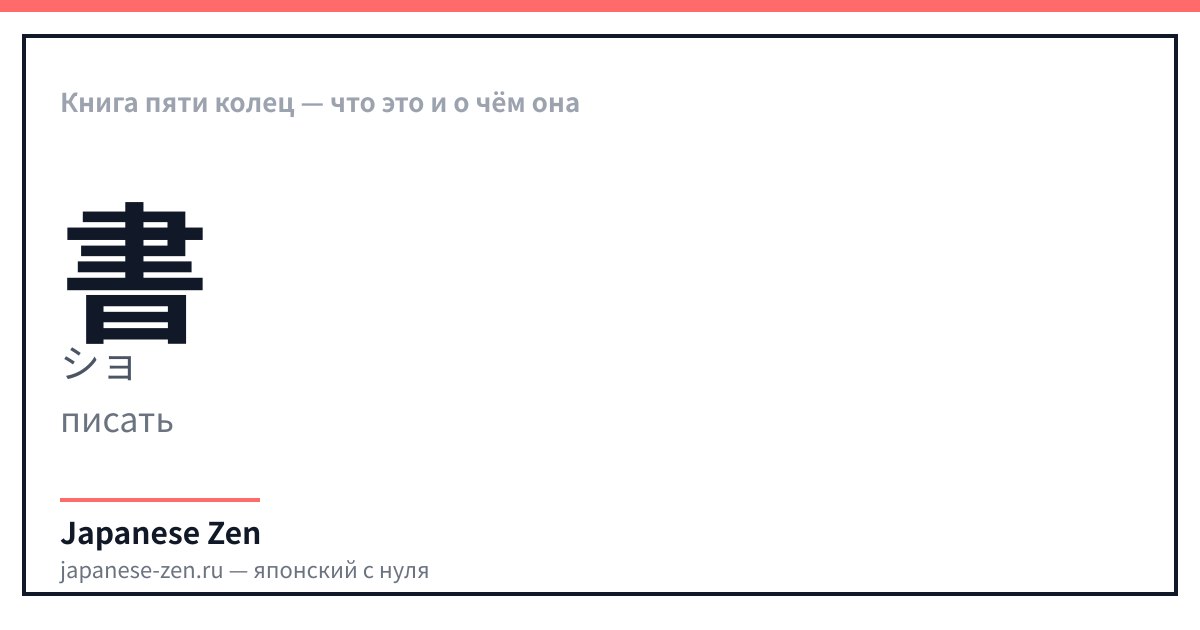
書 — значение: to write — онъёми: ショ — кунъёми: か.く、-が.き、-がき — 10 штрих(ов). 書 — 'to write, book, writing'. In 五輪書 (Gorin no sho) — 'book', recording the 'five rings': the five elements to which the scrolls of the treatise are dedicated.
| Japanese | Reading | Translation |
|---|---|---|
| 五輪書 | gorin no sho · gorin no sho | The Book of Five Rings |
| 宮本武蔵 | Miyamoto Musashi · Miyamoto Musashi | Author of the book |
| 地 | chi · chi | Earth — first scroll |
| 水 | mizu · mizu | Water — second scroll |
| 火 | hi · hi | Fire — third scroll |
| 空 | kuu · kuu | Void — fifth scroll |
五輪 — five elements, not rings
五輪 — 'five rings' or 'five circles', a Buddhist term for the five elements of the universe: earth, water, fire, wind, and void. 書 adds the meaning 'book, writing'. The title describes the structure of the treatise, not its content in a narrow sense.
Listen to the title of the book and the author's name — the app will evaluate your pronunciation.
The Book of Five Rings in culture and games
There are no direct film adaptations of the treatise — it's not a narrative work but a manual. However, the figure of Musashi himself and his teachings regularly appear in other formats.
- The manga 'Vagabond' by Takehiko Inoue shows in detail Musashi's development as a swordsman — up to his later ideas that formed the basis of the treatise.
- In the video game series Nioh and Samurai Warriors, Musashi is a playable character whose skills reference the principles of the Book of Five Rings.
- The title and quotes from the treatise often surface in business literature and motivational materials, without reference to the original source.
FAQ
- What is the Book of Five Rings?
- 五輪書 is a treatise by Miyamoto Musashi on swordsmanship and strategy, dictated in 1643–1645. It consists of five scrolls corresponding to the elements: Earth, Water, Fire, Wind, Void.
- Why do people read the Book of Five Rings today?
- As a guide to strategy and decision-making — in the West it is often published in the business section, compared to Sun Tzu's The Art of War, although Musashi himself wrote only about swordsmanship.
- How do you write 'Book of Five Rings' in Japanese?
- 五輪書, read as 'gorin no sho'. 五輪 means 'five rings', i.e., elements, and 書 means 'book, writing'.
- What is each of the five scrolls about?
- Earth — general principles of strategy, Water — sword technique, Fire — the duel itself, Wind — analysis of other schools, Void — the state of mind beyond technique.
- Who wrote the Book of Five Rings?
- Miyamoto Musashi — swordsman and founder of the Niten Ichi-ryū school, dictated the treatise a few weeks before his death.
- Are there anime or games about the Book of Five Rings?
- There is no direct adaptation of the treatise, but the manga 'Vagabond' shows in detail Musashi's path to the ideas that formed its basis; he himself is a playable character in the games Nioh and Samurai Warriors.
Sources
Updated: 2026-08-24