The Tale of Genji — what the book is about and why it has been read for a thousand years
The Tale of Genji (Genji monogatari) is a Japanese novel from the early 11th century about the courtier Hikaru Genji, the emperor's son whom his father removed from the line of succession and gave the surname Minamoto. The author is the court lady Murasaki Shikibu; its 54 chapters were written in hiragana for the women readers of her circle, and the result was one of the first long stories in world literature about a person's private life rather than about gods and heroic deeds.
The novel has been known for a thousand years, yet the debates around it have not diminished. Who wrote it and when, why no autograph has survived, what "Genji" means in the title, and whether it really is the world's first novel. Let's look at the main storylines, the word 物語 by its kanji, and which English translation is worth reading today.
What happens to Genji over fifty-four chapters
The Tale of Genji tells of Hikaru Genji, the emperor's second son by a beloved but low-ranking consort. To keep his son out of the struggle for the throne, the father removes him from the imperial house as a common subject and gives him the surname Minamoto — thus the hero acquires a second name, Genji, "the Minamoto clan." After the chapter marking Genji's death (its text has not survived; only the title "Clouds That Hid the Moon" remains), his formal son Kaoru comes to the fore. The last ten of the fifty-four chapters are called the "Uji Chapters" (宇治十帖) — they unfold in the town of Uji near Kyoto after the death of the main character.
One of the keys to the tone of the whole book is "mono no aware," the sorrowful charm of fleeting things. The term was introduced into discussion of the novel by the scholar Motoori Norinaga in his treatise Genji monogatari tama no ogushi, completed in 1796.
Why the main character is not called by name
In Heian etiquette it was improper to call a noble person by name, so the novel's characters are referred to by office, kinship, or nickname — and Genji himself is no exception. "Hikaru" ("shining") is a nickname for his beauty, and "Genji" points to his new surname Minamoto; the hero's true personal name is never given in the text. Of the novel's hundreds of characters, real names survive for only two minor men, among them Genji's servant Fujiwara no Koremitsu.
A novel with no autograph at all
Murasaki Shikibu wrote Genji monogatari while already a lady-in-waiting to Empress Shōshi, but it is hard to fit the exact chronology of the novel's composition onto the years of her life — no direct evidence survives. It is known that the novel was read at court no later than 1008: there is an entry about this in The Diary of Murasaki Shikibu.
The original manuscript has not survived: only later copies have come down to us, and they diverge from one another. The most authoritative text is the so-called Aobyōshi-bon, collated in the early 13th century by the poet and scholar Fujiwara no Teika; it is opposed by another line of copies, the Kawachi-bon. The illustrated scrolls Genji monogatari emaki were created in the 12th century, still at the end of the Heian period. The surviving fragments of the scrolls are a National Treasure of Japan, held by the Tokugawa Museum and the Gotoh Museum.
Why a court lady's novel was written in hiragana, not kanji
In Heian Japan official documents and scholarly literature were written in Chinese characters, while the hiragana syllabary was considered "women's writing" — the domain of private letters and stories for ladies and children. Murasaki Shikibu read Chinese fluently, but the novel, like other monogatari of the time, was written in hiragana: this choice of language determined both the genre and the first circle of readers. The paradox is that it was precisely this book that earned its author a reputation as one of the most educated people of her time.
Why the title contains the word "monogatari"
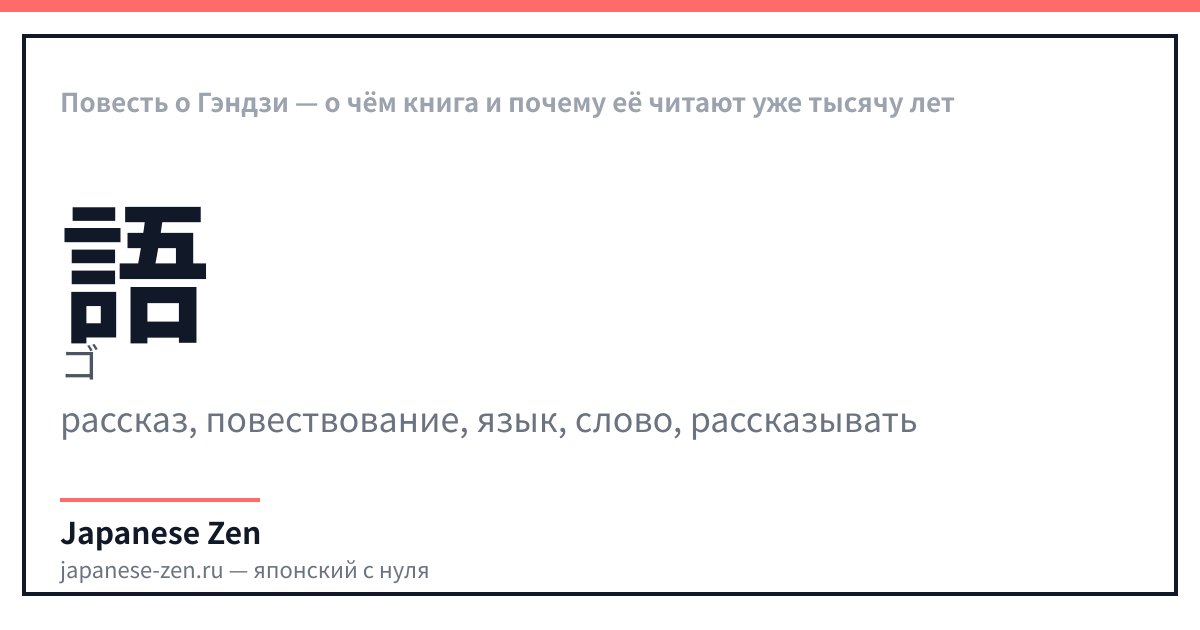
語 — значение: story, narrative, language, word, to tell — онъёми: ゴ — кунъёми: かた.る、かた.らう — 14 штрих(ов). 語 is the second character in 物語 ("narrative"): together with 物 "thing" it forms the name of the novel's genre. The same character appears in 日本語 (nihongo, "Japanese language") and in the verb 語る (kataru, "to tell").
源氏物語 is read げんじものがたり and splits into two words: 源氏 (Genji) — "the Minamoto clan," where 源 means "source, origin" and was once given to members of the imperial family removed from it as common subjects, while 氏 means "clan, family." And 物語 (monogatari) — "narrative," where 物 is "thing, object" plus 語 "story." The character 語 is read GO in Sino-Japanese compounds like 日本語, and kataru as an independent verb "to tell." The word "monogatari" has since become the name of an entire genre of Japanese prose, not just this book.
In The Tale of Genji itself, in the chapter "Eawase" ("A Picture Contest"), The Tale of the Bamboo Cutter (竹取物語) — the prototype of the modern tale of Kaguya-hime — is called "the ancestor of all tales." For Heian readers it was the oldest of the tales they knew.
How the word "monogatari" lives in the modern language
Today 物語 is an ordinary word: it names a novel, a story based on a film, and a person's life path. The verb 語る (kataru) in colloquial speech simply means "to tell, to share," with no connection to court literature.
| Japanese | Reading | Translation |
|---|---|---|
| 源氏物語 | Genji monogatari · Genji monogatari | The title of the novel as a whole |
| 物語 | monogatari · monogatari | Narrative, tale — the genre of the novel |
| 語る | kataru · kataru | To tell |
| 日本語 | nihongo · nihongo | Japanese language |
| 宇治十帖 | Uji jūjō · Uji jūjō | The "Uji Chapters" — the last ten chapters of the novel |
| 光源氏 | Hikaru Genji · Hikaru Genji | "Shining Genji" — the hero's nickname |
Write 語 along the guides — the character for "story," without which no Japanese novel can be named.
Which translation of Genji to read and what is confused about it
The novel has been translated into many languages. Full translations include the English versions by Arthur Waley — in six volumes between 1925 and 1933, in a free, poetic style; Edward Seidensticker — in 1976, closer to the original; and Royall Tyler — in 2001, with detailed commentary for specialists — as well as the Russian translation by T. L. Sokolova-Delyusina, first published in the early 1990s and reprinted several times since.
| Translator | Language | Years |
|---|---|---|
| T. L. Sokolova-Delyusina | Russian | 1991–1993 |
| Arthur Waley | English | 1925–1933 |
| Edward Seidensticker | English | 1976 |
| Royall Tyler | English | 2001 |
Three common misconceptions cling to the novel. The first is that it is "the world's first novel." There is no clear definition of a novel, and Japan itself has older prose texts, including the already-mentioned The Tale of the Bamboo Cutter. So it is more accurate to speak of one of the earliest and most famous full-scale psychological novels. The second is that the book boils down to Genji's love affairs: court life, poetry, and power are no less important in it, and after the chapter about his death the narrative centers on a different hero altogether. The third is that Genji had a real prototype: this is only a hypothesis, not an established fact.
Did Genji have a real prototype?
One hypothesis names Prince Minamoto no Takaakira as the prototype of Genji — like the novel's hero, he was an emperor's son removed from the imperial family as a common subject, and he too suffered disgrace. There is no direct confirmation: Murasaki Shikibu nowhere names prototypes and probably combined features of several contemporaries and literary predecessors in the hero's image.
FAQ
- What is The Tale of Genji about?
- The novel tells of the courtier Hikaru Genji, the emperor's son removed from the imperial family as a common subject with the surname Minamoto: his rise, romances, and disgraces at the Heian court. After the chapter marking his death (whose text has not survived), the book's hero changes — the remaining ten chapters, the "Uji Chapters," are devoted to his formal son Kaoru.
- Who wrote The Tale of Genji and when?
- The author is considered to be the court lady Murasaki Shikibu. The exact date work began is unknown, but the novel was already read at court no later than 1008 — there is an entry about this in The Diary of Murasaki Shikibu. The original has not survived, and only later copies have come down to us.
- How many chapters are in The Tale of Genji?
- In the version familiar today there are 54 chapters, although the text of one of them, "Clouds That Hid the Moon," has not survived — only the title is known. The last ten chapters are separately called the "Uji Chapters" after the place where the action unfolds.
- In which translations can you read The Tale of Genji?
- The novel has been translated into many languages. Full translations include the English versions by Arthur Waley (1925–1933), Edward Seidensticker (1976), and Royall Tyler (2001), as well as the Russian translation by japanologist T. L. Sokolova-Delyusina, first published in the early 1990s and reprinted several times since. Waley's six-volume version is free and poetic; Seidensticker's is closer to the original; Tyler's includes detailed commentary for specialists.
- Is it true that this is the world's first novel?
- It is often called that, but the claim is debatable: there is no clear definition of a novel, and Japan itself has earlier examples of prose, such as The Tale of the Bamboo Cutter. More accurately, it is one of the earliest and the most famous full-scale psychological novel in world literature.
- What does "Genji" mean in the title?
- "Genji" is the surname of the Minamoto clan, which in the Heian period was given to princes removed from the imperial family as common subjects. The novel's hero receives this surname too: "Genji" is not a personal name but an indication of his new status.
Sources
Updated: 2026-09-15