Kojiki: Myths of Ancient Japan — What This Book Is
Kojiki ('Records of Ancient Matters') is not a myth but a book: the oldest surviving chronicle of Japan, written in 712 from the recitation of the storyteller Hieda no Are by the court official Ō no Yasumaro. It is the first written record of myths about the creation of the world, Amaterasu, Susanoo, and the origins of the imperial line.
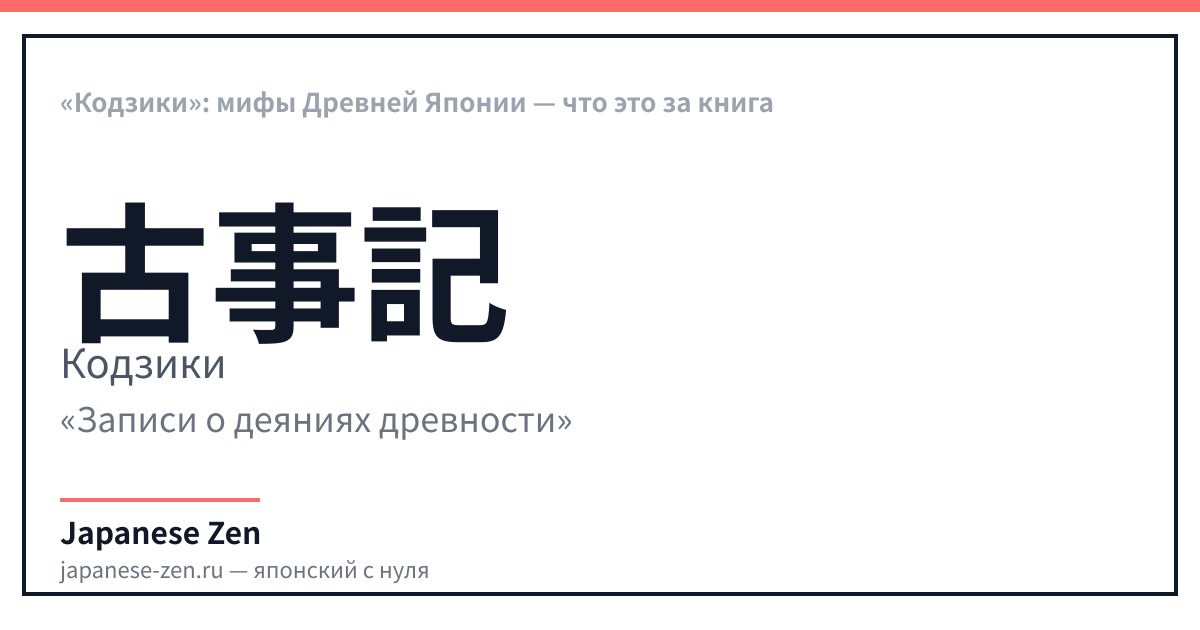
Kojiki is often confused with mythology itself — but it is simply a book, written for a specific political purpose: to justify the divine origin of the ruling dynasty, and at the same time to record oral traditions before they were completely forgotten.
What is Kojiki and why was it written
Kojiki is the oldest surviving written monument of Japan, completed in 712. Emperor Tenmu ordered the storyteller Hieda no Are to memorize the genealogies and traditions of the imperial court, and decades later, the court official Ō no Yasumaro recorded them from Are's recitation by order of Empress Genmei. The purpose was pragmatic: to establish the official version of mythology and genealogy, justifying the power of the ruling dynasty as directly descended from the sun goddess Amaterasu.
- Year of completion: 712, under Empress Genmei.
- Author of the record: Ō no Yasumaro, court official.
- Source of the text: oral traditions recited by the storyteller Hieda no Are.
- Format: three scrolls — the 'Age of the Gods' and the reigns of the first legendary emperors.
What's inside: three scrolls
The first scroll is entirely devoted to the 'Age of the Gods': the creation of the world by Izanagi and Izanami, the myth of Amaterasu's cave, Susanoo's feat against the serpent Yamata no Orochi, and the descent to earth of Amaterasu's grandson Ninigi. The second and third scrolls describe the reigns of legendary and semi-legendary early emperors, from Jimmu to Suiko, gradually shifting from pure myth to semi-historical chronicles — the boundary between fiction and history is never explicitly drawn in the text.
Why the text remained in the shadows for a long time
For several centuries, Kojiki was overshadowed by Nihon Shoki, written in classical Chinese for international prestige. The status of Kojiki was changed by the scholar Motoori Norinaga, who devoted a 44-volume work, 'Kojiki-den' (1798), to analyzing the text — it was after this that the book came to be regarded as the main source on indigenous Japanese, rather than borrowed Chinese, thought.
古事記 — 'Record of Ancient Matters'
| Japanese | Reading | Translation |
|---|---|---|
| 古事記 | Kojiki · Kojiki | Records of Ancient Matters |
| 日本書紀 | Nihon Shoki · Nihon Shoki | The second major chronicle, 720 AD |
| 太安万侶 | Ō no Yasumaro · O no Yasumaro | Compiler of the Kojiki record |
| 神代 | kamiyo · kamiyo | Age of the Gods — the first scroll of the book |
| 本居宣長 | Motoori Norinaga · Motoori Norinaga | Scholar who restored the book's significance in the 18th century |
What three characters make up the title
古事記 is read こじき: 古 'ancient', 事 'deed, event', 記 'to record, record'. Literally — 'record of ancient deeds'. The text is written in a complex mixture of Chinese characters used sometimes for meaning, sometimes phonetically (man'yōgana) — a rare and valuable linguistic monument of the transitional period of Japanese writing.
記 — значение: to record, record, to describe — онъёми: キ — кунъёми: しる.す — 10 штрих(ов). 記 — 'to record, record': on the left is speech 言, on the right the phonetic 己. The same character appears in 日記 (diary) and 記憶 (memory).
Write 記 along the guides and learn the stroke order.
Kojiki as a plot for Ōkami
- Ōkami — the plot and list of gods in the video game are built almost exactly according to the outline of the first scroll of Kojiki.
- Naruto — borrows not plots but names and images: Amaterasu, Susanoo, Izanami straight from the text of the chronicle.
- Fate/Grand Order — the Japanese story arc regularly references events and figures from Kojiki.
- Many historical and fantasy manga use the book as a reference for names and genealogies without retelling it directly.
How Kojiki differs from Nihon Shoki
- Language: Kojiki is written in a hybrid Japanese-Chinese script, Nihon Shoki in classical Chinese for an external audience.
- Audience: Kojiki was created for internal court use, Nihon Shoki with an eye to diplomatic prestige before continental neighbors.
- Structure of myths: Nihon Shoki presents several variants of the same myth in succession, Kojiki gives one coherent version.
- Fate: Kojiki remained in the shadows for centuries until it was rediscovered by Motoori Norinaga in the 18th century.
FAQ
- Is Kojiki mythology or a book?
- A book: the oldest surviving Japanese chronicle from 712, recorded by Ō no Yasumaro from the words of a storyteller. The myths collected in it existed orally before — Kojiki merely recorded them in writing for the first time.
- What does Kojiki tell about?
- About the creation of the world by the gods Izanagi and Izanami, the main myths about Amaterasu and Susanoo, and then about the reigns of the legendary first emperors of Japan up to the 7th century.
- What does the title 古事記 mean?
- 古事記 (こじき): 古 'ancient', 事 'deed', 記 'record' — literally 'record of ancient deeds'. The text is written in a complex mixture of semantic and phonetic characters.
- What in anime is based on Kojiki?
- Directly — rarely, but its plots and names underlie Ōkami and regularly surface in Naruto and Fate/Grand Order as a source of god names and techniques.
- Who is the author of Kojiki?
- The formal compiler of the record is the court official Ō no Yasumaro, but the source of the text was oral traditions recited by the storyteller Hieda no Are. The book has no single 'author' of the myths in the Western sense.
Sources
Updated: 2026-08-29