Shintoism — what it really means
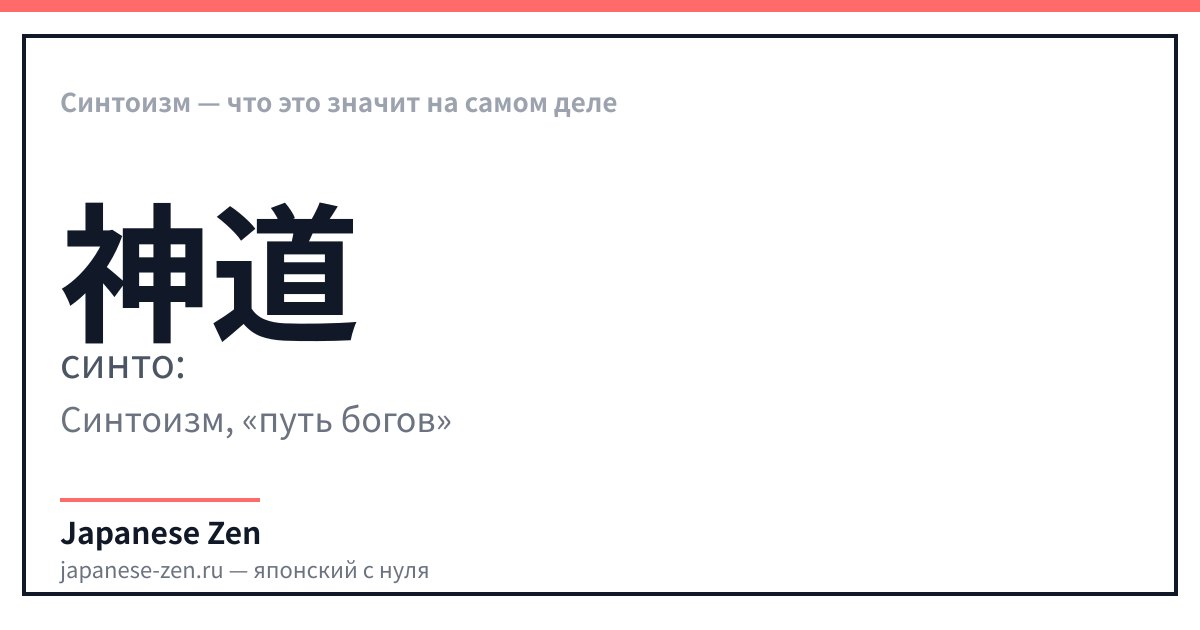
Shintoism is Japan's indigenous religion without a founder, sacred scripture, or concept of sin: a cult of countless kami, spirits of rivers, mountains, ancestors, and natural phenomena. The word literally means 'the way of the gods' (神道). It is not so much a belief system as a set of purification and veneration rituals — you perform them without even articulating what exactly you believe.
Ask a Japanese person if they are a Shintoist, and half the time you'll get a puzzled shrug. Shintoism is not a club with membership, but a backdrop: a New Year's ritual, a wedding at a shrine, hands clapped before torii gates. Believing is optional; doing is enough.
What 'Shintoism' means
The word 'Shinto' (神道) literally translates as 'the way of the gods': 神 means 'god, spirit', 道 means 'way, path'. The term appeared in the 6th century to distinguish the indigenous cult of kami from Buddhism brought from Korea — before that, local beliefs didn't even have a separate name; they were simply what everyone did. A working definition: a system of rituals venerating kami — the spiritual power possessed by mountains, waterfalls, trees, deceased ancestors, and legendary clan founders.
| Japanese | Reading | Translation |
|---|---|---|
| 神道 | shintō · shintō | Shintoism, 'the way of the gods' |
| 神社 | jinja · jinja | Shinto shrine |
| 氏神 | ujigami · ujigami | Clan or local patron deity |
| 祓い | harai · harai | Purification ritual |
| 八百万の神 | yaoyorozu no kami · yaoyorozu no kami | 'Eight million gods' — all kami collectively |
How to translate this without losing meaning
'The way of the gods' sounds too lofty for what in practice amounts to washing hands at a shrine and clapping hands. More accurately — 'how one is supposed to deal with the divine here': a way in the sense of a route, a habit, not a philosophical doctrine. Comparing it to a Western-type 'religion' is itself a distortion — Shinto has no creed to accept.
神道 character by character: 'way' and 'gods'
道 — значение: road, street, district, journey, course — онъёми: ドウ、トウ — кунъёми: みち、いう — 12 штрих(ов). 道 — 'way, road, doctrine': the same character appears in 武士道 (way of the warrior) and 茶道 (way of tea). Inside, it contains the element 'to go' and the head 首, a symbol of direction of movement.
What parts the character is made of
道 consists of the element 'to go, to advance' (辶) and the character 'head' (首) — literally 'to lead with the head', meaning to move consciously, not wander aimlessly. The same character appears at the end of dozens of Japanese 'ways': tea ceremony, calligraphy, martial arts. Shinto is just one of many paths, simply the oldest.
Write 道 along the guides and learn the stroke order at the same time.
How it works in practice
- Hatsumōde — the first shrine visit of the New Year: buy a lucky omamori amulet and toss a coin into the offering box.
- Jichinsai — a ground-breaking ceremony before construction: even Tokyo office skyscrapers start with a priest and offerings.
- Kamidana — a home altar shelf with miniature torii gates, where rice, salt, and water are placed.
- Matsuri — seasonal festivals in honor of the local kami, when it is temporarily paraded through the streets in a portable shrine (mikoshi).
- Purification ritual (harai) before important undertakings — from opening a store to the start of the baseball season.
What Japanese people mean by it, and what the West added
In the West, Shinto is often described as a 'religion of nature' with a New Age tinge — harmony with all living things. In Japan itself, the emphasis is more pragmatic: rituals remove pollution (kegare) — not sin in the Christian sense, but something like spiritual dirt from death, illness, or misfortune that needs to be physically washed away.
Common misconceptions
- 'Shinto is Buddhism' — no, they are two different religions that have coexisted side by side for centuries: weddings are often Shinto, funerals are Buddhist.
- 'Shinto has a sacred book like the Bible' — the 'Kojiki' and 'Nihon Shoki' are mythological compilations written at the court's request, not a revelation that must be followed.
- 'Shinto requires belief in gods' — no formal belief is required: you can perform rituals purely out of tradition without pondering the literal existence of kami.
- 'All Shinto shrines are the same' — each has its own tutelary kami, its own history, and often a narrow specialization: exams, childbirth, commerce.
FAQ
- What does 'Shintoism' mean?
- Literally — 'the way of the gods' (神道): a system of rituals venerating kami, the spiritual power of nature, ancestors, and places. It is not so much a doctrine as a practice: a set of actions performed regardless of personal beliefs.
- How many gods are there in Shintoism?
- The phrase 'eight million kami' (八百万の神) is not a census but an image of countlessness: a mountain, waterfall, tree, or clan ancestor can be a god. No exact list exists or is intended.
- How is 'Shintoism' written in kanji?
- 神道, shintō. The first character 神 means 'god, spirit', the second 道 means 'way'. The Russian word 'синтоизм' is a suffixal adaptation of this Japanese term; in Japan itself, people simply say Shinto.
- Where did this concept come from?
- The name appeared in the 6th century CE, when Buddhism arrived from Korea and the local kami cult needed a separate name. Before that, it existed without a name — it was simply the everyday order of things.
- How does it work in practice?
- Through purification and offering rituals: visiting shrines, the home kamidana altar, seasonal matsuri festivals. Shintoism does not require formal belief or regular services like a church.
- What is most often misunderstood?
- That Shinto is Buddhism, or that it requires faith like Christianity. In reality, it is a separate religion without a creed: a Japanese person can easily be Buddhist in philosophy and Shinto in rituals at the same time.
Sources
Updated: 2026-08-29