Ise Jingū: the shrine that is rebuilt from scratch every 20 years
Ise Jingū (伊勢神宮) is Japan's most important Shinto shrine, made up of two parts: Naikū is dedicated to the sun goddess Amaterasu, Gekū to the food goddess Toyouke. Every 20 years all the buildings are rebuilt on an adjacent plot in the Shikinen Sengū ceremony: a tradition almost 1,300 years old, though during the era of civil wars the ceremony was interrupted for more than a hundred years.
Constant rebuilding sounds like a paradox for an "ancient" shrine, but that is precisely the essence of the Shinto understanding of holiness: not a stone that stands forever, but a ritual that is repeated anew. Let's look at who Naikū and Gekū are dedicated to, why the shrine's official name is simply "Jingū," and how the character 勢 from the name of Ise Province lives on in ordinary Japanese words.
Naikū and Gekū: the two halves of Ise Jingū and their goddesses
Ise Jingū is a complex in Mie Prefecture: two main shrines and more than a hundred smaller ones — 125 in total. Naikū, the "inner shrine," is dedicated to Amaterasu — the sun goddess and mythical ancestress of the Japanese imperial line. Gekū, the "outer shrine," stands a few kilometers from Naikū and is dedicated to Toyouke — the goddess of food and harvest, who, according to legend, provides Amaterasu with food. Both parts also have their own full names — 皇大神宮 for Naikū and 豊受大神宮 for Gekū — but in everyday use they are called more simply.
Why the official name is simply "Jingū"
In conversation and guidebooks the place is called Ise Jingū, but the shrine's own official name is only 神宮, "Jingū," without the qualifier "Ise." In Japanese tradition this word by default refers to this very complex, while other Shinto shrines of equally high status add their own name to "Jingū," for example Meiji Jingū in Tokyo. This exception emphasizes the special place of Ise Jingū among the country's shrines.
Shikinen Sengū: the ceremony that rebuilds the shrine every 20 years
Shikinen Sengū is the ceremony by which both main shrines of Ise Jingū are rebuilt every 20 years on an adjacent empty plot, and then the shintai — the object in which the deity is believed to reside — is transferred there. It is not only the buildings that are transferred: the priests' robes are sewn anew, and sacred utensils and garments for the deities are made anew. The first such ceremony was held in 690, and since then the tradition is almost 1,300 years old.
The interruption in the era of civil wars
The ritual did not always run continuously: during the era of warring provinces the sengū was interrupted for more than 120 years, and the tradition was resumed only in 1585. So the claim that "Shikinen Sengū has been held without interruption since the 7th century" is inaccurate: the tradition itself does indeed go back to 690, but with a noticeable gap of several generations. The 62nd Shikinen Sengū was held in 2013, and the 63rd is planned for 2033.
神宮 vs 神社 and 大社: ranks of shrine names
Shinto shrines have several ranks of names that historically indicated the status of the place. 神社 (jinja) is the general word for any shrine. 大社 (taisha) is a "great shrine": this is what either the most significant shrine of a region is called, or the head temple of a whole network of shrines of one deity across the country, like Fushimi Inari Taisha. 神宮 (jingū) is the highest status, historically reserved for shrines closely connected with the imperial house: besides Ise, this name is borne, for example, by Meiji Jingū in Tokyo and Atsuta Jingū in Nagoya.
伊勢 — the name of an ancient province
Ise is not part of the name of a deity, but the name of a historical province in the east of present-day Mie Prefecture, where the shrine stands. The second character in its name, 勢, means "force, momentum," while the first, 伊, in place names is mostly used for its sound, without a meaning of its own — similar combinations are found in other old names of Japanese provinces.
勢 — force and momentum: the character from the name of Ise Province
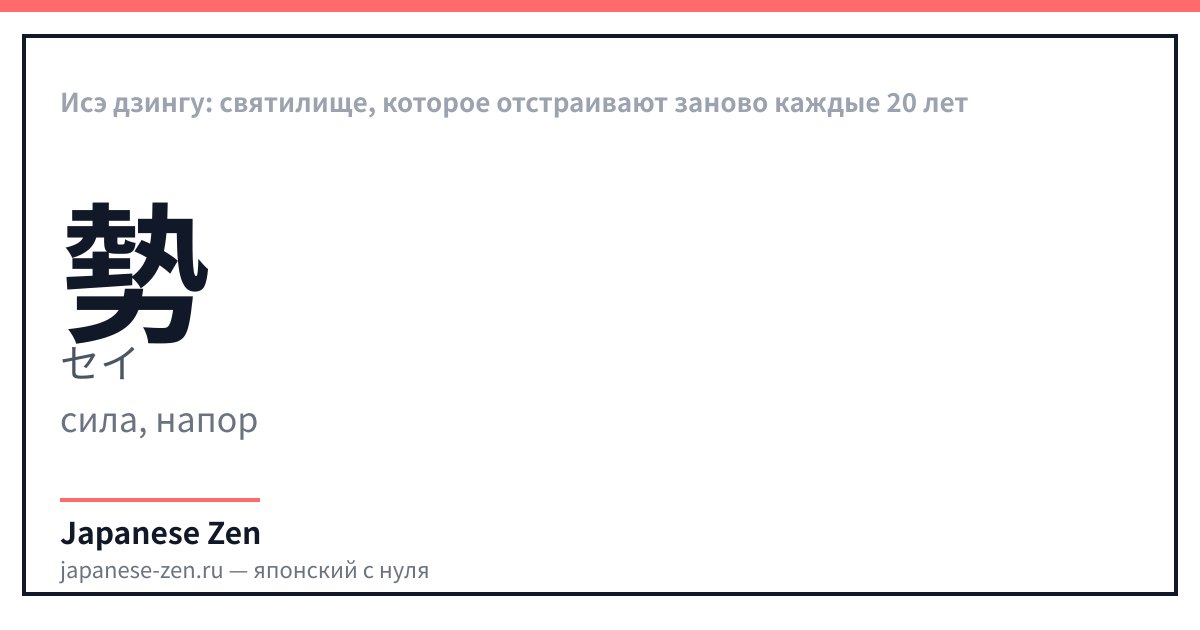
勢 — значение: force, momentum — онъёми: セイ、ゼイ — кунъёми: いきお.い、はずみ — 13 штрих(ов). 勢 — the second character in the name of Ise Province (伊勢), "force, momentum." In standalone words it appears far more often than in this place name: 勢い, "momentum, impetuosity," and 姿勢, "posture, stance."
The character 勢 has two on'yomi readings — sei and zei — and the kun'yomi ikioi, "momentum, impetuosity." In the name Ise it appears as part of a place name and carries no special meaning on its own, but as a standalone word 勢い (ikioi) means impetuosity or momentum — of rain, a crowd, an argument.
姿勢 — not just posture
姿勢 (shisei) is made up of 姿 "appearance, pose" and 勢 "momentum." The word means not only physical posture but also a person's stance in an argument or a matter: a firm stance — shisei — is taken in negotiations too, not only while standing at a desk.
| Japanese | Reading | Translation |
|---|---|---|
| 伊勢神宮 | Ise Jingū · Ise Jingū | Name of the shrine |
| 神宮 | jingū · jingū | Official name of the shrine |
| 内宮 | Naikū · Naikū | Inner shrine, dedicated to Amaterasu |
| 外宮 | Gekū · Gekū | Outer shrine, dedicated to Toyouke |
| 勢い | ikioi · ikioi | Momentum, impetuosity |
| 姿勢 | shisei · shisei | Posture, stance |
Write 勢 along the guides — the character of "momentum" from the name of Ise Province.
FAQ
- What is Ise Jingū?
- Japan's most important Shinto shrine in Mie Prefecture, consisting of two parts: Naikū venerates the sun goddess Amaterasu, and Gekū the food goddess Toyouke. Everything here is regularly rebuilt anew — permanence rests not on stone but on a repeated ritual.
- How do Naikū and Gekū differ?
- Naikū, the "inner shrine," is dedicated to Amaterasu — the sun goddess and ancestress of the imperial line. Gekū, the "outer shrine," stands a few kilometers from Naikū and is dedicated to Toyouke, the goddess of food and harvest, who, according to legend, supplies Amaterasu with food.
- What is Shikinen Sengū?
- The ceremony by which both main shrines of Ise Jingū are rebuilt every 20 years on an adjacent plot and the shintai — the object in which the deity is believed to reside — is transferred there. The first ceremony was held in 690, and the 62nd in 2013; the next, the 63rd, is planned for 2033.
- Is it true that Shikinen Sengū has been held without interruption since the 7th century?
- No: the tradition did indeed begin in 690, but during the era of warring provinces the rebuildings ceased for more than 120 years and resumed only in 1585. Since then the ceremony has been held regularly every 20 years.
- Why is the shrine called simply "Jingū"?
- The word 神宮 without the qualifier "Ise" in Japanese tradition by default means this very complex — such a status is historically reserved only for it. Other shrines of the same rank, for example Meiji Jingū, always add their own name to the word "Jingū."
- How is "Ise Jingū" written in kanji?
- 伊勢神宮, in kana いせじんぐう. 伊勢 is the name of the ancient province where the shrine stands, 神宮 (jingū) is a shrine of the highest rank. The second character in the province's name, 勢, on its own means "force, momentum" and appears in words like 勢い and 姿勢.
Sources
Updated: 2026-09-15