Shichi-go-san: Why Children Are Taken to a Shrine at Three, Five, and Seven
Shichi-go-san (七五三) is a rite held on November 15 for children aged three, five, and seven: the family visits a Shinto shrine to give thanks for the child's health and ask for protection in the future. The day never became a national holiday and remains a working day. Each age has its own historical rite — kamioki, hakamagi, and obitoki — and children take home a long chitose-ame candy with a wish for long life.
Three, five, and seven years were not chosen at random: behind them are three different old coming-of-age rites that over time were combined under a single festive name. Let's look at what each of these rites meant, where the date of November 15 came from, and why the sweet gift of this day is called the "thousand-year candy."
November 15: An Ordinary Day, But Not for Families with Children
On November 15, families with children aged three, five, and seven go to a Shinto shrine: the children are dressed in kimono, a priest reads a prayer of thanks, and afterward there are photographs in the shrine courtyard. The day is not among Japan's 16 national holidays and remains an ordinary working and school day, so the visit is often moved to the nearest weekend.
From Edo Fashion to a Nationwide Custom
Shichi-go-san took shape during the Edo period: according to tradition, the occasion was the kamioki rite for Tokugawa Tokumatsu, son of the fifth shogun Tokugawa Tsunayoshi, held on the 15th day of the eleventh lunar month in 1681. The lavish urban version of the celebration was first taken up by the residents of Edo, then Kyoto and Osaka, and it became a nationwide custom far from immediately.
Three, Five, Seven: What These Numbers Mean
Three years, five years, and seven were not chosen at random: in Chinese numerology, which Japan adopted, odd numbers are considered auspicious, and festive rites are traditionally scheduled on them. Each age has its own rite, and originally these were three different events, not three variants of the same holiday.
| Age | Rite | What It Meant |
|---|---|---|
| 3 years | 髪置 (kamioki) | The child stopped having their head shaved for the first time and began to grow their hair |
| 5 years | 袴着 (hakamagi) | A boy wore hakama for the first time — part of adult men's clothing |
| 7 years | 帯解 (obitoki) | A girl switched from a children's string belt to a real wide obi |
Who Goes Through Which Rite
In the most common, Edo version, kamioki at three years is mainly undergone by girls, although in the past boys were also celebrated this way. Hakamagi at five years is only for boys, and the rite goes back to court practice of the Heian period. Obitoki at seven years is only for girls. In different regions of the country, the ages and order of the rites differ, so this is a common version, not the only correct one.
Chitose-ame: A Candy a Thousand Years Long
Chitose-ame is a long, thin candy, usually colored red and white, placed in a bag decorated with images of a crane, turtle, pine, bamboo, and plum — traditional symbols of longevity in East Asia. The name "chitose" means "a thousand years" and directly expresses the wish for long life, while the stretching shape of the candy itself reinforces the same image — a thread one does not want to break.
The Asakusa Merchant Who Started It All
According to a common version, the candy was invented by a sweets merchant named Shichibei in the Asakusa district of Edo, at the turn of the 17th and 18th centuries, during the reign of the same shogun Tokugawa Tsunayoshi. He called his product "sennen-ame," "thousand-year candy," and from this name, it is believed, the current "chitose-ame" originated.
The Kanji 千: How a Thousand Became a Wish for Longevity
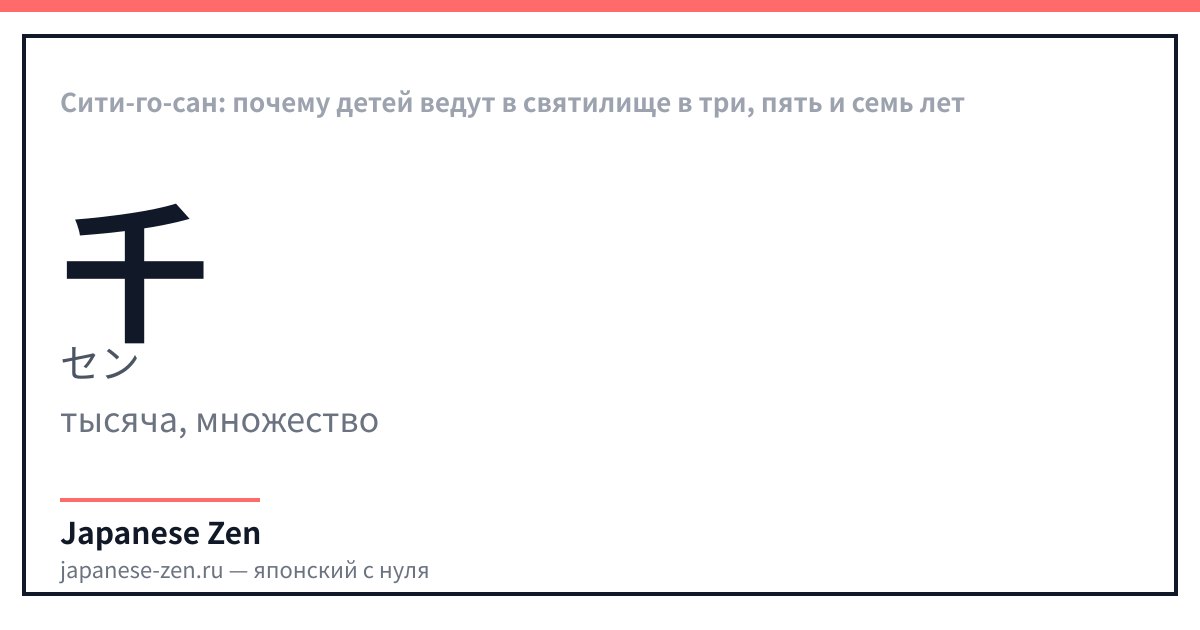
千 — значение: thousand, many — онъёми: セン — кунъёми: ち — 3 штрих(ов). 千 means "thousand" — the same character appears in 千歳飴, the "thousand-year candy" that children take home after the shrine rite.
Why "Shichi-go-san," Not "Nanatsu-itsutsu-mittsu"
七五三 is read with the Chinese-derived readings of the numbers: 七 — shichi, 五 — go, 三 — san. In ordinary speech, the same numbers when counting age are called differently, with native Japanese readings: nanatsu, itsutsu, mittsu. The name of the holiday is a fixed combination that has long lived separately from colloquial age counting.
The character 千 also appears in other wishes for longevity. 千歳 (chitose) means "a thousand years" — the same word as in the name of the candy, only without "ame." 千代 (chiyo) — "a thousand generations," similar in meaning. 千羽鶴 (sembazuru) — a thousand paper cranes folded with the same wish for health.
| Japanese | Reading | Translation |
|---|---|---|
| 七五三 | shichigosan · shichigosan | Shichi-go-san |
| 千歳飴 | chitose ame · chitose ame | Thousand-year candy |
| 髪置 | kamioki · kamioki | Hair-growing rite at three years |
| 袴着 | hakamagi · hakamagi | First hakama rite at five years |
| 帯解 | obitoki · obitoki | First obi rite at seven years |
Write 千 along the guides — the character for "thousand" from 千歳飴, the candy children carry home after the rite.
FAQ
- What is the shichi-go-san rite and when is it held?
- Shichi-go-san is a rite held on November 15 for children aged three, five, and seven: the family goes to a Shinto shrine to give thanks for the child's health and ask for protection in the future. The day never became a national holiday, so the shrine visit is often moved to the nearest weekend.
- Why are children taken to the shrine specifically at three, five, and seven years?
- These numbers are odd, and in Chinese numerology, which Japan adopted, odd numbers are considered auspicious for festive rites. Each age also has its own historical coming-of-age rite — kamioki, hakamagi, and obitoki — which over time were combined under a single name.
- What do the rites kamioki, hakamagi, and obitoki mean?
- Kamioki at three years — the child stopped having their head shaved for the first time and began to grow their hair. Hakamagi at five years — a boy wore hakama for the first time, part of adult men's clothing. Obitoki at seven years — a girl switched from a children's string belt to a real wide obi.
- What does the chitose-ame candy symbolize at shichi-go-san?
- The long, thin candy in red-and-white stripes symbolizes a wish for long life: the name "chitose" itself means "a thousand years," and the stretching shape reinforces the same image. According to a common version, the candy was invented by the merchant Shichibei in Asakusa at the turn of the 17th and 18th centuries.
- How is "shichi-go-san" written in Japanese?
- 七五三, in kana しちごさん. The three characters are the numbers seven, five, and three, read with the Chinese-derived readings: shichi, go, san. In ordinary speech, when counting years, the same numbers are called differently, with the Japanese words nanatsu, itsutsu, mittsu.
Sources
Updated: 2026-09-15