Koinobori — Carp Streamers on May 5: Which Carp Is Which in the Family
Koinobori (鯉のぼり) are cloth carp streamers flown on May 5 for Tango no Sekku, also known as the national Children's Day, Kodomo no Hi. The black carp, magoi, represents the father; the red carp, higoi, the mother; and the blue and other carp added later represent the children. The custom began in the Edo period: townspeople replaced the samurai banner with a family crest with a carp figure from the legend of the Dragon Gate.
Koinobori looks like a simple holiday decoration, but each carp in the set has a role, and the figure itself appeared as the townspeople's answer to the samurai privilege of flying banners. Let's break down which carp is which, where the legend of the carp and the dragon came from, and why the character 端 in the festival's name does not mean "end" at all.
May 5: What Is Flown and Why It's a Holiday
On May 5, koinobori are raised on balconies, roofs, and poles in courtyards — hollow cloth carp that fill with wind and seem to swim through the air. The day is called Tango no Sekku, and since 1948 it has also been Kodomo no Hi, Children's Day: a national holiday under the Holidays Act. Originally Tango no Sekku was celebrated only for boys; today Kodomo no Hi is a holiday for all children, though by tradition koinobori are still flown in honor of sons.
The Holiday Law: Both Children and Gratitude to Mothers
The 1948 law describes the meaning of the day as follows: to respect the child's personality, to care for their happiness, and also to thank the mother. The last part was added for a reason: during the law's discussion, there was a proposal to make a national holiday not the May day but the March Hinamatsuri, the girls' festival. In the end, the date of Tango no Sekku was kept, but its meaning was expanded to include gratitude to mothers and all children regardless of gender.
Which Carp Is Which in the Family: A Breakdown by Figure
| Figure | Writing | Who or What It Is |
|---|---|---|
| Fukinagashi | 吹き流し | A multicolored cloth streamer at the top of the pole — a talisman, not a carp |
| Magoi | 真鯉 | The black carp — the eldest and once the only one, represents the father |
| Higoi | 緋鯉 | The red carp; appeared paired with magoi at the turn of the 19th–20th centuries |
| Aogoi | 青鯉 | The blue carp was added later — around the same time higoi came to be read as the mother, and aogoi took the child's place |
How the Family on the Pole Changed
The first koinobori was monochrome: a black magoi and no one else. By the late 19th to early 20th century, it had a companion, the red higoi, and in the 1931 song "Koinobori," magoi is still called the father and higoi the child. The third, blue carp, aogoi, was added only at the turn of the 1950s and 1960s, and with it higoi came to be read as the mother, while aogoi took the child's place. Later, more carp — green, pink — began to be added to the set, one for each child in the family, though no single name for them ever took hold.
Why the Carp: A Chinese Legend and a Samurai Dispute
The legend of the carp that climbed the waterfall of the Dragon Gate (登竜門) and became a dragon came from China — it is recorded in the "Hou Hanshu," the history of the Later Han dynasty. Dozens of fish tried to overcome the current, but only one carp reached the end and turned into a dragon. In Japan, the story became a metaphor for perseverance and success on the way up: the word "tōryūmon," "dragon gate," still means a difficult exam or a decisive test.
The Samurai Banner and the Townspeople's Carp
The custom of flying banners on Tango no Sekku began in samurai families of the Edo period: at the entrance they placed nobori and hatajirushi — banners with the family crest that had previously marked the gathering place of troops. In the middle of the period, townspeople, for whom a crest was above their station, came up with their own answer: they replaced the small flag at the top of the pole with a carp figure from the legend of the Dragon Gate. Gradually the figure grew into a separate flag-bag — the very koinobori.
The Kanji 端: The Edge from Which Counting Begins
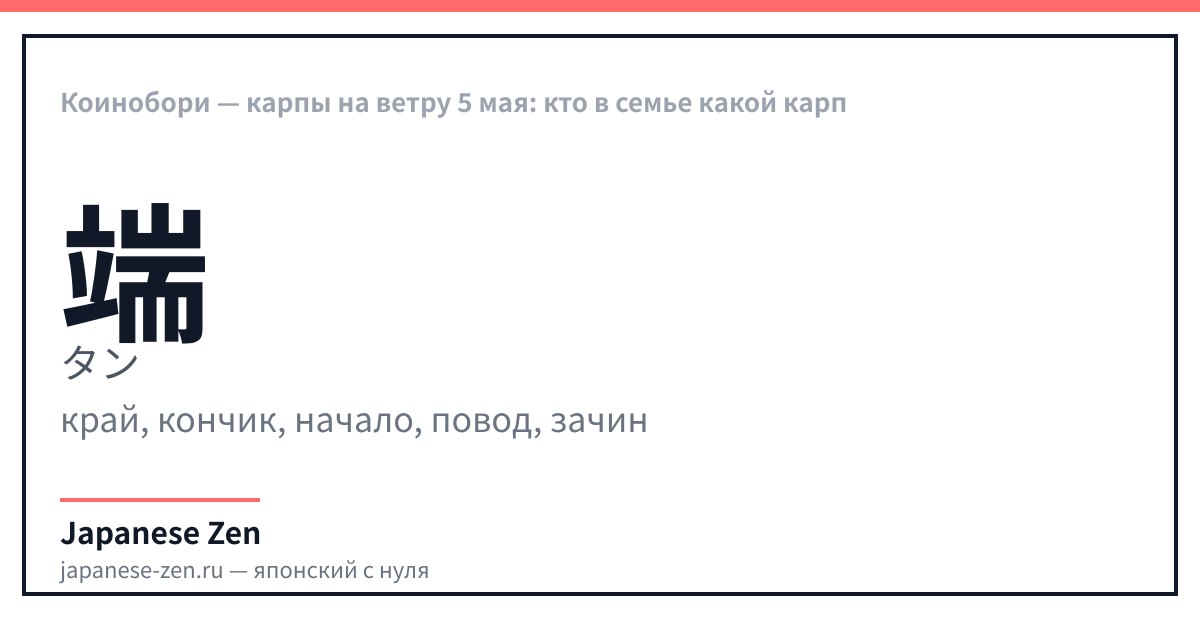
端 — значение: edge, tip, beginning, occasion, start — онъёми: タン — кунъёми: はし、は、はた、-ばた、はな — 14 штрих(ов). 端 means "edge, tip" — and in 端午 (Tango no Sekku) it points to the beginning: the first day of a special count in the fifth month. Koinobori are flown on this holiday.
Why in the Word 端午 the Character 端 Means "Beginning"
In the combination 端午, the character 端 means "beginning": in the old lunar calendar, the fifth month corresponded to the sign "horse" in the twelve-cycle, and "tango" originally meant "the first day of the horse" in that month. The day of the horse, 午, and the number five, 五, sound the same in Chinese reading — "go" — and over time the festival became fixed on the fifth day of the fifth month, that is, May 5 in the current calendar.
| Japanese | Reading | Translation |
|---|---|---|
| 鯉のぼり | koinobori · koinobori | Carp streamers |
| 端午の節句 | tango no sekku · tango no sekku | Boys' Festival on May 5 |
| 真鯉 | magoi · magoi | Black carp — father |
| 緋鯉 | higoi · higoi | Red carp — mother |
| 登竜門 | tōryūmon · tōryūmon | Dragon Gate — a decisive test |
Write 端 along the guides — the character of "beginning," from which the day of the Tango no Sekku festival was once counted.
FAQ
- What are koinobori and when are they flown?
- Koinobori are hollow cloth carp that inflate with wind on a pole. They are raised on May 5, for Tango no Sekku, also known as the national Children's Day, Kodomo no Hi. The custom is tied to wishing boys perseverance and success in life, though the national holiday itself today is dedicated to all children.
- Which carp in koinobori represents which family member?
- The black magoi is the eldest carp, represents the father, and appeared first. The red higoi, added later, is today read as the mother, though originally it also denoted a child. The blue and other colored carp, added even later, stand for the children in the family — one carp for each.
- Why does the carp symbolize perseverance in Japan?
- Because of a Chinese legend: the carp that alone among many fish managed to climb the waterfall of the Dragon Gate turned into a dragon. In Japan, this story is read as a metaphor for hard work that is ultimately rewarded — that is why the carp was chosen as the symbol for the boys' festival.
- Since when have koinobori been flown in Japan?
- Banners on Tango no Sekku began to be flown by samurai families in the Edo period — with a family crest instead of a carp. The carp figure was invented by townspeople in the middle of the same period: a crest was above their station, and the small flag at the top of the pole was replaced with a carp from the legend of the Dragon Gate.
- How is "koinobori" written in Japanese?
- 鯉のぼり, in kana こいのぼり. The first character 鯉 means "carp," and のぼり is a separate word for a narrow flag on a pole, usually written with the character 幟. Together it makes "carp-flag" — a word that has long had its own dictionary entry.
Sources
Updated: 2026-09-15