Umeboshi — Japanese salted plum: what it is, how it tastes, and what to eat it with
Umeboshi (梅干し) are ume fruits salted and sun-dried: a very sour and salty taste, often bright red from shiso leaves. Botanically, ume is closer to apricot than to plum. Umeboshi are eaten with rice, put in onigiri and hinomaru bento, and most are salted in Wakayama Prefecture from the Nanko variety.
For a visitor from another country, umeboshi is the most deceptive taste on the Japanese table: it looks like a sweet plum, but your mouth gets salt and sharp acidity. Let's break down which fruit umeboshi is actually salted from, why the skin turns red, what the Nanko variety from Wakayama has to do with it, and how the character 干す 'to dry' becomes 'boshi' inside the word.
Which fruit umeboshi is salted from and how it is sun-dried
Umeboshi are made from the fruits of the ume tree (梅), which are picked ripe when they turn yellow: green hard fruits go into umeshu liqueur. Botanically, ume belongs to the same genus as plum and apricot, but in taste and appearance of the fruit it is closer to apricot: it is no wonder that in English the tree is often called 'Japanese apricot' rather than 'plum'.
Three days in the sun: doyoboshi
- Harvest — for umeboshi, ripe, yellowed fruits are taken.
- Salting — ume are covered with salt and pressed with a weight until juice, umezu, appears; later, red shiso leaves rubbed with salt are added to it — this is what gives the color.
- Doyoboshi (土用干し) — the salted fruits are dried in the sun for three days and three nights during the hottest part of summer; during the day they are laid out on racks, and at night they are left under the open sky.
- Storage — the dried umeboshi are returned to the brine or placed in jars for further flavor maturation.
What to eat umeboshi with: rice, onigiri, and hinomaru bento
Most often umeboshi is placed on white rice, wrapped in onigiri, or added to ochazuke — rice poured with hot tea or broth. From unripe green ume fruits, a slightly sweet liqueur umeshu is made separately — this is no longer umeboshi, but a completely different product of the same tree.
Why umeboshi is put in a lunch box
Rice with one umeboshi plum in the center is called hinomaru bento — because of its resemblance to the Japanese flag. It is believed that the sour and salty taste helped protect rice from spoilage in the heat even before refrigerators appeared: salt and acidity do indeed hinder the growth of many bacteria. But this is more of a folk explanation than a verified fact.
Wakayama and the Nanko variety
More than half of the Japanese ume harvest is gathered in Wakayama Prefecture, primarily in the city of Tanabe and the town of Minabe. The modern ume variety Nanko, with a large fruit and thick flesh, was officially registered in 1965 after decades of selecting the best trees. Mass cultivation of ume in these places began back in the Edo period: the lord of Tanabe Domain encouraged planting plums on infertile land to ease the tax burden on peasants.
Plum and drying: what 梅干し is composed of
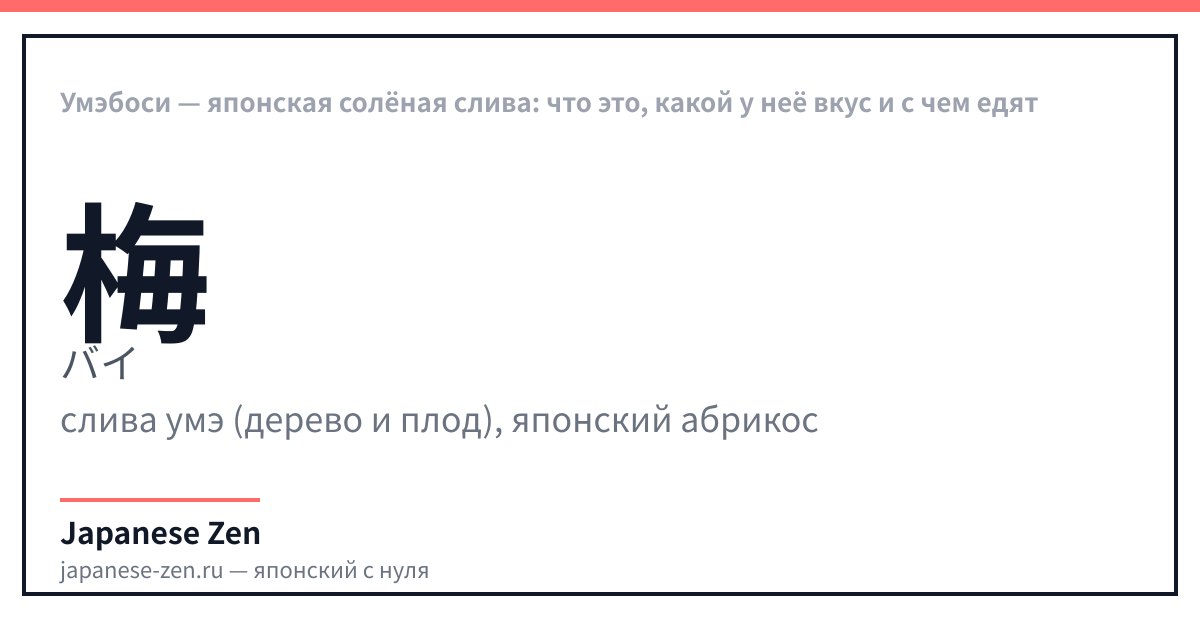
梅 — значение: ume plum (tree and fruit), Japanese apricot — онъёми: バイ — кунъёми: うめ — 10 штрих(ов). 梅 — 'ume', Japanese plum: the same character is in 梅干し (umeboshi), 梅雨 (rainy season), and 梅酒 (plum liqueur).
梅干し is composed of 梅 'ume' and the verb 干す 'to dry': literally — 'dried ume plum'. The verb 干す itself in noun form gives the word 干し (hoshi), but inside a compound word after 梅 the sound is regularly voiced — resulting in 干し → ぼし (boshi).
Why 'hoshi' becomes 'boshi'
This sound shift is called rendaku (連濁) in Japanese, 'voicing when combining': when two words are combined into one, the first consonant of the second component often becomes voiced. Thus the voiceless 'h' becomes the voiced 'b': 花 'hana' and 火 'hi' give 花火 (hanabi), 'fireworks', and 干し inside 梅干し is read 'boshi'. The rule is not universal and has exceptions, but for 'umeboshi' it has become firmly established — the form with 'hoshi' is no longer found.
| Japanese | Reading | Translation |
|---|---|---|
| 梅干し | umeboshi · umeboshi | Umeboshi |
| 梅 | ume · ume | Ume plum — the tree and its green fruits |
| 梅雨 | tsuyu · tsuyu | Rainy season — a special reading of the same character |
| 梅酒 | umeshu · umeshu | Liqueur made from unripe ume fruits |
| 梅見 | umemi · umemi | Plum blossom viewing |
| 紫蘇 | shiso · shiso | Shiso leaf, which colors umeboshi red |
Write 梅 along the guides — the character for ume, from which umeboshi is salted.
Not a plum, not a prune, and not a medicine
From botany to the medicine cabinet: four mistakes about umeboshi
- 'Umeboshi is just a salted plum.' Not quite: ume is botanically closer to apricot than to plum (Prunus domestica) — hence the English name 'Japanese apricot'.
- 'Umeboshi is a type of prune.' No: prunes are dried from ripe sweet plums without salt, while umeboshi is salted from the sour ume fruit and dried in the sun already salted — a completely different fruit and a different process.
- 'Umeboshi cures diseases.' This is a folk belief, not a medical fact: umeboshi has been used for centuries as a home remedy for various ailments, but it is not a medicine and not a substitute for a doctor.
- 'All umeboshi are bright red.' The red color comes from added shiso leaves; without shiso, umeboshi remains pale — this variant is called 白干し, 'white drying'.
FAQ
- What is umeboshi?
- Umeboshi (梅干し) are fruits of the ume tree, salted and sun-dried. The result is a very sour and salty snack, often bright red from added shiso leaves. Umeboshi are eaten with rice, put in onigiri and ochazuke, and most are salted in Wakayama Prefecture.
- What does umeboshi taste like?
- First of all, very sour and very salty, with a slight astringency from the shiso leaf — there is almost no sweetness in classic umeboshi. For an unaccustomed person, this is a surprising contrast: the fruit looks like a plum or apricot, but the taste is much closer to pickled lemon with salt.
- What is umeboshi made from?
- From ripe, yellowed fruits of the ume tree (梅): they are salted with a weight and red shiso leaves, and then dried in the sun for several days during the hottest part of summer. Botanically, ume is closer to apricot than to plum, although all three plants are from the same genus.
- What do you eat umeboshi with?
- Most often it is placed on white rice in the center — this makes hinomaru bento, 'bento with the rising sun'. Umeboshi is wrapped in onigiri and added to ochazuke — rice poured with hot tea or broth. From the green fruits of the same tree, a slightly sweet liqueur umeshu is made separately.
- How does umeboshi differ from prunes?
- Different fruits and different processing. Prunes are dried from ripe sweet plums without salt, and their taste is mild, slightly sweet. Umeboshi is salted from the sour ume fruit, and then dried already salted in the sun — the result is sharply sour and salty, nothing sweet.
- How is 'umeboshi' written in Japanese?
- 梅干し, kana うめぼし. 梅 means 'ume plum', and 干し is the form of the verb 干す 'to dry', which inside a compound word is voiced to 'boshi'. Literally it means 'dried ume plum' — an exact description of how it is prepared.
Sources
Updated: 2026-09-14