Yakitori: What It Is — Japanese Grilled Chicken Skewers and How to Order Them
Yakitori are pieces of chicken on bamboo skewers, grilled over binchōtan charcoal and brushed with tare sauce or simply salted. Classic yakitori is chicken: breast, thigh, skin, liver, heart, and other parts, each with its own name. Yakitori is served at izakaya and specialty yakitori restaurants, and you order by the counter suffix 本 for skewers: "yakitori o nihon kudasai" — two skewers, please.
A yakitori restaurant's menu can intimidate a newcomer with its long list of unfamiliar chicken parts — from juicy thigh momo to liver reba and the fatty tail bit bonjiri. Let's break down how tare differs from salt, where the binchōtan charcoal in the grills comes from, and why in a couple of Japanese cities yakitori is unexpectedly made from pork. Along the way, we'll see how the character 焼 "to grill" links yakitori with a dozen other dishes ending in "-yaki."
Yakitori Restaurant, Izakaya, and Binchōtan Charcoal
A yakitori restaurant and an izakaya are not the same thing, though yakitori is served at both: a yakitori restaurant specializes in skewers, while an izakaya is a general place for drinks and snacks of all kinds. The best grills burn binchōtan — dense white charcoal made from ubame oak wood, which burns very hot and almost without smoke — and the traditional sign of such an establishment remains the red paper lantern chōchin at the entrance.
Tare or Salt
There are two ways to season yakitori. Tare is a thick sauce based on soy sauce, mirin, and sugar, brushed onto the skewer several times during grilling until it gets a glossy glaze. Salt is the simpler, drier option: it's chosen so as not to overpower the taste of the meat itself.
Chicken Parts in a Yakitori Restaurant: From Momo to Bonjiri
| Name | Written | What It Is |
|---|---|---|
| Momo | もも | A piece of thigh — juicy and the most popular part |
| Negima | ねぎま | Pieces of thigh skewered alternately with green onion |
| Tsukune | つくね | A ball or sausage of minced chicken, often with cartilage for crunch |
| Kawa | かわ | Chicken skin, grilled until crispy |
| Tebasaki | 手羽先 | A whole wing, with the bone |
| Reba | レバー | Liver |
| Hatsu | ハツ | Heart |
| Seseri | せせり | Neck meat, firm and richly flavored |
| Bonjiri | ぼんじり | The fatty bit at the base of the tail |
How to Order Yakitori by the Skewer
Yakitori is counted in skewers, not portions: Japanese has its own counter suffix 本 for long, thin objects. One skewer is ippon, and two is nihon (二本): it sounds exactly like "Nihon" (日本), "Japan," though the words are written with different characters. So the phrase "焼き鳥を二本ください" — "yakitori o nihon kudasai" — means "two skewers of yakitori, please," and only context prevents you from confusing it with the country when hearing it.
One Character for "Grilling" — for a Good Dozen Dishes
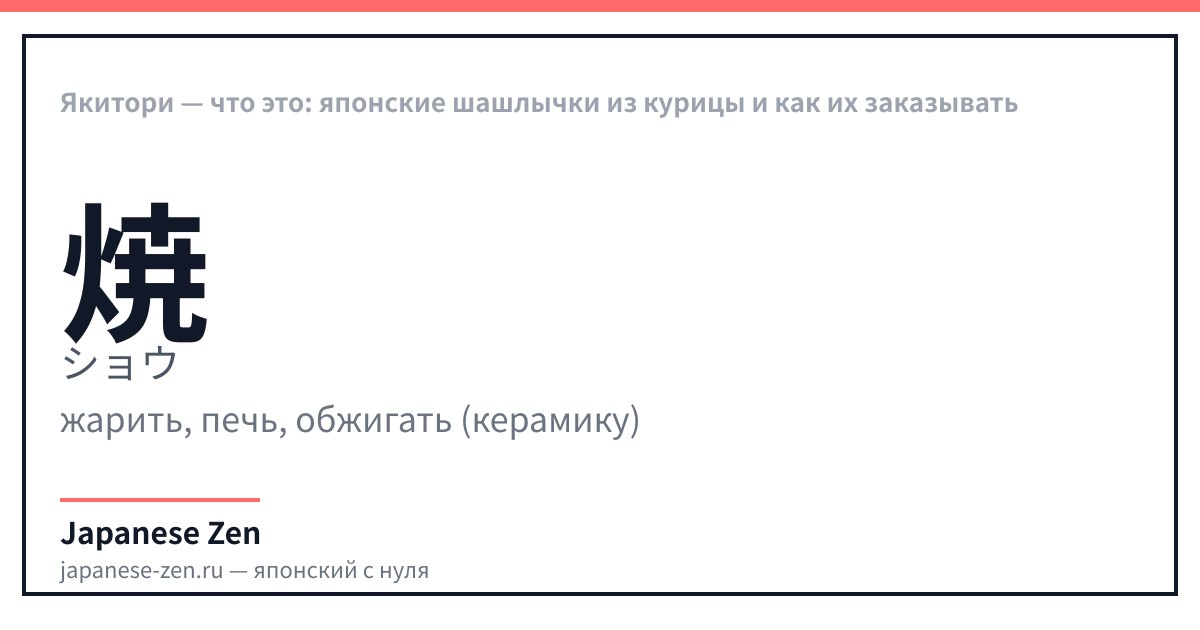
焼 — значение: to grill, to roast, to fire (ceramics) — онъёми: ショウ — кунъёми: や.く、や.き、や.き-、-や.き、や.ける — 12 штрих(ов). 焼 — "to grill, to roast": the same character appears in 焼き鳥 (yakitori), 照り焼き (teriyaki), and たこ焼き (takoyaki).
焼き鳥 is made up of 焼き "grilling" and 鳥 "bird" — literally "grilled bird." The kun reading of the character, やく (yaku), is heard in the word "to grill" itself; the on reading しょう (shō) is less common, but it appears in the word 焼酎 (shōchū), a strong distilled alcohol, literally "burned wine" — after its distillation method.
The "-yaki" Word Family
焼き appears in the names of many Japanese dishes cooked on a griddle or pan. 照り焼き (teriyaki) — meat or fish is glazed with a similar sweet sauce, but cooked not on skewers, but as a whole piece. たこ焼き (takoyaki) are balls with octopus, and お好み焼き (okonomiyaki) is a savory pancake with fillings of your choice. 焼き肉 (yakiniku) is meat grilled right at the table. And if you replace the chicken in yakitori with pork, the dish is usually no longer called yakitori but 焼きとん (yakiton).
| Japanese | Reading | Translation |
|---|---|---|
| 焼き鳥 | yakitori · yakitori | Yakitori |
| 焼く | yaku · yaku | To grill, to roast |
| 備長炭 | binchōtan · binchōtan | Dense white charcoal for grilling over an open fire |
| 焼き鳥を二本ください | yakitori o nihon kudasai · yakitori o nihon kudasai | Two skewers of yakitori, please |
| 焼きとん | yakiton · yakiton | The same thing, but made from pork |
| 照り焼き | teriyaki · teriyaki | Meat or fish glazed with a sweet soy sauce |
Write 焼 along the guides — the character for "grilling" that appears in the name yakitori.
Not Always Chicken: Where Yakitori Is Traditionally Grilled from Pork
Teriyaki, Stalls, and Real Tare
- "Yakitori is any meat on a skewer." Classic yakitori is specifically chicken; pork on a skewer in most of Japan is called yakiton. But there are traditional exceptions: in Muroran on Hokkaido and in Higashimatsuyama in Saitama Prefecture, pork has long been grilled under the name "yakitori," and there it's not a mistake but a local norm.
- "Yakitori and teriyaki are the same thing." The tare for yakitori and the sauce for teriyaki are similar in composition, but teriyaki is a method of cooking a whole piece of meat or fish in a pan or on a grill, not skewered kebabs.
- "Tare is just soy sauce." Tare is reduced from soy sauce, mirin, and sugar, often with the juice from the meat itself added during grilling — the result is a distinct thick sauce, not plain soy sauce.
- "Yakitori is only sold at street fairs." It is indeed grilled at matsuri stalls, but far more often yakitori is ordered at permanent establishments with menus of dozens of chicken parts, not just on festival occasions.
FAQ
- What is yakitori?
- Yakitori are pieces of chicken on thin bamboo skewers, grilled over charcoal and seasoned with tare sauce or salt. They are served at izakaya and specialty yakitori restaurants, and the word 焼き鳥 literally means "grilled bird."
- What meat is yakitori made from?
- Classic yakitori is made from chicken: thigh, breast, skin, liver, heart, and other parts are used, each with its own name. Pork on a skewer in most of Japan is called by a separate word — yakiton — although in Muroran and Higashimatsuyama, "yakitori" is traditionally made from pork.
- What is tsukune?
- Tsukune is a ball or sausage of minced chicken, often with cartilage added for crunch, shaped around a skewer and grilled over charcoal. Tsukune is seasoned just like other yakitori — with tare sauce or salt, as you choose.
- How does yakitori differ from shashlik?
- Yakitori is grilled on thin bamboo skewers in small pieces of a single type of meat or a specific part of the bird, not in large chunks of meat mixed with vegetables as in shashlik. Yakitori is seasoned with tare sauce or salt, not marinated before grilling.
- How do you order two skewers of yakitori in Japanese?
- "焼き鳥を二本ください" — "yakitori o nihon kudasai." In Japanese, skewers are counted with the suffix 本 for long, thin objects: one skewer is ippon, and two is nihon (二本), which sounds like "Nihon" (日本), "Japan," though the characters are different.
- How is "yakitori" written in kanji?
- 焼き鳥, kana やきとり. 焼き means "grilling" from the verb 焼く "to grill," and 鳥 means "bird." The same character 焼 appears in a dozen other names of grilled dishes — from teriyaki to takoyaki and okonomiyaki.
Sources
- Ministry of Agriculture, Forestry and Fisheries of Japan (MAFF): "Our Local Cuisine" — Muroran yakitori (Hokkaido)
- Ministry of Agriculture, Forestry and Fisheries of Japan (MAFF): "Our Local Cuisine" — Higashimatsuyama yakitori (Saitama Prefecture)
- Kotobank: 焼き鳥
- Wikipedia: 焼き鳥 — history, parts, regional variations
- Kotobank: 焼き鳥
Updated: 2026-09-14