Sukiyaki: Beef in a Sweet Sauce and a "Plough-Side Grill" in the Name
Sukiyaki is thinly sliced beef, vegetables and tofu cooked right at the table in a sweet-and-salty warishita sauce, then dipped in raw egg before eating. The name is linked to 鋤焼き, "grill on a ploughshare": long ago fish was grilled on a ploughshare, and the method was later applied to beef when it came back onto the table. In Kanto the sauce is poured in all at once; in Kansai sugar and soy sauce are added to taste right in the pan.
Sukiyaki has no single correct recipe: what is served in Tokyo is prepared differently from Osaka, even though the name and the main ingredients are the same. Let's look at where beef came from on the Japanese table and how the Kanto method differs from the Kansai one. And also — what versions exist for the origin of the word "sukiyaki" and what a song has to do with it, a song released in the US under that name even though it has nothing to do with the dish.
Thinly Sliced Beef Cooked Right at the Table
Sukiyaki is thinly sliced beef grilled and simmered in a shallow pan together with green onion, napa cabbage, shungiku, shiitake, fried tofu and shirataki noodles. All of this is poured over with the sweet-and-salty warishita sauce — a mixture of soy sauce, sugar, sake and mirin — and the cooked pieces are dipped in raw beaten egg before eating.
Zaku — the General Word for What Goes Around the Meat
The vegetables, tofu and noodles placed around the meat are called by one word in Japan — zaku. The set is not strict: in different families and regions, zaku may include bean sprouts or potatoes, and the cook is free to assemble it to their own taste and from what is available at the market.
Warishita All at Once or Sauce to Taste: Two Ways to Cook Sukiyaki
In Kanto — Tokyo and Yokohama — sukiyaki is prepared like this: beef fat is melted in the pan, some of the meat is seared and then immediately poured over with ready-made warishita sauce mixed in advance. In Kansai — Osaka and Kobe — the meat is also seared first, but the sauce is not poured in all at once: sugar, soy sauce and dashi broth are added one after another and by eye, tasting right at the table.
Why Neither Method Is Considered "More Correct" Than the Other
In Tokyo, the pre-mixed warishita sauce came to sukiyaki as an inheritance from gyunabe, the local predecessor of the dish. In Kansai, its own order took hold independently and is just as much the norm, not a deviation. The difference is alive today: in both parts of the country people are equally proud of their sukiyaki, and neither tourist guides nor Japanese themselves call one of the methods more correct.
From the Ban on Eating Meat to Beef on the Meiji Table
Until the second half of the 19th century, beef was rarely eaten in Japan: for centuries the Buddhist custom of avoiding the meat of four-legged animals held in the country. The young Meiji government deliberately promoted meat-eating as part of its course toward rapprochement with the West: in 1870 Fukuzawa Yukichi published the pamphlet "On Meat Eating," and in 1872 Emperor Meiji himself publicly tried beef for the first time.
Gyunabe — the Tokyo Predecessor of Sukiyaki
After the opening of the port of Yokohama in 1859, foreigners arrived in the city and brought with them the habit of eating beef. One of the first shops serving gyunabe — beef simmered in a shallow pot — opened in Yokohama in 1862. After the Meiji Restoration of 1868, gyunabe spread through Tokyo so quickly that by 1877 the city already had about 550 such shops.
Plough-Side Grill or Thin Slices — Two Versions of the Name
The main version links the word to 鋤焼き: in the Kansai region, back in the Edo period, fish and shellfish were grilled on a heated ploughshare — 鋤, suki. When beef came back onto the Japanese table, the method was simply applied to it as well. There is another version — that the name comes from すき身, thinly sliced meat, which formed the basis of the dish. Both versions are cited by Japanese reference works, and neither is recognized as the only correct one.
The Song That Made the Word Famous, Not the Dish
The name Sukiyaki was given to Sakamoto Kyu's song "Ue o Muite Aruko" by the head of the British company Pye Records: he could not read the Japanese title, but remembered the word "sukiyaki" from a dinner in Japan. Under this name the song was released first in Britain, and in 1963 in the US. On June 15 it took first place on the Billboard chart — the only time a song in Japanese topped the American hit parade. The lyrics have nothing to do with the food itself.
肉: One Character for Beef, Butcher Shop and Grilled Meat
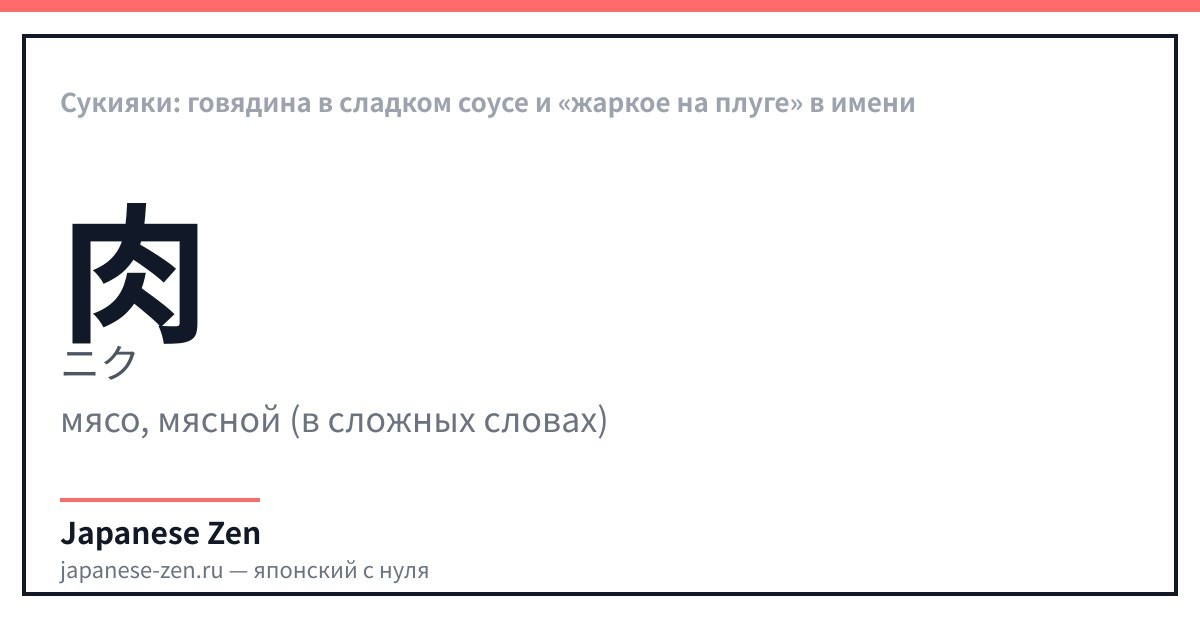
肉 — значение: meat, meat- (in compound words) — онъёми: ニク — кунъёми: しし — 6 штрих(ов). 肉 — "meat": sukiyaki in its current form appeared when beef began to be eaten openly in Japan again. The same character is in 牛肉 (beef) and 肉屋 (butcher shop).
The on'yomi reading of the character 肉 is ニク (niku). It is heard in almost all words with this character: 牛肉 (gyūniku) — "beef," 肉屋 (nikuya) — "butcher shop," 焼肉 (yakiniku) — meat grilled right at the table on a grate, a dish separate from sukiyaki.
すき in Kana, 鋤 in the Plough Character
Even though the "suki" in "sukiyaki" is traced to the character 鋤, "plough," the word すき焼き itself is almost always written not with a kanji but in hiragana. The reason is simple: since the etymology of the word has never been definitively established, it proved impossible to assign a single kanji to it, and in everyday use the neutral kana spelling won out.
| Japanese | Reading | Translation |
|---|---|---|
| すき焼き | sukiyaki · sukiyaki | Sukiyaki |
| 牛肉 | gyūniku · gyūniku | Beef |
| 肉屋 | nikuya · nikuya | Butcher shop |
| 焼肉 | yakiniku · yakiniku | Meat grilled right at the table |
| 割下 | warishita · warishita | Pre-mixed sauce for sukiyaki |
| 牛鍋 | gyūnabe · gyūnabe | Beef hot pot — the predecessor of sukiyaki |
Write 肉 along the guides — the "meat" character, without which there would be no sukiyaki.
FAQ
- What kind of dish is sukiyaki?
- Sukiyaki is beef, thinly sliced and cooked right at the table together with vegetables, tofu and shirataki noodles in a sweet-and-salty warishita sauce. The cooked pieces are customarily dipped in raw beaten egg before eating. The dish is cooked in a shallow pan, and ingredients are added gradually as the group finishes the previous portion.
- How does sukiyaki in Kanto differ from the Kansai method?
- In Kanto, including Tokyo, the meat is seared first and then immediately poured over with pre-mixed warishita sauce. In Kansai, in Osaka and Kobe, the sauce is not mixed in advance: sugar, soy sauce and dashi broth are added one after another right in the pan, tasting as you go. Both methods are considered classic; there is no single "correct" version.
- Where did the name "sukiyaki" come from?
- The main version links the word to 鋤焼き — "grill on a ploughshare": in Kansai, fish had long been grilled on a heated ploughshare, and later the method was applied to beef. There is also a second version — that the name comes from すき身, thinly sliced meat. Both versions appear in Japanese reference works, and neither is recognized as the only correct one.
- What does the song Sukiyaki, which was a hit in the US, have to do with it?
- The name was invented by the head of the British company Pye Records: he could not read the Japanese title "Ue o Muite Aruko," but remembered the word "sukiyaki" from a dinner in Japan. Under that name Sakamoto Kyu's song was released first in Britain, and then in the US, where in 1963 it topped the Billboard chart. The lyrics have nothing to do with the dish itself.
- Why is meat in sukiyaki customarily dipped in raw egg?
- The exact reason is not established — Japanese sources give several versions: the egg cools the hot piece of meat, softens the rich taste of the warishita sauce, or simply became established historically as a way of serving. The habit of eating a hot dish with raw egg is older than sukiyaki and existed in Japan even before beef came back onto the table.
Sources
Updated: 2026-09-15