Gyōza: Japanese Fried Dumplings and How They Differ from Chinese Ones
Gyōza are thin dumplings filled with pork, cabbage, garlic, and green onion, pan-fried until crispy on the bottom. In Japan, unlike in China, they are more often fried rather than boiled or steamed. The familiar name and taste of the dish took shape after World War II — largely thanks to settlers returning from Manchuria.
Gyōza look like a close relative of Chinese jiaozi, but over a century in Japan they became a separate dish — with thin dough, garlic, and almost always pan-fried rather than boiled. Let's sort out what's true and what's simplified in the legend of settlers from Manchuria, where the word "gyōza" itself came from, and why Utsunomiya and Hamamatsu still argue over whose city is the top for these dumplings.
Thin Dough and Crispy Bottom: What Gyōza Are
Gyōza are dumplings made from thinly rolled wheat dough filled with ground pork, cabbage, garlic, and green onion, folded into a crescent shape. They are prepared in several ways, but in Japan frying is almost always chosen: yaki-gyōza are first briefly steamed in a pan under a lid, then fried on the bottom until crispy.
Yaki-gyōza and Sui-gyōza: Fried or Boiled
Sui-gyōza are the same dumplings but fully boiled in water without frying; in Japan they are served less often, usually as one of the menu items alongside yaki-gyōza. What distinguishes the Japanese version from Chinese jiaozi is the thin dough, the obligatory garlic, and regular green cabbage instead of napa cabbage. In China itself, garlic is not added to the filling everywhere, and this type of cabbage is used mainly in the northeast of the country.
From China Through the Centuries, and in Japan — After the War
Prototypes of filled dumplings have been known in China for a very long time: finds considered to be their prototype date back to the Xue kingdom in what is now Shandong province and are dated to around the 6th century BCE. The first Japanese person to try gyōza is said to have been Tokugawa Mitsukuni in the Edo period — he was supposedly treated to the dish by Zhu Shunshui, a Chinese scholar-refugee. This is a nice story, not a confirmed fact, and it should be presented as a legend.
Settlers from Manchuria — Not Inventors but Popularizers
A common version is that fried gyōza were invented in Japan only after World War II by settlers returning from Manchuria. In fact, recipes for fried gyōza were printed in Japanese cookbooks as early as the 1920s, meaning the dish existed in the country before the war. The role of the settlers was different: it was they who after 1945 made gyōza a mass and familiar dish. This is especially noticeable in the city of Utsunomiya, whose 14th Infantry Regiment was stationed in Manchuria from 1940 — soldiers and settlers returning from there brought with them the Manchurian recipe and a taste for this dish.
Why "Gyōza" Doesn't Sound Like Mandarin
Before the war, Japanese cookbooks rendered the Chinese name through a reading close to Mandarin — "chaozu." The current "gyōza" came by a different path: Japanese who lived before the war in the Chinese city of Dalian adopted the pronunciation from the local northern dialect or from the Manchurian language, and this sound was brought to Japan by settlers returning after 1945. By the 1950s, "gyōza" had become established in cookbooks and newspapers as the main reading.
Utsunomiya and Hamamatsu: Two Cities That Claim Gyōza as Theirs
Utsunomiya and Hamamatsu have competed for first place in the official statistics on household spending on gyōza, published annually by Japan's statistics bureau, for many years. The ranking changes from year to year: in 2021–2022, the city of Miyazaki unexpectedly took the lead, and in 2023–2025, Hamamatsu was first again. Utsunomiya traces its gyōza history to the settlers of the 14th Regiment, and today the city has about 300 establishments serving these dumplings, and since 2001 the trademark "Utsunomiya Gyōza" has been registered.
Hane-tsuki Gyōza — Dumplings in a Lacy Crust
Hane-tsuki gyōza, literally "gyōza with wings," is a frying method in which a thin lacy crispy crust forms around the dumplings from salted flour water, resembling wings or lace. The technique was invented relatively recently, in the 1980s, in Tokyo's Kamata district, and since then it has spread across the country as a separate presentation, not tied to any particular rival city.
皮: Animal Skin and Dough Wrapper
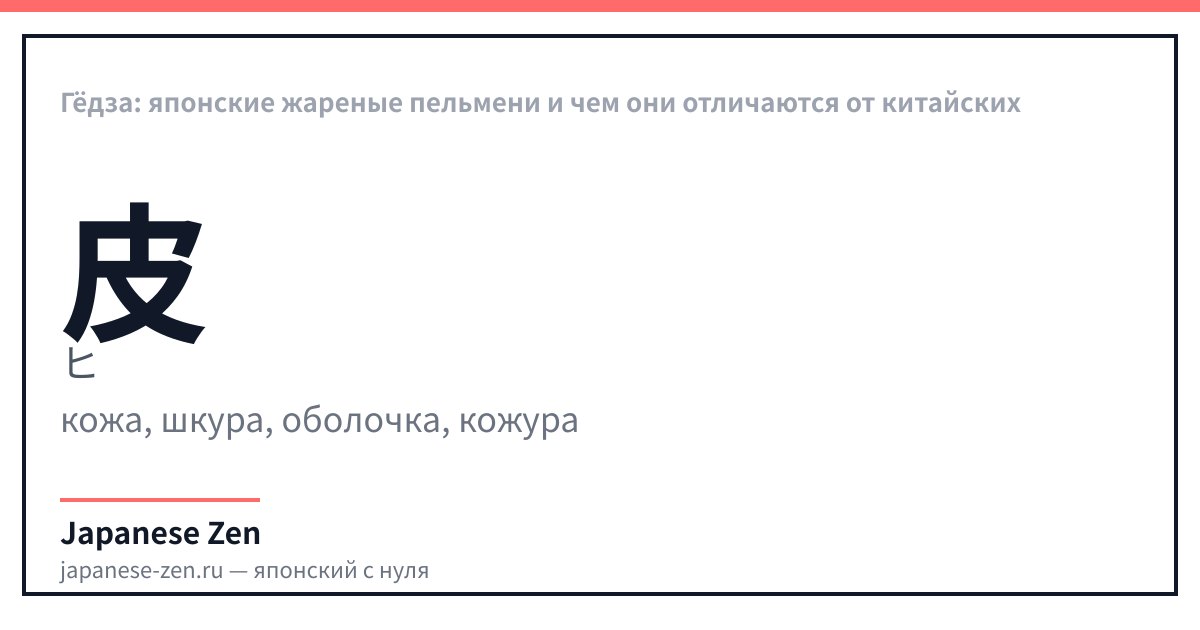
皮 — значение: skin, hide, wrapper, peel — онъёми: ヒ — кунъёми: かわ — 5 штрих(ов). 皮 — "skin, wrapper": the dough for gyōza is called 餃子の皮 in Japanese, literally "gyōza skin." The same character appears in 皮膚 (human skin) and in 毛皮 (fur).
The on'yomi of the character 皮 is ヒ (hi), the kun'yomi is かわ (kawa). The on'yomi is heard in the word 皮膚 (hifu) "human skin," the kun'yomi in 毛皮 (kegawa) "fur, animal hide," where かわ voices to がわ at the compound boundary. The word 餃子, by comparison, hardly appears outside this dish: the character 餃 itself is rare, and its semantic radical — 食, "food" — directly points to the culinary nature of the character.
| Japanese | Reading | Translation |
|---|---|---|
| 餃子 | gyōza · gyōza | Gyōza |
| 皮 | kawa · kawa | Skin, wrapper |
| 餃子の皮 | gyōza no kawa · gyōza no kawa | Dough wrapper for gyōza |
| 皮膚 | hifu · hifu | Skin (human) |
| 毛皮 | kegawa · kegawa | Fur, hide |
| 羽根つき餃子 | hanetsuki gyōza · hanetsuki gyōza | Gyōza in a thin crispy "wing" crust |
Write 皮 along the guides — the character for "skin," which appears in the name for gyōza dough.
A Wrapper Is Not Only for a Dumpling
皮 describes any outer wrapper, not only dough and not only the skin of a living being: the same character is used for fruit peel or a cover in some compound words. In 餃子の皮 the character works literally — it is precisely the thin sheet of dough in which the filling is wrapped before the dumpling is sealed.
FAQ
- What are gyōza?
- Gyōza are small crescent-shaped dumplings: thin wheat dough is wrapped around a filling of ground pork, cabbage, garlic, and green onion. The serving style in Japan is called yaki-gyōza if the dumplings are pan-fried — this is the most common option, though fully boiled sui-gyōza also appear on menus.
- How do Japanese gyōza differ from Chinese jiaozi?
- In Japan, frying is almost always chosen, whereas in China they are more often boiled or steamed. The dough for Japanese gyōza is thinner, garlic is always added to the filling, and regular green cabbage is used instead of napa cabbage — in China this combination is characteristic primarily of the northeast of the country, from where the recipe came to Japan.
- Is it true that gyōza were brought to Japan after the war by settlers from Manchuria?
- Not exactly: fried gyōza existed in Japan even before World War II, and recipes were printed in cookbooks of the 1920s. The settlers who returned from Manchuria after 1945 did not invent the dish but made it mass and popular, especially in cities like Utsunomiya, where many former military personnel and residents of Manchuria settled after the war.
- Which city in Japan is the top for gyōza — Utsunomiya or Hamamatsu?
- There is no clear winner: according to official household spending statistics, the lead passes from city to city almost every year. In 2023–2025, Hamamatsu was first, while in 2021–2022 the city of Miyazaki unexpectedly took the lead. Utsunomiya and Hamamatsu have been competing for this place the longest and are considered the main "gyōza cities."
- What is hane-tsuki gyōza?
- Hane-tsuki gyōza, literally "gyōza with wings," is a frying method in which a thin crispy crust of salted flour water sets around the dumplings, resembling lace or wings. The technique was invented in the 1980s in Tokyo and has since been used across the country, regardless of any particular shop or city.
- How is "gyōza" written in kanji?
- 餃子, kana ぎょうざ. The first character 餃 hardly appears outside this word, but its semantic radical 食 "food" clearly points to the culinary meaning. The second character, 子, literally means "child," while the dough wrapper for the filling is called by a separate word — 皮 (kawa), "skin."
Sources
Updated: 2026-09-15