Okonomiyaki — the "grill what you like" pancake: Osaka and Hiroshima styles
Okonomiyaki is a Japanese savory pancake made from a wheat-flour batter with cabbage and a filling of your choice, cooked on a teppan griddle and topped with sauce and mayonnaise. The name literally means "grill what you like": each diner chooses the filling. There are two main styles — Osaka, where all the ingredients are mixed right into the batter, and Hiroshima, where they are layered and noodles are always added.
Okonomiyaki has no single recipe — only the principle "cook what you like." But it does have a clear geography: Osaka and Hiroshima make it in completely different ways, and both cities consider the dish their own local food rather than something borrowed from the other. Let's look at the kanji in the name, the differences between the two cooking styles, and where this dish actually came from.
What okonomiyaki is and how Osaka differs from Hiroshima
Okonomiyaki is made from a thin batter with cabbage and a filling of your choice — from pork and seafood to cheese — cooked on a flat metal teppan griddle. The finished pancake is topped with a thick sauce and mayonnaise, then sprinkled with dried aonori seaweed and thin shavings of dried bonito (katsuobushi): from the heat they quiver almost imperceptibly, as if dancing.
| Feature | Osaka | Hiroshima |
|---|---|---|
| Cooking method | all ingredients are mixed right into the batter | a thin layer of batter, then cabbage and meat layered on top, covered with a batter "lid" |
| Noodles | not included by default — with them it's a separate dish, modan-yaki | always included: soba or udon are added as a separate layer |
| Sauce | sharper and more tangy | thicker and sweeter |
Monjayaki — the Tokyo relative
Okonomiyaki has a Tokyo relative — monjayaki: a runny batter with no firm shape, built up on the griddle into a low "wall" and eaten straight off the griddle with a small spatula. According to a common account, monjayaki goes back to a 19th-century Tokyo treat called monji-yaki; from it in the 1920s came the street food "dondon-yaki," and from that in the Kansai region came issen-yōshoku, "Western food for one coin," the predecessor of modern okonomiyaki. Historians continue to refine the details of this chain.
The kanji 好: what "konomi" means
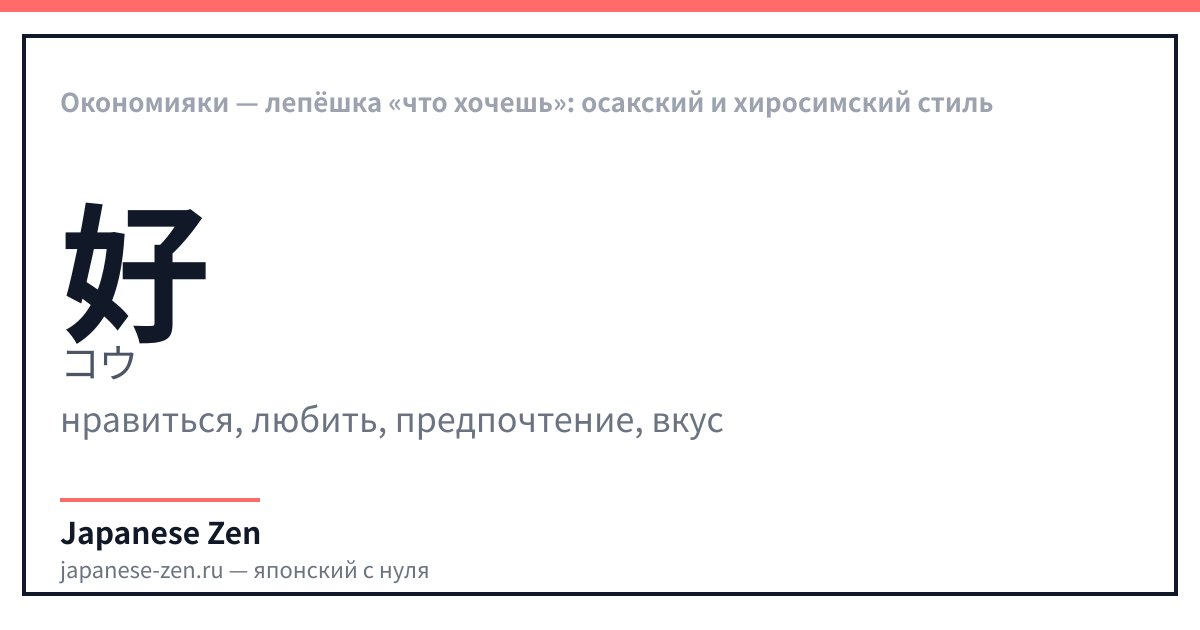
好 — значение: to like, to love, preference, taste — онъёми: コウ — кунъёми: この.む、す.く、よ.い、い.い — 6 штрих(ов). 好 — "to like, to love": the same character appears in 好き (suki) "liked, favorite" and in 好み (konomi) "what one likes" — the basis of the name okonomiyaki.
お好み焼き is made up of the polite prefix お, the word 好み "what one likes, what suits one's taste," and 焼き "grilling." Together it means "grilled to your taste": the finished dish is assembled from the ingredients the diner has chosen.
| Japanese | Reading | Translation |
|---|---|---|
| お好み焼き | okonomiyaki · okonomiyaki | Okonomiyaki |
| 好き | suki · suki | Liked, favorite |
| 好み | konomi · konomi | Preference, what one likes |
| 焼く | yaku · yaku | To grill, to bake |
| 鉄板 | teppan · teppan | Metal griddle for cooking |
| かつお節 | katsuobushi · katsuobushi | Dried bonito shavings |
Write 好 along the guides — the character of "preference" that gave okonomiyaki its name.
What else is "yaki"
The suffix 焼き (yaki) simply means "grilling" and appears in the names of many griddle dishes: yakitori — grilled chicken on skewers, takoyaki — octopus balls, teppanyaki — grilling on a metal griddle.
Where okonomiyaki came from
The closest known predecessor is issen-yōshoku (一銭洋食), a Kansai street snack of thin batter with a filling under a Western-style sauce: the name meant "Western food for one coin." The modern form with cabbage and mixed batter spread after World War II, and in Hiroshima, devastated by the atomic bombing, a simple one-griddle dish became an affordable way to feed oneself in the hard postwar years.
Osaka and Hiroshima: whose food is it
Both Osaka and Hiroshima consider okonomiyaki their everyday food. In both cities the dish took root precisely in the postwar years and has remained a calling card of each ever since — only their recipes differ.
FAQ
- What is okonomiyaki?
- Okonomiyaki is a Japanese pancake made from a thin batter with cabbage and a filling of your choice, cooked on a teppan griddle and topped with sauce and mayonnaise. The filling — from pork to seafood — is chosen by each diner, hence the name "grill what you like."
- How does Osaka okonomiyaki differ from Hiroshima okonomiyaki?
- In Osaka, all the ingredients, including the cabbage, are mixed right into the batter before cooking. In Hiroshima, they are layered on a thin crepe and covered with a second layer of batter on top, and noodles — soba or udon — are always added, not optional as in the Osaka version with modan-yaki.
- What does "okonomiyaki" mean?
- お好み焼き literally means "grilled to your taste": 好み (konomi) is "what one likes," and 焼き (yaki) is "grilling." The polite prefix お simply softens the word. The name reflects the very essence of the dish — each person chooses the filling and how much of it, and there is no single recipe.
- Are noodles part of okonomiyaki?
- It depends on the style: in Hiroshima okonomiyaki, noodles — soba or udon — are a mandatory layer, and without them the dish is not considered complete. In Osaka there are no noodles by default at all, and the version with them in the batter is called separately — modan-yaki, "modern grill," and served as a dish in its own right.
- How is "okonomiyaki" written in Japanese?
- お好み焼き, in kana おこのみやき. The word consists of the polite prefix お, the character 好み (konomi) "what one likes, preference," and 焼き (yaki) "grilling." The same character 好 on its own means "to like, to love" and appears in the very common word 好き (suki).
Sources
Updated: 2026-09-14