How to Hold Chopsticks for Sushi and Any Food: Grip, Mistakes, and Etiquette
How to hold chopsticks for sushi: the bottom chopstick rests motionless in the hollow between your thumb and index finger, with its far end supported by your ring finger. The top chopstick is held like a pencil and only it moves — with your thumb, index, and middle fingers. The same grip works for any Japanese food, and nigiri sushi may be eaten directly with your hands.
Chopsticks are used throughout most of East Asia, but it is the Japanese grip and Japanese etiquette that determine whether a person seems confident or awkward at the table. We'll break down the grip step by step, six table etiquette taboos, what the kanji 箸 means, and how Japanese chopsticks differ from Chinese and Korean ones — in length, tip shape, and material.
The Correct Chopstick Grip, Step by Step
Chopsticks are held in one hand for the entire meal, usually the right — traditional etiquette prescribes this, though nothing stops a left-handed person from using their left hand. Only one of the two chopsticks moves; the other serves as a fixed support.
- Place the bottom chopstick in the hollow between your thumb and index finger and rest its near end against the base of your thumb.
- The far end of the bottom chopstick rests on the pad of your ring finger — this chopstick does not move at all in the grip.
- Hold the top chopstick just like a pen or pencil: with your thumb, index, and middle fingers, closer to its tip.
- Only the top chopstick moves — your thumb and index finger bring it together and apart, while your middle finger provides support from below.
- The tips of both chopsticks should be even in length; if they have shifted, align them by lightly tapping them against the edge of your plate, not the table.
- Pick up food with the very tips of the chopsticks, not the middle — it's easier to feel whether it's held securely.
Sushi Can Be Eaten with Your Hands
Nigiri sushi — rice with a slice of fish on top — is an exception to the general rule: by tradition it is eaten with the hands even in an expensive restaurant, and this is not a breach of etiquette. Sashimi without rice, however, is not taken with the hands: for raw fish without a base, chopsticks are obligatory.
What Not to Do with Chopsticks at the Table
- 箸渡し (hashi-watashi) — passing food from your chopsticks to someone else's. After cremation, relatives pass the bones of the deceased to each other this way, so at the dining table the gesture is read as a bad omen.
- 立て箸 (tate-bashi) — sticking chopsticks vertically into a bowl of rice. This is how rice is offered to the deceased at a Buddhist memorial service — the resemblance to a funeral rite is what makes the gesture taboo.
- 刺し箸 (sashi-bashi) — stabbing food with chopsticks, like a fork. It looks untidy and is considered rude.
- 迷い箸 (mayoi-bashi) — hovering chopsticks over dishes, unable to decide what to take.
- 寄せ箸 (yose-bashi) — pulling a distant plate toward you with your chopsticks instead of picking it up with your hand.
- 渡し箸 (watashi-bashi) — laying chopsticks across your bowl or plate during a pause in eating; this is done only when you have truly finished eating.
What to Do with Chopsticks After the Meal
Chopsticks are placed on a hashioki — a small rest for the tips made of ceramic, wood, or stone. If there is no rest, disposable waribashi chopsticks are returned to their paper envelope, the hashibukuro.
The Kanji 箸 and Words with It
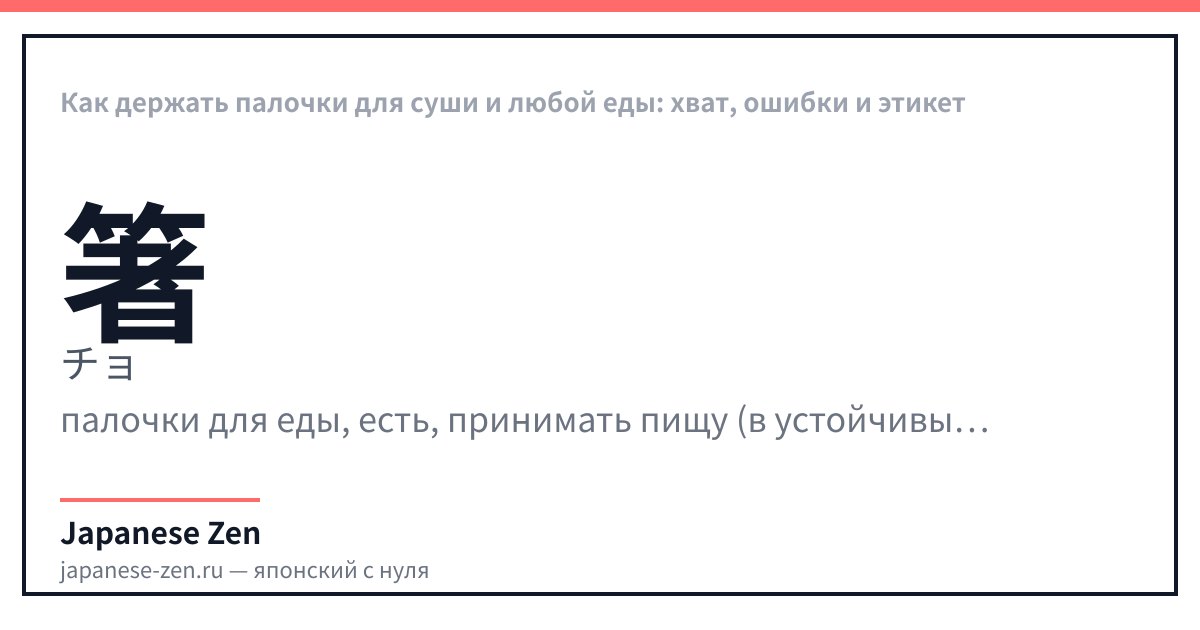
箸 — значение: eating chopsticks, to eat, to take a meal (in set expressions) — онъёми: チョ、チャク — кунъёми: はし — 15 штрих(ов). 箸 — 'eating chopsticks': on top is the radical ⺮ 'bamboo,' from which chopsticks have been made since ancient times, and the lower part 者 mainly provides the reading 'cho'.
| Japanese | Reading | Translation |
|---|---|---|
| お箸 | ohashi · ohashi | Chopsticks (polite) |
| 箸 | hashi · hashi | Chopsticks |
| 割り箸 | waribashi · waribashi | Disposable chopsticks that are split apart |
| 箸置き | hashioki · hashioki | Chopstick rest |
| 取り箸 | toribashi · toribashi | Serving chopsticks for taking food from a shared dish |
| 箸使い | hashizukai · hashizukai | Manner of using chopsticks |
Write 箸 along the guides — 15 strokes for the word used to eat across most of East Asia.
箸, 橋, and 端: Three 'Hashi'
Three different words — 箸 'chopsticks,' 橋 'bridge,' and 端 'edge, tip' — are pronounced the same: 'hashi.' They are distinguished by pitch accent, not by sound: a separate layer of Japanese speech that is not visible in either kana or romaji. There is no single scheme for all regions of the country, so it is enough to simply know this fact.
Japanese, Chinese, and Korean Chopsticks: What's the Difference
| Feature | Japan | China | Korea |
|---|---|---|---|
| Length | shorter, for one hand | longer than Japanese — convenient for reaching shared dishes | medium length |
| Tip | pointed | barely tapers, round or square in cross-section | flat, blunt |
| Material | wood or bamboo, often lacquered | bamboo and wood; expensive ones in jade or bone | metal, usually stainless steel |
Why Japanese Chopsticks Are Pointed
The most common explanation is bony fish: a pointed tip is convenient for separating meat from bones without breaking the piece apart. This explanation is given in reference works on Japanese chopsticks, and it also explains why Chinese chopsticks, designed more for shared boneless dishes, barely taper at the tip.
FAQ
- How do you hold chopsticks correctly?
- The bottom chopstick stays motionless: its near end rests against the base of your thumb, and its far end rests on your ring finger. The top chopstick is held with three fingers like a pen, and only it moves. Align the tips by lightly tapping them against the edge of your plate, not the table.
- What are Japanese chopsticks called?
- Japanese eating chopsticks are called 箸, pronounced 'hashi.' The same word, just written differently, names a bridge (橋) and an edge or tip (端) — all three sound the same but differ in pitch accent. The polite form with the prefix is お箸 (ohashi), which is also more common in speech.
- Can you eat sushi with your hands?
- Yes. Nigiri sushi — rice with a slice of fish on top — is traditionally eaten with the hands even in an expensive restaurant, and this is not considered a breach of etiquette. Sashimi without rice, however, is not taken with the hands: raw fish without a base requires chopsticks.
- How do Japanese chopsticks differ from Chinese ones?
- Japanese chopsticks are shorter and pointed at the tip — this makes it easier to separate fish from small bones. Chinese chopsticks are longer and barely taper toward the tip: they are meant for taking food from shared dishes in the center of the table. The material is different too: Japanese ones are usually wooden, Korean ones are almost always metal.
- Why shouldn't you stick chopsticks into rice?
- Chopsticks stuck into rice replicate the rite in which a bowl of rice is offered to the deceased at a Buddhist memorial service. At the dining table this gesture — 立て箸 (tate-bashi) — is read as a bad omen, so after a meal chopsticks are placed on a rest rather than left in the bowl.
- How do you write 'chopsticks' in Japanese?
- 'Eating chopsticks' is 箸, kana はし, romaji hashi. The top part of the character is the radical ⺮ 'bamboo,' the material from which chopsticks have been made since ancient times, and the lower part 者 mainly provides the reading 'cho' in other words with this kanji.
Sources
Updated: 2026-09-14