How to say bon appétit in Japanese: いただきます
"Bon appétit" in Japanese is いただきます (itadakimasu), but it is said by the person who eats, not by the one who treats. Literally — "I humbly receive." After eating, one says ごちそうさまでした (gochisōsama deshita) — "thank you for the meal." There is no way to wish another person bon appétit in Japanese.
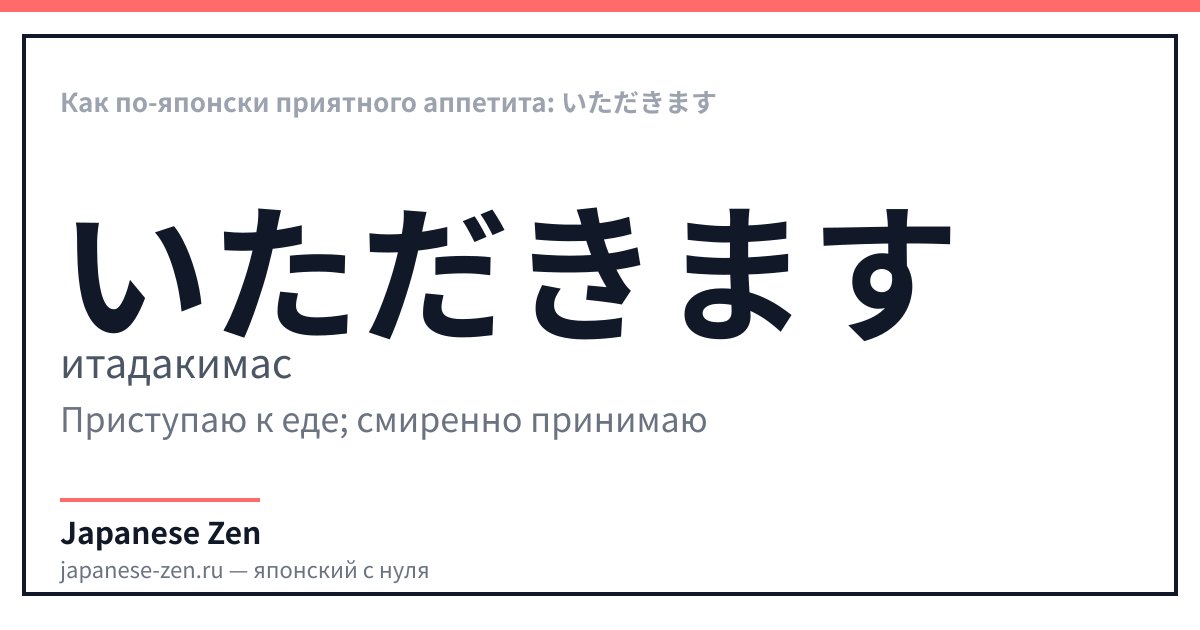
In Japanese, there is no phrase to wish a table neighbor a good appetite. The logic is different: before eating, each person gives thanks themselves — to the rice, the cook, the one who paid. Therefore, いただきます is said even alone over a convenience store boxed meal.
What is said before and after eating
| Japanese | Reading | Translation |
|---|---|---|
| いただきます | itadakimasu · itadakimasu | I begin eating; I humbly receive |
| ごちそうさまでした | gochisōsama deshita · gochisōsama deshita | Thank you, it was delicious |
| おいしい | oishii · oishii | Delicious |
| 美味しかったです | oishikatta desu · oishikatta desu | It was very delicious |
| どうぞ召し上がってください | dōzo meshiagatte kudasai · dōzo meshiagatte kudasai | Please, help yourself (what the host says — the closest analogue to "bon appétit") |
| お腹すいた | onaka suita · onaka suita | I'm hungry |
Who is "itadakimasu" addressed to
Not to the table neighbor. The formula thanks everyone involved in the meal: the one who grew, cooked, and paid for it, and the life itself that you are eating. Hence the verb いただく — "to receive from above." Hands are placed in front of the chest while saying it.
Table etiquette: what else is worth knowing
- Chopsticks are not stuck vertically into rice — that's how rice is offered to the dead.
- Soup is drunk directly from the bowl, and slurping noodles loudly is normal and even welcomed.
- It is customary to lift the rice bowl to yourself, not bend down to the table.
- After eating, chopsticks are placed on a rest parallel to the table edge, not across the plate.
Say "itadakimasu" out loud
The final "su" is devoiced: it sounds like "itadakimas", not "itadakimasu".
FAQ
- How do you say "bon appétit" in Japanese?
- There is no direct equivalent. Before eating, the eater says いただきます (itadakimasu). The host may say どうぞ召し上がってください — "please, help yourself."
- What does "itadakimasu" literally mean?
- "I humbly receive." It is the humble form of the verb "to receive": gratitude to everyone thanks to whom the food is on the table, including the life of the ingredients.
- What is said after eating?
- ごちそうさまでした (gochisōsama deshita) — "thank you for the meal." In cafes, this is also said to the cashier when leaving.
- Do people say "itadakimasu" when eating alone?
- Yes. The phrase is addressed not to a companion, but to the food and those who provided it, so it is said even when alone.
Updated: 2026-07-25