"Nice to Meet You, God" in Japanese: How the Title Sounds
"Nice to Meet You, God" is called 神様はじめました (Kami-sama hajimemashita) in Japanese — literally "I have become a god." The Russian title conveys a play on words: はじめまして is the usual "nice to meet you," while はじめました means "I started doing." Hence the double reading, which the translation had to unfold.
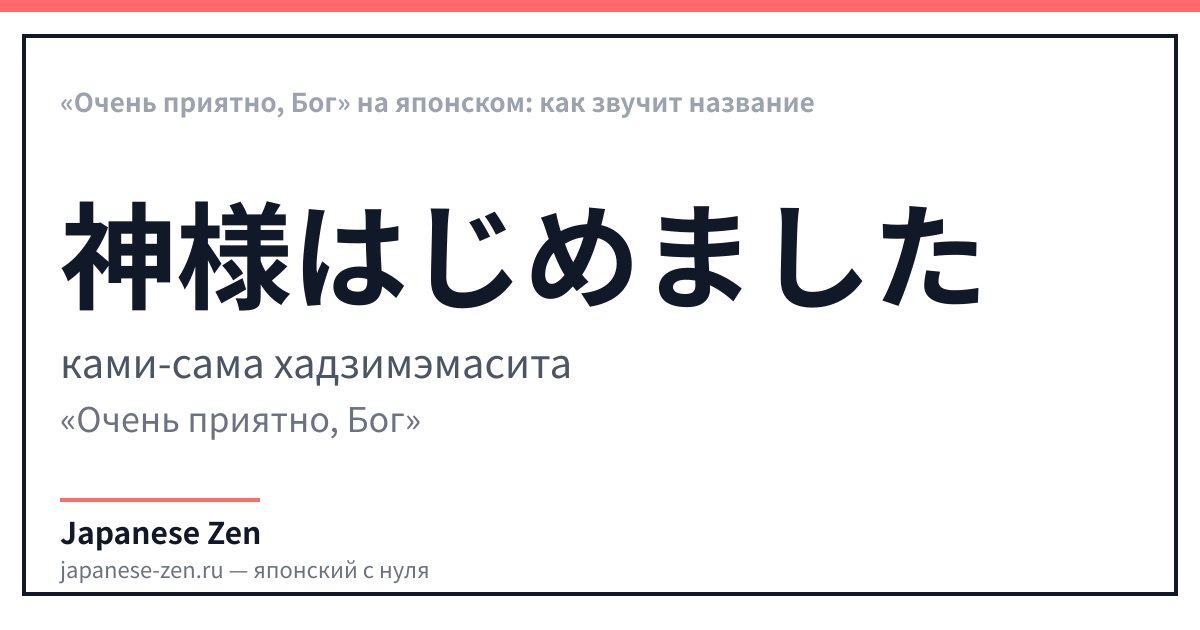
The title of the series is a grammatical joke, and it completely disappears in a literal translation. Let's break down what it consists of.
What the title consists of
| Japanese | Reading | Translation |
|---|---|---|
| 神様はじめました | kamisama hajimemashita · kamisama hajimemashita | "Nice to Meet You, God" (literally "I have become a god") |
| 神様 | kamisama · kamisama | God (respectful) |
| はじめまして | hajimemashite · hajimemashite | Nice to meet you |
| はじめました | hajimemashita · hajimemashita | Started doing (past tense of the verb 始める) |
| 土地神 | tochigami · tochigami | Deity of the land (the position the heroine receives) |
One mora decides everything
はじめまして and はじめました differ by one character, but belong to different worlds: the first is a fixed formula of introduction, the second is an ordinary verb in the past tense. The author used the similarity so that the title reads both as a greeting and as "I am now a god."
Useful phrases from the series
| Japanese | Reading | Translation |
|---|---|---|
| はじめまして | hajimemashite · hajimemashite | Nice to meet you (the first thing said when meeting someone) |
| よろしくお願いします | yoroshiku onegaishimasu · yoroshiku onegaishimasu | Please treat me well (the second half of an introduction) |
| お邪魔します | ojama shimasu · ojama shimasu | Sorry for intruding (said when entering someone's home) |
| ただいま | tadaima · tadaima | I'm home |
| おかえり | okaeri · okaeri | Welcome back |
Say はじめまして and はじめました one after the other — the difference is audible only at the end.
Why the series is convenient for studying
The characters' speech is everyday, and the plot revolves around a shrine — hence many words about home, politeness, and Shinto. This is a rare combination: simple language plus vocabulary that is not found in school textbooks.
FAQ
- What is "Nice to Meet You, God" called in Japanese?
- 神様はじめました (Kami-sama hajimemashita) — literally "I have become a god."
- What is the play on words in the title?
- はじめまして — "nice to meet you", はじめました — "started doing". The titles almost coincide, but the meaning is different.
- What does "kami-sama" mean?
- 神様 — respectful "god, deity". In the series, the heroine becomes the deity of a specific place.
- Is the series suitable for learning Japanese?
- Yes: the speech is everyday and not fast, plus a lot of vocabulary about home, politeness, and Shinto.
Updated: 2026-07-25