How to say please in Japanese: どうぞ, お願いします and ください
“Please” in Japanese is three different words. どうぞ (dōzo) — when offering something (“please, take it”). お願いします (onegai shimasu) — when asking for a favor. ください (kudasai) — “give me, please,” placed after the object: 水をください. In response to thanks, you say どういたしまして.
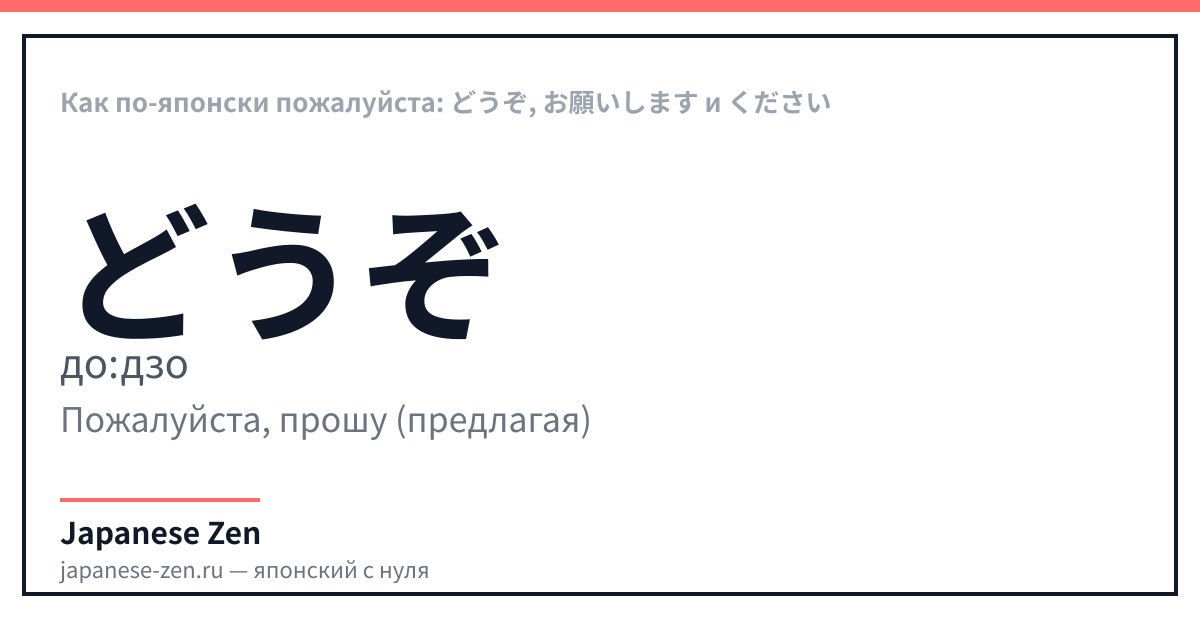
The Russian “please” does four jobs at once: it asks, offers, responds to thanks, and softens a command. Japanese has distributed these roles to different words — and using the wrong one means either demanding instead of asking, or giving instead of requesting.
Three Japanese “please”
| Japanese | Reading | Translation |
|---|---|---|
| どうぞ | dōzo · dōzo | Please, go ahead (offering) (handing a cup, letting someone through a door, giving permission) |
| お願いします | onegai shimasu · onegai shimasu | Please, I ask you (request) (universal request for a favor) |
| ください | kudasai · kudasai | Give me, please (after the object: 水をください — “water, please”) |
| どういたしまして | dō itashimashite · dō itashimashite | You’re welcome (in response to thanks) |
| よろしくお願いします | yoroshiku onegai shimasu · yoroshiku onegai shimasu | Please treat me favorably (when meeting someone and at the start of any endeavor) |
How to choose the right one
If you are giving or allowing something — どうぞ. If you are asking someone to do something — お願いします. If you are asking for an object — [object]をください. The response to thanks is a separate word どういたしまして, and it is not used for requests.
Examples in real-life situations
| Situation | Phrase | Reading |
|---|---|---|
| Handing over a document | どうぞ | dōzo |
| Asking for water at a café | 水をください | mizu o kudasai |
| Asking to call a taxi | タクシーをお願いします | takushī o onegai shimasu |
| Letting someone go ahead | どうぞお先に | dōzo o-saki ni |
| Response to thanks | どういたしまして | dō itashimashite |
| Meeting someone | よろしくお願いします | yoroshiku onegai shimasu |
Say “onegai shimasu” out loud
The “u” in “shimasu” is barely heard: it becomes “onegai-shimasu.”
FAQ
- How do you say “please” in Japanese?
- It depends on the meaning: どうぞ (dōzo) — when offering, お願いします (onegai shimasu) — when asking for a favor, ください (kudasai) — when asking for an object, どういたしまして — in response to thanks.
- What is the difference between どうぞ and お願いします?
- どうぞ is said by the one who gives: “please, take it.” お願いします — by the one who asks: “please do it.” Mixing them up means offering instead of asking.
- How to correctly use “kudasai”?
- After the object with the particle を: 水をください (mizu o kudasai) — “water, please.” With a verb — in the -te form: 待ってください (matte kudasai) — “please wait.”
- What do you reply to “arigatou”?
- Formally どういたしまして, but in everyday life more often いいえ (iie) with a nod or とんでもないです. The full form sounds a bit textbook-like.
Updated: 2026-07-25