Natto — What Are These Japanese Beans and Why Do They Stretch into Threads
Natto (納豆) is a Japanese dish made from soybeans fermented with the bacterium Bacillus subtilis var. natto. Fermentation makes the beans sticky: when stirred, threads stretch from the spoon, and the smell becomes sharp and unmistakable. Natto is usually eaten with rice, with karashi mustard and soy sauce, most often for breakfast. Some find the taste of natto disgusting, others grew up with it.
Natto frightens tourists more than almost any other Japanese food — not by its appearance, but by its smell and stretching threads. Yet the dish has no exact inventor: its origin is lost in legends about warlords and hungry horses. Let's break down the word by its kanji, where the threads come from, and why not all Japanese even like natto.
What Natto Is Made From and How It Is Eaten
Natto is made from soybeans that are steamed and then fermented with the bacterium Bacillus subtilis var. natto. It is this bacterium that turns ordinary soybeans into a viscous mass with long stretching threads and a strong, incomparable smell. Natto is most often eaten with rice for breakfast, with karashi mustard, a little soy sauce, and green onions, and before eating the beans are thoroughly mixed with chopsticks.
July 10 — Natto Day
On July 10, Japan celebrates 'Natto Day' — the date was chosen as a play on numbers: '7' is read as 'na', '10' as 'to', together giving 'natto'. The holiday was established in 1981 by a cooperative of natto producers in the Kansai region to promote the product where it was eaten less, and in 1992 the date was re-approved by the all-Japan producers' union.
Legends of Origin and the Difference Between East and West of the Country
Who and when invented natto is not exactly known — scholars acknowledge the origin of the dish is unclear. But there are several legends. According to one, Prince Shōtoku wrapped leftover boiled beans in straw for his horse, and one day they accidentally fermented. According to another, more famous one, the warlord Minamoto no Yoshiie in the 11th century during a campaign in northeastern Japan carried boiled beans as horse feed in straw bags. The beans fermented on the road, and the hungry soldiers ate them anyway — and liked them. In the city of Yokote, in Akita Prefecture, a commemorative stone 'birthplace of natto' is dedicated to this legend.
- Natto production is highest in Ibaraki Prefecture, and it is eaten more in the east and north of the country.
- In the west of the country, in Kansai, natto was historically eaten less — it was there that 'Natto Day' was promoted.
Hikiwari Natto and Other Types
Regular natto is made from whole beans — it is called tsubu natto. There is another type, hikiwari natto: the beans are crushed and hulled before fermentation. Due to the larger surface area, this natto ferments faster, has fewer individual threads, and is easier to wrap in rolls. Traditionally, hikiwari natto was made in the north of the Tōhoku region, in Akita Prefecture.
Kanji 納豆: What the Characters Mean
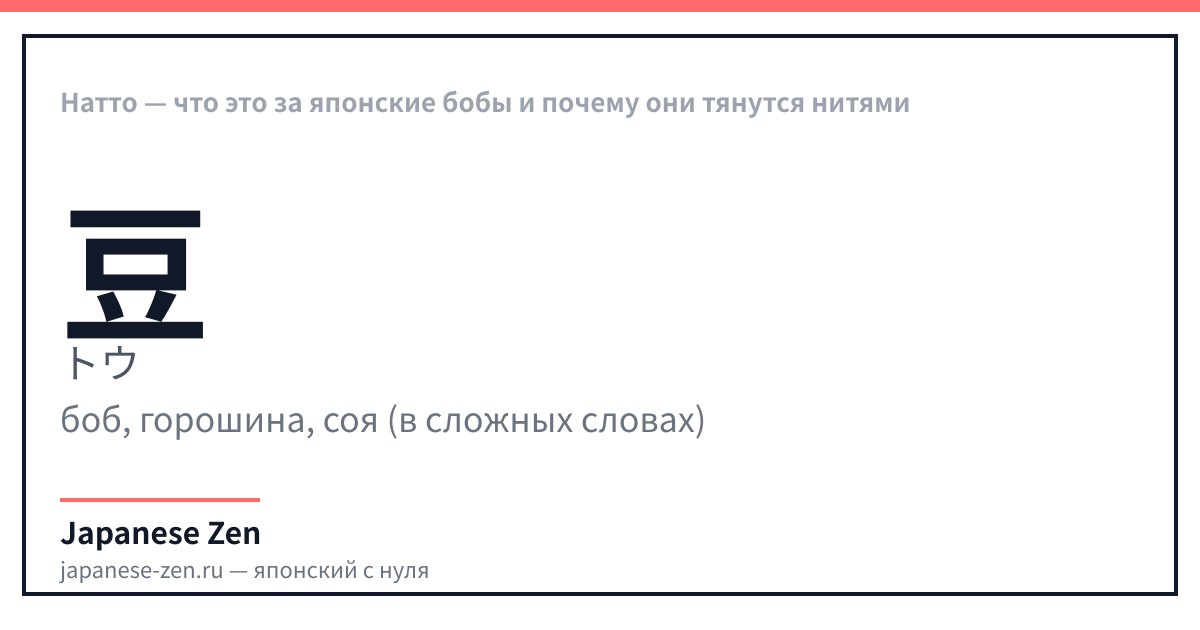
豆 — значение: bean, pea, soybean (in compound words) — онъёми: トウ、ズ — кунъёми: まめ、まめ- — 7 штрих(ов). 豆 — 'bean': the same character is the second in the word 納豆 and in the word 大豆 (daizu) — 'soybean', the raw material for natto.
納豆 consists of the characters 納 'to bring in, to store' and 豆 'bean'. There is a version that the name comes from 納所 — storehouses at Zen Buddhist temples where monks prepared fermented soybeans. This version was cited as early as 1697 in the food encyclopedia 'Honchō Shokkan', though it was immediately doubted: the word 'natto' appears in sources from earlier times, before the arrival of Zen Buddhism in Japan. So the temple version is just one of several, not a proven fact.
| Japanese | Reading | Translation |
|---|---|---|
| 納豆 | nattō · nattō | Natto |
| 大豆 | daizu · daizu | Soybeans |
| 豆 | mame · mame | Bean, pea |
| 糸 | ito · ito | Thread |
| ねばねば | nebaneba · nebaneba | Sticky, gooey (texture) |
| 納豆ご飯 | nattō gohan · nattō gohan | Rice with natto |
Write 豆 along the guides — the 'bean' character without which there would be no natto.
ねばねば — the Japanese Word for 'Sticky'
ねばねば is not a name or a verb, but an expressive word: such words in Japanese convey not a sound but a feeling or quality, in this case stickiness and gooeyness. The word consists of a syllable repeated twice, which is a common word-formation device for this group of words: 'sparkling' kira-kira or 'soft' fuwa-fuwa are structured the same way.
Natto Is Not for Everyone, Not Spoilage, and Not 'Confused Tofu'
- 'All Japanese love natto.' In fact, quite a few Japanese do not like natto, especially in the west of the country — not for nothing was it there that the producers' cooperative once launched the advertising 'Natto Day'.
- 'Natto is spoiled beans.' Spoilage and fermentation are different processes: natto is fermented by a specific, specially cultivated bacterial strain using controlled technology, and does not spoil accidentally like food forgotten on the table.
- 'The name natto was confused with tofu.' This tall tale is sometimes retold seriously — supposedly the words for 'fermented' and 'pressed into shape' were once swapped. This is an erroneous folk version: natto is a native Japanese dish and name, while tofu came from China and is called tofu there too, so there was simply nothing to confuse the names with.
FAQ
- What is natto?
- Natto is a traditional Japanese dish made from soybeans fermented with the bacterium Bacillus subtilis var. natto. Fermentation makes the beans sticky and gives them a sharp smell. Natto is usually eaten with rice, karashi mustard, and soy sauce, most often for breakfast.
- What does natto taste like?
- The taste itself is quite mild, slightly nutty, with a slight bitterness from fermentation. Much more than the taste, the first impression is influenced by the sharp smell and the gooey, viscous texture — it is these, rather than the taste as such, that most often prevent an unaccustomed person from appreciating the dish.
- Why does natto stretch?
- The threads are produced by the bacterium Bacillus subtilis var. natto: during fermentation it produces viscous substances that form long stretching threads when stirred. The longer and more actively you stir natto with chopsticks, the thicker this gooey mass becomes.
- How is natto eaten in Japan?
- Most often with rice for breakfast: the beans are stirred with chopsticks, karashi mustard, a little soy sauce, and finely chopped green onions are added, then it is placed on hot rice. Less often, natto is added to miso soup or used as a filling for rolls.
- How is 'natto' written in kanji?
- 納豆, read as なっとう, 'nattō' with a long 'o' in the second syllable. 納 means 'to bring in, to store', 豆 means 'bean'; the combination of characters can be understood as 'preserved beans'. There is also a version that the name is related to the word 納所 — a storehouse at a Buddhist temple, though not all sources confirm this version.
Sources
Updated: 2026-09-14