Miso Paste: What It's Made From and Why There Are More Than One Kind
Miso paste is a fermented paste made from soybeans, salt, and koji, a starter culture based on the mold Aspergillus oryzae. There are several types: the Japanese standard divides miso by its raw material into rice, barley, and soybean miso, and by color into light and dark. The darkest, mame-miso, is made only in Aichi, Gifu, and Mie prefectures. Most often miso is used to make misoshiru, a soup eaten in Japan almost every day.
Miso has no single flavor and no single geography: what is made in Aichi doesn't taste like what is made in Kyoto, and sweet and salty are often entirely different categories under Japanese standards. Let's look at what koji is and how long the paste matures, how rice miso differs from barley and soybean miso, where the expression "praise your own miso" comes from, and why the second character in 味噌 appears almost nowhere else.
Soybeans, Salt, and Koji: What Miso Is Made From
Miso is made from boiled soybeans, salt, and koji, a starter culture based on the mold Aspergillus oryzae, in Japanese ニホンコウジカビ. Koji turns the starch and protein of the beans into sugars and amino acids, and long fermentation and aging give the paste a salty taste with a slight tartness and sweetness. The Japanese industrial standard explicitly requires that miso use this species of mold, not any other.
How Long the Paste Matures
The aging time varies greatly by type. Light pastes, where the proportion of koji is higher, mature noticeably faster than dark ones: the color of the finished paste depends primarily on how the beans were treated and how long it was aged. Dense dark mame-miso, on the other hand, is aged for a long time: Japanese producers cite natural maturation from six months to a year, and with heating, from four to six months.
Rice, Barley, Soybean: Why Miso Is Not One Substance
| Type | In Japanese | How It Differs |
|---|---|---|
| Kome-miso | 米味噌 | Soybeans plus rice koji. The most common type, made almost all over Japan |
| Mugi-miso | 麦味噌 | Soybeans plus barley koji. Traditionally a country-style miso; industrially it is made mainly in Kyushu, Shikoku, and Chugoku |
| Mame-miso | 豆味噌 | The koji is made from the soybeans themselves, without rice or barley. Made only in Aichi, Gifu, and Mie prefectures; the most famous variety is hatcho-miso from Okazaki |
| Shiro-miso (white) | 白味噌 | More koji, shorter aging, lighter and sweeter in taste — this is how, for example, Saikyo-miso from Kyoto is made |
| Aka-miso (red) | 赤味噌 | Ages longer, darker and saltier. All mame-miso is like this, as is part of rice and barley miso |
Why Miso Has Such a Varied Geography
Until modern times, each region of Japan knew mainly its own miso: the ratio of beans, koji, and salt, the aging time, and the final color came from the local climate and harvest. This gave rise to dozens of local names — from Saikyo-miso in Kyoto to Sendai-miso in the northeast of the country, and almost every name directly points to the city or region where that recipe developed.
Misoshiru and Temae-miso in Everyday Speech
味噌汁 (misoshiru) is a soup based on miso and dashi broth, with additions like tofu, wakame seaweed, or potato. It is one of the most ordinary everyday dishes: a bowl of misoshiru often goes with rice for breakfast or dinner, and every family's recipe is a little different.
Why "Praise Your Own Miso" Means to Brag
When miso was made at home, every housewife had her own method and her own reason for pride — what was called "temae," one's own skill. From this comes the expression 手前味噌 (temae miso), literally "miso made in one's own way": at first it simply noted home craftsmanship, but over time it came to mean any self-praise. "Praise your own miso" in Japanese means to brag, even if the subject is not food.
汁: The Soup That Isn't Limited to Miso
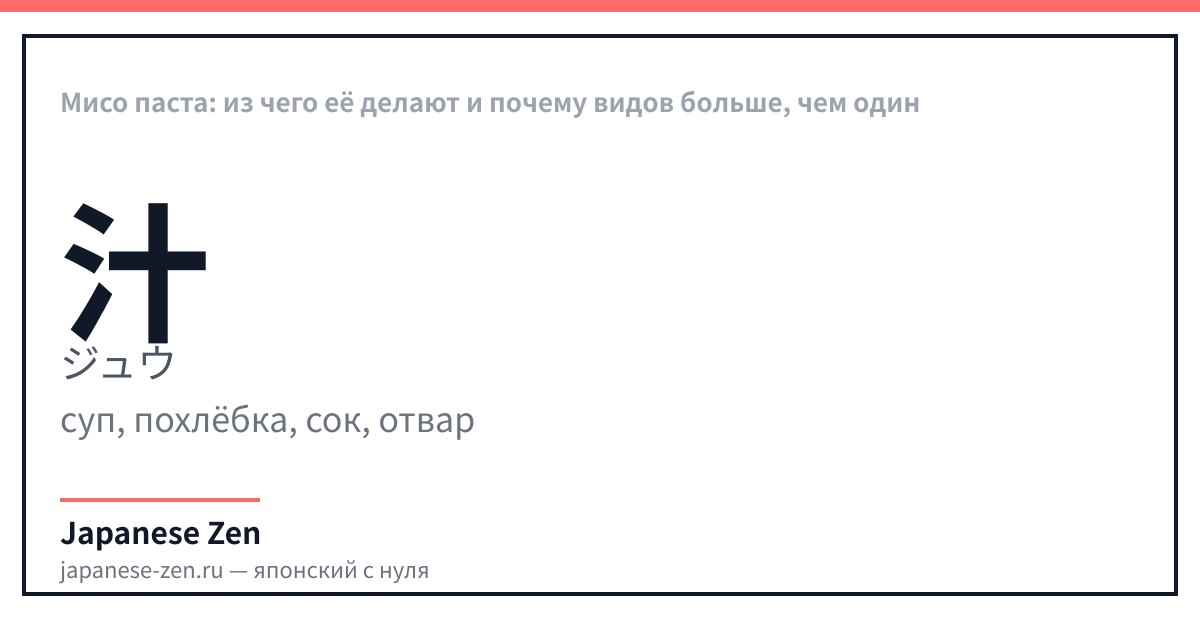
汁 — значение: soup, broth, juice, decoction — онъёми: ジュウ — кунъёми: しる、-しる、つゆ — 5 штрих(ов). 汁 — "soup, juice": from the word 味噌汁, misoshiru, the most common thing made with miso. The same character appears in the ordinary word 果汁 (kajū), "fruit juice."
The on'yomi of the character 汁 is ジュウ (jū), the kun'yomi is しる (shiru). The kun'yomi is heard in misoshiru itself and in other soups like 豚汁 (tonjiru), where at the word boundary it becomes voiced as "jiru." The on'yomi leads far from the kitchen: 果汁 (kajū) is "fruit juice," about fruit, not soup.
噌 — The Character That Appears Almost Nowhere Else
味噌 consists of the characters 味 "taste" and 噌. The second character is almost never used outside the word "miso" in Japanese — it is, by all appearances, a character of Japanese origin. In Chinese there is a character with exactly the same form, but it means "loud sound, noise," and is in no way related to the Japanese 噌 in the word "miso."
| Japanese | Reading | Translation |
|---|---|---|
| 味噌 | miso · miso | Miso |
| 味噌汁 | miso shiru · miso shiru | Miso soup |
| 麹 | kōji · kōji | Mold starter culture |
| 大豆 | daizu · daizu | Soybeans |
| 手前味噌 | temae miso · temae miso | Praising your own miso — bragging |
| 果汁 | kajū · kajū | Fruit juice |
Write 汁 along the guides — the character for "soup," which appears in the word misoshiru.
FAQ
- What is miso paste and what is it made from?
- Miso is a thick paste made from boiled soybeans, salt, and koji, a starter culture of the mold Aspergillus oryzae. The beans are fermented together with koji and salt: light varieties are ready noticeably faster, while dark mame-miso needs months of aging. Most often miso is used for misoshiru, an everyday soup with dashi broth.
- How does rice miso differ from barley and soybean miso?
- The difference is in the koji: in kome-miso it is rice-based, in mugi-miso it is barley-based, and in mame-miso the koji is made from the soybeans themselves, without rice or barley at all. Mame-miso is made only in Aichi, Gifu, and Mie prefectures, while rice miso is the most common type, made almost all over Japan under local names.
- What is koji?
- Koji is rice, barley, or soybeans inoculated with the mold Aspergillus oryzae. The mold produces enzymes that break down starch and protein into sugars and amino acids — that is why miso is not bland but sweetly salty with a pronounced umami taste. Koji is used not only for miso but also for sake and soy sauce.
- Why do white and red miso taste so different?
- The difference is in the proportion of koji and the aging time. Shiro-miso, white, has more koji and ages for a short time, hence its mild and slightly sweet taste. Aka-miso, red, is aged longer — the paste darkens and becomes saltier and sharper. All mame-miso, due to long fermentation, belongs to the red type.
- What does the expression "praise your own miso" mean?
- 手前味噌 (temae miso) literally means "miso made in one's own way" — that is what homemade miso was called, which a housewife was proud of. Over time the expression came to mean self-praise in any matter, not just in the kitchen: "praise your own miso" in Japanese is equivalent to "to brag."
- How is "miso" written in kanji?
- 味噌, read as みそ. 味 means "taste," and the second character 噌 appears in almost no other Japanese word. In Chinese there is a character of the same form meaning "loud noise," but it is not related to the Japanese 噌 in the word "miso."
Sources
Updated: 2026-09-15