Mochi: What Japanese Rice Cakes Are Made From and Why They Stretch
Mochi (餅) is a Japanese cake made from glutinous mochigome rice: it is steamed and pounded for a long time in a mortar with a wooden mallet until the rice turns into a sticky, uniform mass. Ordinary table rice will not do: mochi stretches because of amylopectin — a starch that mochigome contains far more of. Mochi is eaten both sweet, with a filling, and savory — for example, in the New Year's soup zoni.
Almost everyone who has taken an interest in Japan has heard the word "mochi," but behind it lies not just one cake but a whole family of dishes based on the same thing. Let's look at how mochi differs from dango made from other flour and why the east and west of the country pound it differently. We'll talk about New Year's kagami-mochi with the kagami-biraki ritual, the rabbit on the moon, and the kanji 鏡 and 餅.
Mochigome, the Mortar, and the Sticky Mass: What Mochi Is Made From
Mochi is not made from ordinary table rice but from mochigome — a special glutinous variety whose grains stick together into a solid mass after cooking. The steamed mochigome is pounded in a mortar called an usu with a wooden mallet on a long handle — a kine — until the grains turn into a uniform, elastic mass without a single whole grain left. In the past, mochi-tsuki, the pounding, was a communal affair: neighbors and relatives would gather, one person raised the kine, and another quickly turned the mass with wet hands between strikes.
Why Mochi Is So Stretchy
Starch is responsible for the stretchiness: in mochigome it consists almost entirely of amylopectin — a branched molecule that, when cooked and pounded, gives a viscous, elastic texture. Ordinary table rice has noticeably less amylopectin, so it stays fluffy no matter how long you cook it.
Kiri-Mochi, Maru-Mochi, and Daifuku: Shapes of the Same Dough
The East Cuts, the West Shapes
The pounded dough sets differently in different parts of Japan. The dividing line runs roughly at Sekigahara in Gifu Prefecture. In eastern Japan, the sheet of pounded rice is rolled out and, once it has set, cut into rectangular blocks — this is kiri-mochi, "cut mochi." In western Japan, the dough is shaped by hand directly into individual round cakes — maru-mochi, "round mochi." There are exceptions to this division as well: for example, in the town of Ichinoseki in the northeast of the country or in the former lands of Tosa and Satsuma in the south.
| Shape | Where it is common | How it is made |
|---|---|---|
| Kiri-mochi (角餅) | Eastern Japan | The sheet is rolled out and, after setting, cut into blocks |
| Maru-mochi (丸餅) | Western Japan | Shaped by hand directly into individual round cakes |
Daifuku, Zoni, and Dango Are Not Quite the Same Thing
- Daifuku — a ball of mochi with a filling of anko bean paste inside; a sweet version that is shaped in small portions.
- Zoni — a New Year's soup in which mochi is boiled or grilled and placed in dashi broth; the broth's flavor and the cake's shape in it vary by region.
- Dango look similar to mochi, but usually they are not pounded; instead they are kneaded from rice flour with hot water — resulting in a denser texture. There is still no clear boundary between them: there are dango made from glutinous rice and mochi-like sweets made from flour, so reference books acknowledge that there is no single rule here.
Kagami-Mochi at New Year: A Mirror of Two Cakes
At New Year, in the tokonoma alcove or on the altar, kagami-mochi is placed — two round cakes stacked one on top of the other with a bitter daidai orange on top. The name means "mirror mochi": the shape resembles the old round bronze mirrors that served as vessels for the spirit in Shinto rituals. Kagami-mochi in the home is considered a temporary dwelling of toshigami, the god of the year, so it is put out in advance. The most common day for this is December 28: the number eight is considered lucky. December 29 is avoided because it sounds like "suffering," and the 31st because decorating just one evening before the holiday resembles a funeral rite.
Kagami-Biraki: Why Mochi Is Not Cut with a Knife
When the holidays end, the kagami-mochi is supposed to be eaten — the ritual is called kagami-biraki, "opening the mirror." Cutting the dried cakes with a knife is avoided: a sharp blade recalls the ritual suicide of samurai, so the mochi is broken by hand or with a wooden mallet, and instead of "cutting" and "breaking," people deliberately say "opening." The date of the ritual depends on the region: in Kanto, including Tokyo, it is January 11; in Kyoto and the surrounding area, January 4; and where New Year decorations are kept longer, kagami-biraki is moved to January 20.
The Rabbit Pounding Mochi on the Moon
According to Japanese belief, at the full moon one sees not a person but a rabbit pounding mochi in a mortar on the moon — this is a folk motif, not a scientific fact. It is also linked to one version of the origin of the word "mochi" itself: it is traced to 望月 (mochizuki) — "full moon," although dictionaries also give other versions, including an old word meaning "stickiness."
Why People Are Careful with Mochi at New Year
Every year before the holidays, the Consumer Affairs Agency warns about the danger of choking on mochi. According to its analysis of deaths in 2018–2019, 43% of mochi choking cases occurred in January, and within January, in the first three days of the New Year; among the dead, men outnumbered women by 2.6 times. The warning is addressed primarily to the elderly: with age, both chewing and swallowing weaken.
The Kanji 鏡 and 餅: Mirror and Glutinous Rice
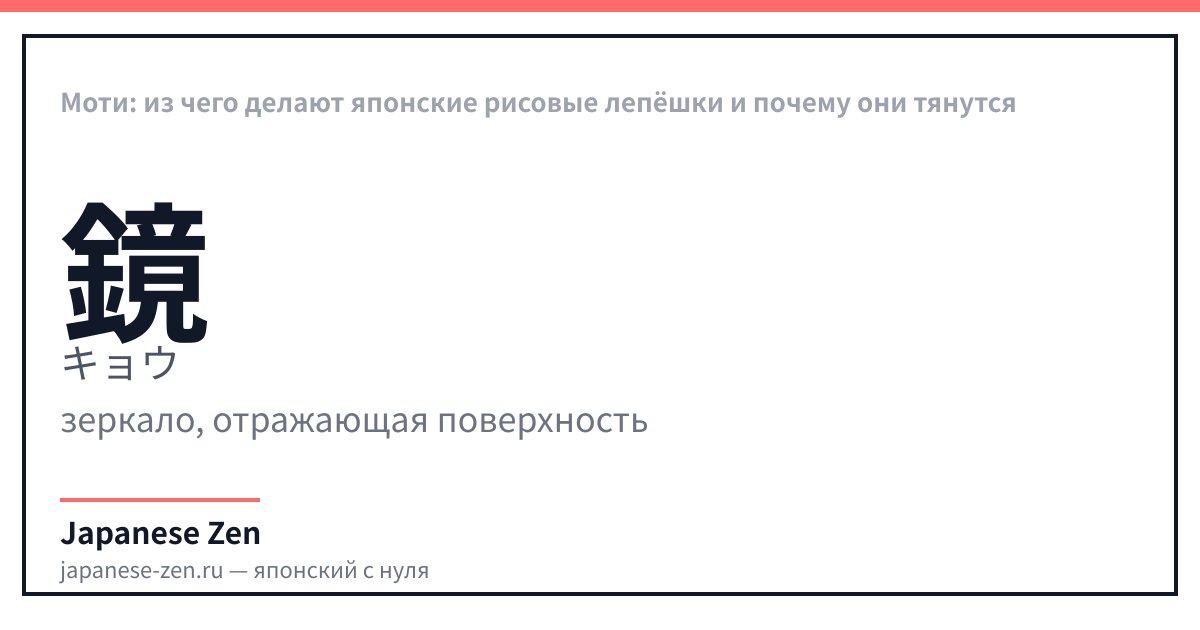
鏡 — значение: mirror, reflective surface — онъёми: キョウ、ケイ — кунъёми: かがみ — 19 штрих(ов). 鏡 — "mirror": not the first character in the word "mochi," but it is the one that gives its name to kagami-mochi — the New Year's cakes stacked like an old round mirror.
Two Readings: Kyō and Kagami
The on'yomi of 鏡 is kyō (キョウ), and the kun'yomi is kagami (かがみ). The kun reading is heard in 鏡餅 (kagami-mochi) and in 手鏡 (tekagami) — a "hand mirror" with a handle. The character is built on the radical 金 "metal": in the old days, mirrors in Japan were not glass but round bronze, and it is precisely such a mirror that the stacked kagami-mochi cakes resemble.
The word "mochi" is written with the kanji 餅, which has the radical 食 "food." The reading itself did not become fixed immediately: in 10th-century sources the word was written as "mochii," and the familiar form "mochi" appears no later than the 17th century. The origin of the word remains disputed — dictionaries give several versions at once, from an old word meaning "stickiness" to the already mentioned 望月, "full moon."
| Japanese | Reading | Translation |
|---|---|---|
| 鏡餅 | kagami-mochi · kagami-mochi | New Year's "mirror" cakes |
| 餅 | mochi · mochi | Rice cake |
| 手鏡 | tekagami · tekagami | Hand mirror |
| 望月 | mochizuki · mochizuki | Full moon (one of the versions of the etymology of the word "mochi") |
| 鏡開き | kagami-biraki · kagami-biraki | The ritual of "opening" the New Year's cakes |
| 餅つき | mochitsuki · mochi-tsuki | Pounding rice in a mortar for mochi |
Write 鏡 along the guides — the character for "mirror" that gave its name to the New Year's kagami-mochi cakes.
FAQ
- What is mochi and what is it made from?
- Mochi is a traditional Japanese cake made from glutinous mochigome rice, which is first steamed and then pounded for a long time in a mortar until the grains turn into a sticky, uniform mass. There are sweet mochi with a filling and savory ones — for example, in the New Year's soup zoni — while the cake itself remains the same.
- Why is mochi so stretchy?
- The stretchiness is due to amylopectin — a component of starch that glutinous mochigome rice contains far more of than ordinary table rice. Pounding and cooking unfold this molecule into a viscous network, which is why the mass stretches rather than crumbles.
- How does mochigome differ from ordinary rice?
- Mochigome is a separate glutinous variety of rice, not ordinary table rice: after cooking, its grains stick together into a solid mass that is convenient for pounding mochi. Ordinary rice, ご飯, stays fluffy and is not suitable for mochi, but it is eaten every day as a side dish.
- What does New Year have to do with kagami-mochi?
- Kagami-mochi is two round cakes stacked one on top of the other, placed at New Year as a temporary dwelling of the god of the year. Their name means "mirror mochi": the shape resembles old round bronze mirrors. The cakes are usually put out on December 28, and eaten after the holidays, in the kagami-biraki ritual.
- Why is kagami-mochi not cut with a knife?
- Cutting the dried cakes with a knife is avoided because a sharp blade recalls the ritual suicide of samurai. Instead, the mochi is broken by hand or with a wooden mallet, and the ritual is called kagami-biraki — "opening," not "cutting" or "breaking." The date depends on the region: in Kanto it is January 11, in Kyoto January 4.
- How does mochi differ from dango?
- Mochi is pounded from steamed whole grains of glutinous mochigome rice, while dango is usually kneaded from rice flour with hot water — the texture comes out denser. There is still no clear boundary between them: there are dango made from glutinous rice and mochi-like sweets made from flour, so no single rule exists.
Sources
Updated: 2026-09-15